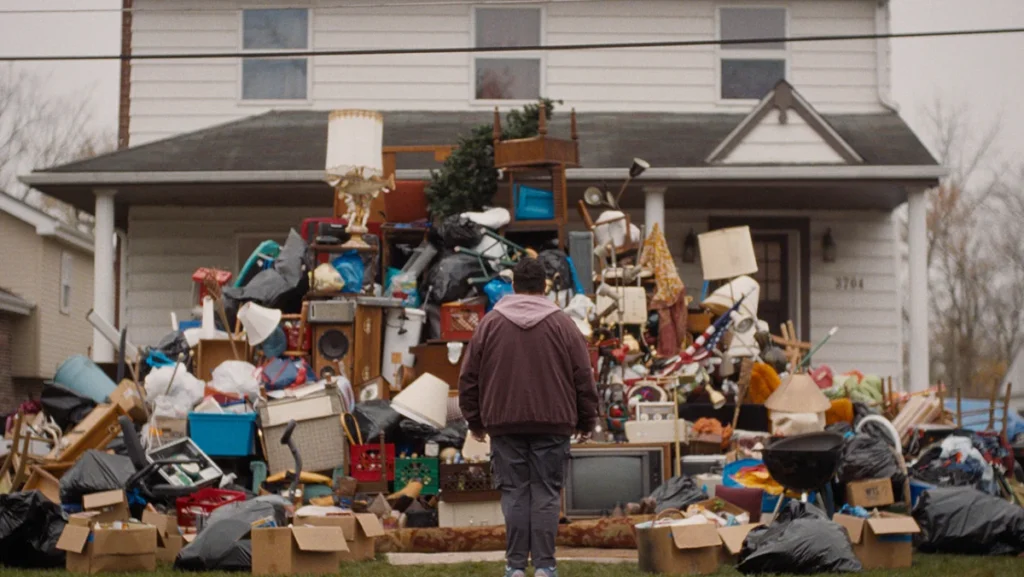

The intersection of humor and grief has long provided rich narrative soil for filmmakers navigating the complexities of human loss. At the 49th annual Toronto International Film Festival (TIFF), this delicate balancing act took center stage with the world premiere of Trash Mountain. Co-written by breakout comic and actor Caleb Hearon alongside collaborator Ruby Caster, the dramedy offers a deeply personal exploration of unexpected death, estranged family dynamics, and the heavy physical and emotional baggage left behind in the wake of a parent’s passing. Directed by Kris Rey and starring Hearon alongside Zooey Deschanel, the film captivated audiences at the Scotiabank Theatre, sparking conversations about how art can mirror life during moments of profound personal upheaval.
For Hearon, whose meteoric rise in the comedy world includes an HBO Max comedy special and a coveted role in the upcoming sequel to The Devil Wears Prada, Trash Mountain represents a significant pivot in his burgeoning career. The project was born out of his own lived experience processing the unexpected death of his father. Rather than shying away from the somber realities of loss, Hearon utilized the creative process as a therapeutic vehicle, yet remained intensely mindful of the tonal tightrope required to keep the narrative from tipping entirely into melodrama.
Plot Dynamics and Character Development
In Trash Mountain, Hearon stars as Gavin, a young gay man living in Chicago whose carefully constructed life is abruptly upended when he is forced to return to his rural Missouri hometown following the sudden death of his father. Gavin is depicted as a man who has emotionally isolated himself, seemingly walking away from everyone he ever loved in a bid to outrun his roots. Upon his return, he is thrust into a tense, emotionally charged reunion with his half-sister Abbi, portrayed by Zooey Deschanel.
The narrative is anchored by the imposing physical manifestation of their father’s mental illness: a literal mountain of rubbish accumulating in the front yard of the family home. Though the father does not appear on screen, his presence looms heavily over the narrative. He is characterized not as a simple caricature, but as a complicated man who left behind an equally complicated son. As Gavin and Abbi pick through the detritus of his life, the discarded items force them to confront buried resentments, shared history, and the lingering affection that persists even through deep dysfunction.
The central metaphor of the film—sorting through a hoarder’s accumulated trash—resonates deeply with the physical and emotional residue of grief. One man’s trash becomes a trove of ambiguous keepsakes, forcing the siblings to make agonizing decisions about what to hold onto and what to discard. This thematic resonance bled into the production itself. During an early wardrobe and prop call, Deschanel made the creative decision to bring in a scarf that had belonged to her late grandfather before his passing, utilizing it as a tangible prop on set.
Speaking to the TIFF audience following the screening, Deschanel reflected on the emotional weight of physical objects in the grieving process. "I have them in my closet, and every time I see them I think of my grandfather. These objects can be conduits for people that have passed," she shared, highlighting the universal nature of mourning and the comfort found in holding onto tangible pieces of lost loved ones.
Behind the Scenes: Writing Collaboration and Tonal Balance
The creative partnership between Hearon and Caster was integral to striking the elusive balance between comedy and tragedy. Writing a film about grief while utilizing a comedic lens required intense negotiation between the co-writers. Caster admitted to the festival audience that she frequently found herself exercising caution, wary of a skilled comedian like Hearon leaning too heavily into gags that might cross the boundary between generating laughter and trivializing the genuine pain of grief.
True to form, Hearon broke the rising emotional tension in the room with a swift comedic jab, joking to Caster, "You stepped across a lot of lines. And I want to talk about that, here, tonight."
Despite the lighthearted banter, Hearon was unequivocal during the post-screening Q&A about his ambitions for the project and his career trajectory moving forward. Eschewing the notion that comedians must remain confined to purely comedic spaces, he addressed the audience directly: "No. If anything, I’m eager to prove that I’m not just a clown."
This desire to stretch his artistic boundaries is precisely what drew a high-profile ensemble cast and crew to the project. Alongside Hearon and Deschanel, Trash Mountain features stellar supporting performances from Jackie Weaver, Jaboukie Young-White, Kyle Martin, and Holmes. Furthermore, the film boasts heavy-hitting backing behind the scenes, with visionary filmmaker Lilly Wachowski serving among the executive producers.
The Broader Festival Context and Industry Implications
The world premiere of Trash Mountain at the Toronto International Film Festival places the film squarely within the prestigious environment that often serves as a launching pad for fall prestige cinema. Running through September 20, TIFF continues to be a crucial barometer for independent film distribution, audience reception, and early-season critical momentum.
Dramedies dealing with the messy realities of family estrangement and parental loss occupy a unique space in contemporary cinema. They require a high degree of emotional intelligence from their creators, as missteps can easily lead to mawkish sentimentality or tonal whiplash. By grounding the script in Hearon’s authentic processing of real-life trauma, Trash Mountain manages to bypass standard cinematic tropes, offering instead a raw, messy, and ultimately healing look at how families pick up the pieces after a tragedy.
The implications for Hearon’s career are similarly significant. Transitioning from short-form digital comedy, stand-up, and supporting television roles into leading a feature-film dramedy that he also co-wrote marks a maturation of his artistic output. Industry analysts will undoubtedly be watching closely to see how distributors respond to the film, particularly given its strong ensemble cast and the rising star power of its lead actor and writer.
As the credits rolled at the Scotiabank Theatre on Friday night, the reception underscored a growing appetite for stories that do not sanitize grief, but instead find humanity, humor, and connection in the trash we leave behind. Through Trash Mountain, Caleb Hearon has not only honored his father’s memory and processed his own personal loss, but he has also firmly established himself as a dramatic voice capable of commanding the screen with both vulnerability and wit.