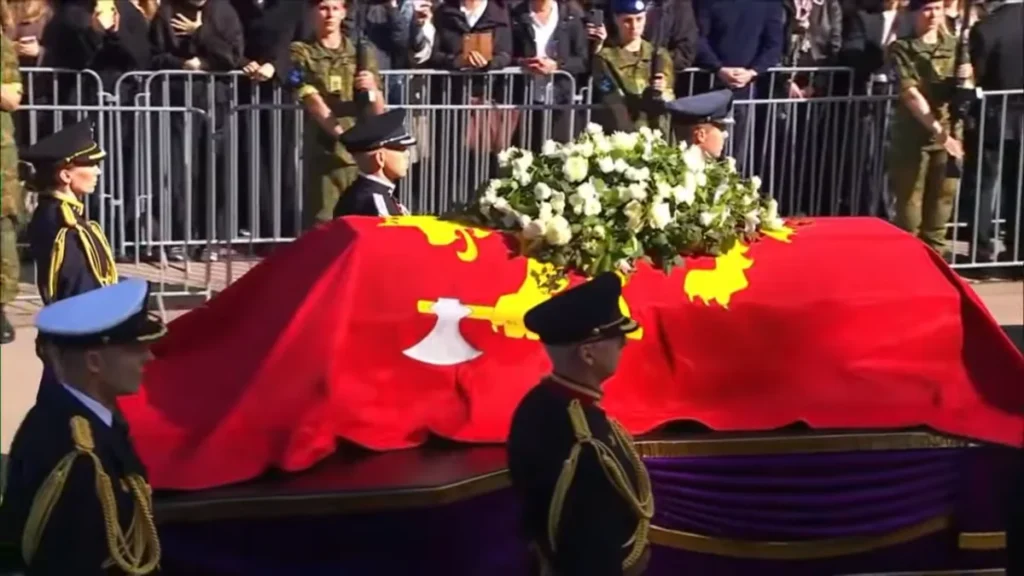

The state funeral of King Harald V of Norway at Oslo Cathedral concluded with a deeply personal and poignant tribute to his late mother, Crown Princess Märtha, blending centuries of Scandinavian monarchical tradition with raw family grief. As the solemn liturgical proceedings reached their final moments, the congregation listened to the prayer of St. Francis of Assisi read aloud in Swedish—a subtle yet profound acknowledgment of the late monarch’s maternal heritage. Crown Princess Märtha, born a Princess of Sweden, had been a towering figure of resilience during the Second World War before her untimely death from cancer in 1954, when King Harald was just 17 years old.
The inclusion of the Swedish language served as a living bridge to a chapter of the King’s life defined by early loss and wartime displacement. Throughout the service, the emotional resonance of the day was felt by both the Norwegian royal family and the international dignitaries who had gathered in the capital to pay their respects. From the procession winding through the autumn streets of Oslo to the private interment at Akershus Fortress, the day marked the end of an era for the House of Glücksburg and the Nordic nations.
Main Facts and the State Funeral Proceedings
The state funeral drew royalty, heads of state, and thousands of mourners to Oslo Cathedral to honor the life and reign of King Harald V. The service was characterized by traditional Lutheran liturgy, interspersed with deeply personal musical and spoken selections. Among the most striking moments of the service was the tribute paid by the late King’s widow, Queen Sonja. Visibly moved to tears during a moving eulogy delivered by Norwegian Prime Minister Jonas Gahr Støre, the 89-year-old Queen walked slowly toward her husband’s funeral bier, holding a single red rose, which she gently laid upon the coffin in a gesture of private grief witnessed by a global audience.
Seated nearby was the late King’s sister, Princess Astrid. At 94 years of age, Princess Astrid watched stoically as her younger brother—with whom she had shared the hardships of wartime exile—was commended to history.
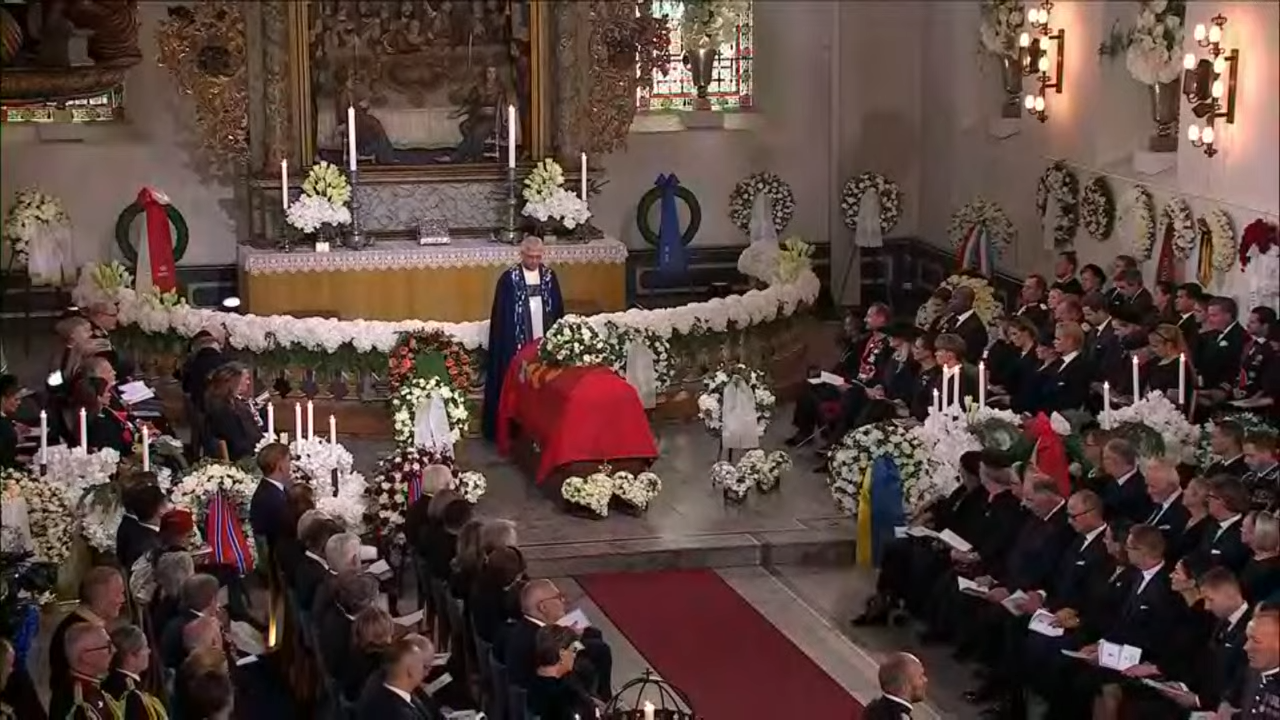
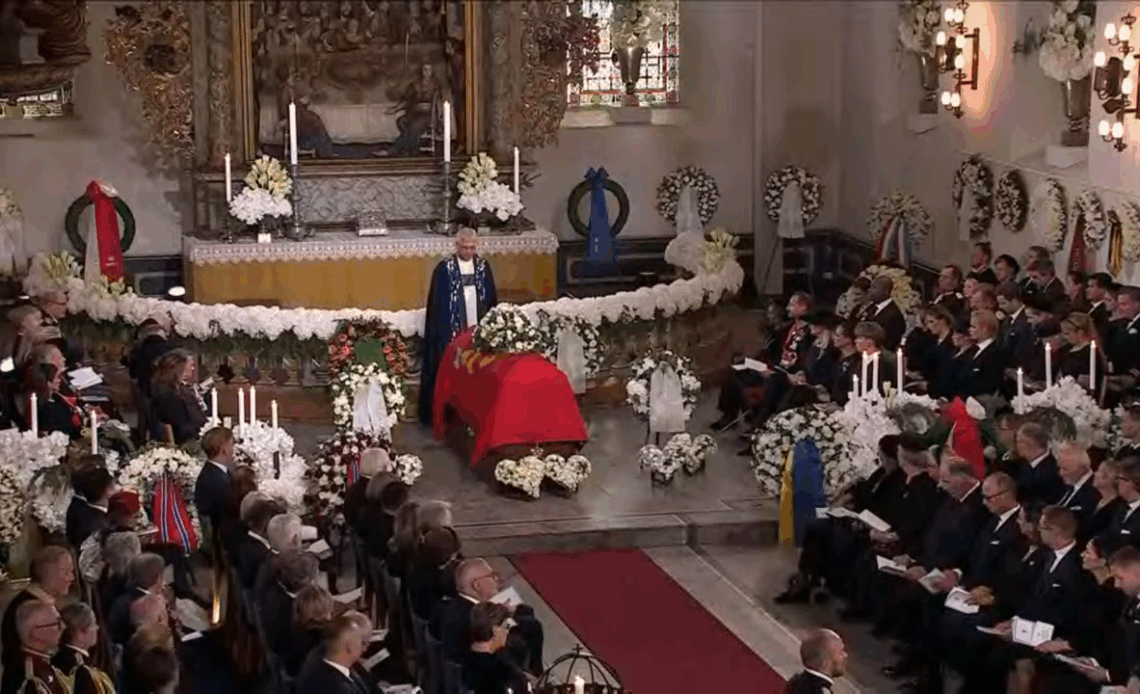
The musical arrangements for the service carried profound personal significance. They included a special hymn originally composed to celebrate the 70th birthdays of both King Harald and Queen Sonja, anchoring the service in their decades-long partnership. Additionally, a traditional rendition of "Abide with Me" was sung in English, reflecting the broader international ties of the Norwegian royal family.
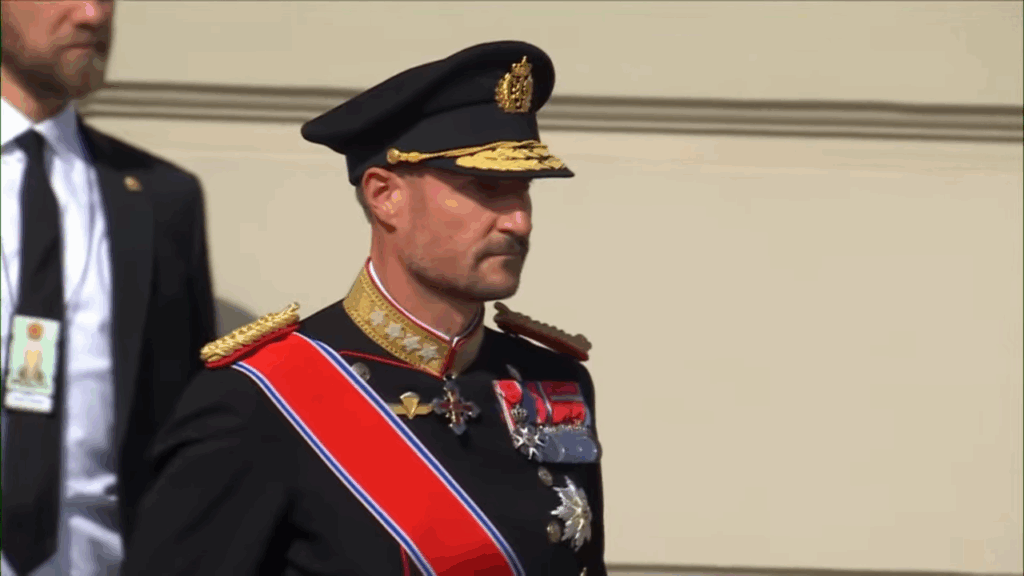
Preceding the service, the funeral procession from the Royal Palace to Oslo Cathedral set a somber tone for the capital. King Haakon VIII, stepping into his new role as sovereign, led the mourners directly behind the gun carriage bearing his father’s coffin. Flanked by his children, Crown Princess Ingrid Alexandra and Prince Sverre Magnus, as well as his sister, Princess Martha Louise, the new monarch maintained a composed demeanor despite the weight of public sorrow.
Chronology of King Harald V’s Life and Reign
To fully understand the historical gravity of the funeral, one must look back at the extraordinary timeline that shaped King Harald’s nearly 80-year presence in the public eye. Born in February 1937 at the Skaugum estate near Asker, Harald was the first Norwegian prince to be born in Norway in over 500 years. His early childhood, however, was violently disrupted by the outbreak of the Second World War.
In April 1940, Nazi Germany invaded neutral Norway. The royal family was forced into immediate fracture and flight. While King Haakon VII and Crown Prince Olav remained in Norway to lead the military resistance before escaping to London, Crown Princess Märtha fled across the border to neutral Sweden with young Prince Harald and his sisters, Princess Ragnhild and Princess Astrid. From Sweden, the Crown Princess and the royal children eventually traveled to the United States, where they spent the remainder of the war years residing in Washington, D.C., under the protection of President Franklin D. Roosevelt.
Following the liberation of Norway in 1945, the royal family was reunited, and a young Prince Harald returned to a liberated homeland to resume his education. Tragedy struck in 1954 when Crown Princess Märtha passed away at the age of 53, leaving a profound void in the teenage prince’s life.
Harald acceded to the throne on January 17, 1991, following the death of his father, King Olav V. Breaking with centuries of strict royal tradition, King Harald had married a commoner, Sonja Haraldsen, in 1968 after a nine-year courtship—a union that required immense patience and political maneuvering but ultimately modernized the Norwegian monarchy for the late 20th century. Over a reign spanning more than three decades, King Harald became known as the "People’s King," celebrated for his informal charm, his dedication to environmental causes, and his prowess as an Olympic sailor.
International Presence and Diplomatic Significance
The global stature of the House of Glücksburg was underscored by the heavy representation of European royalty at the funeral. Walking in the procession immediately behind the Norwegian royals were several prominent members of foreign royal houses. The British monarchy was represented by the Prince of Wales and Princess Anne, highlighting the close dynastic ties between the House of Windsor and the Norwegian royal family—ties cemented during the Second World War when King Haakon VII operated the Norwegian government-in-exile from London.
Following the public service at Oslo Cathedral, a strictly private interment took place at the royal mausoleum at Akershus Fortress. For this solemn final phase, King Haakon VIII was joined by fellow Nordic monarchs: King Carl XVI Gustaf of Sweden and King Frederik X of Denmark. The presence of the Swedish and Danish kings not only signaled deep familial bonds across the Scandinavian thrones—sharing common ancestry through Queen Victoria of the United Kingdom and King Christian IX of Denmark—but also emphasized the geopolitical stability and regional solidarity of the Nordic region.
Official Responses and Public Reactions
The passing of King Harald V prompted an outpouring of grief across Norway and official tributes from international leaders. Prime Minister Jonas Gahr Støre captured the national sentiment in his cathedral eulogy, describing the late monarch as a unifying anchor for the Norwegian people through times of rapid social, economic, and technological change. Støre emphasized the King’s unique ability to connect with everyday citizens, noting that Harald viewed his role primarily as a servant to the nation.
Public participation in the days leading up to the funeral was extensive, with tens of thousands of mourners lining the streets of Oslo, leaving floral tributes outside the gates of the Royal Palace, and signing books of condolence.
The emotional climax for the public occurred later in the afternoon. Stepping out onto the traditional balcony of the Royal Palace, the newly acceded King Haakon VIII and Queen Mette-Marit appeared alongside the widowed Queen Sonja. They were soon joined by the younger generation of royals, including Crown Princess Ingrid Alexandra and Prince Sverre Magnus. The assembled crowds greeted the family with prolonged, resonant cheers—a traditional Scandinavian demonstration of loyalty and support for the continuation of the crown.
Broader Impact and Implications for the Norwegian Monarchy
The transition from the reign of King Harald V to that of King Haakon VIII marks a pivotal inflection point for the Norwegian constitutional monarchy. Throughout his reign, King Harald successfully navigated a period of intense cultural shift, steering the institution toward greater accessibility while preserving its core dignity. His willingness to embrace modern social realities—most notably supporting his children’s choices and maintaining a transparent dialogue with the public regarding his own health challenges in his later years—cemented the monarchy’s high approval ratings.
Now, King Haakon VIII inherits an institution that, while broadly popular, faces the continuous challenge of modern relevance in the 21st century. The prominent placement of Crown Princess Ingrid Alexandra during the funeral processions and balcony appearances serves as a clear signal of the crown’s long-term continuity. As Norway looks to the future under a new sovereign, the dignified farewell given to King Harald V demonstrates that the ties binding the Norwegian people to their royal house remain remarkably resilient, rooted in a shared history of survival, democracy, and national identity.