
The conclusion of the 2026 FIFA World Cup has ignited a firestorm of social media commentary and cultural debate, centered not only on the tactical prowess of the Spanish national team but also on a recurring phenomenon known as the “Trump Curse.” Following Argentina’s unexpected defeat in the final match, the internet has seen a massive resurgence of the trend, linking President Donald Trump’s public endorsements and physical presence to the sporting failures of the teams and athletes he supports. The narrative gained significant traction after a series of high-profile sporting events in 2025 and 2026 resulted in losses for those favored by the President, culminating in the high-stakes environment of the World Cup Final held on American soil.
The 2026 World Cup Final: A Night of High Stakes and Political Overtones
The final match of the 2026 World Cup, hosted across North America, saw a heavily favored Argentina face off against a disciplined and resurgent Spanish side. Argentina, led by the legendary Lionel Messi in what many considered his final international appearance, carried the hopes of millions who expected a fairy-tale conclusion to his storied career. However, the atmosphere at the stadium was complicated by the presence of President Donald Trump, who attended the match as part of his official duties.
Before the match commenced, President Trump participated in a pre-recorded interview with Fox Sports’ Jenny Taft. During the segment, Trump was asked for his perspective on the match and the impact of Lionel Messi. “I would say that it’s hard to bet against Messi,” Trump stated, offering high praise for the Argentine captain. “I won’t pick sides. I just think it’s very hard to bet against Messi. He’s great.” While the comments were framed as an objective appreciation of talent, they were immediately flagged by sports fans who have tracked the President’s history of "jinxing" teams.
In stark contrast to his praise for Messi, Trump had recently engaged in a series of diplomatic altercations with Spain. During a NATO summit held in Ankara, Turkey, just days prior to the final, Trump criticized the Spanish government over defense spending and trade policies. “We don’t want to do any trade with Spain anymore. Spain is a terrible partner in NATO,” Trump told reporters in Ankara. This juxtaposition—praising the Argentine star while disparaging the Spanish nation—set a tense stage for the final. When Trump eventually stepped onto the field to participate in the post-match ceremonies, he was met with a chorus of boos from the international crowd, a moment that underscored the polarized reception of his involvement in the tournament.
The Anatomy of the “Trump Curse” Narrative
The “Trump Curse” is a colloquial term used by social media users to describe a perceived pattern where teams or athletes suffer losses shortly after receiving praise, endorsements, or a visit from Donald Trump. While skeptics dismiss the phenomenon as a classic example of confirmation bias—where observers notice the losses but ignore the wins—the sheer volume of high-profile instances during the 2025-2026 period has given the narrative a life of its own.
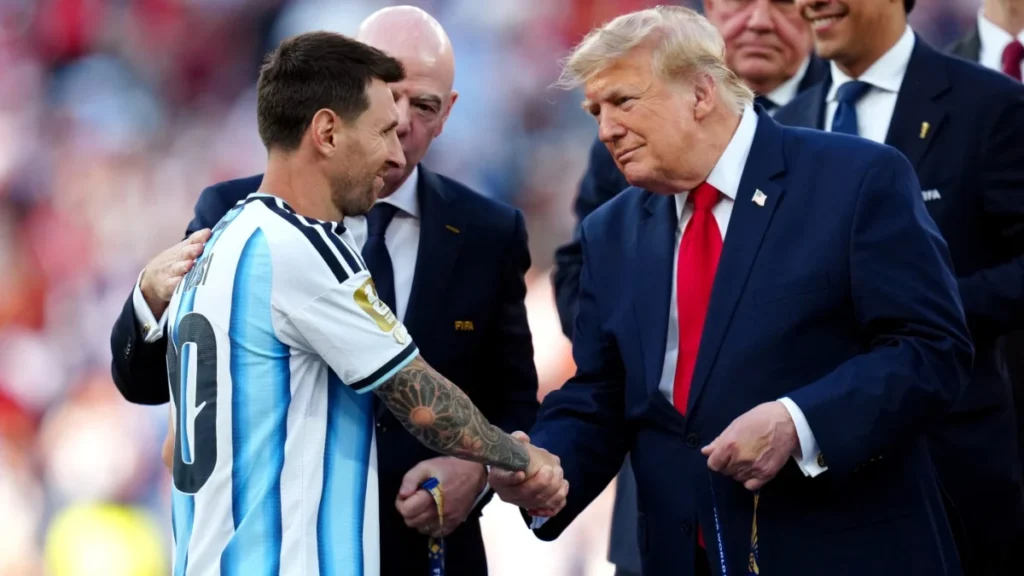
The 2026 World Cup provided the perfect catalyst for this trend. Argentina’s loss was not just a defeat; it was a perceived statistical anomaly given their form leading into the final. When Messi and his teammates were held scoreless by the Spanish defense, the internet immediately pivoted to Trump’s pre-match comments. The brief and somewhat awkward interaction between Trump and Messi during the silver medal ceremony further fueled the fire, with images of a dejected Messi standing near the President circulating widely as "proof" of the curse’s efficacy.
The USMNT and the FIFA Intervention Controversy
The roots of the curse’s 2026 resurgence can be traced back to earlier in the World Cup tournament, specifically involving the United States Men’s National Team (USMNT). During the knockout stages, the U.S. faced a formidable Belgian side. The match was preceded by a significant controversy involving American forward Folarin Balogun, who had been issued a red card in a previous match.
In an unprecedented move for a sitting U.S. President, Trump reportedly contacted FIFA President Gianni Infantino to advocate for a review of the suspension. Following these discussions, FIFA made the controversial decision to rescind Balogun’s one-game ban, allowing him to start against Belgium. Despite the presidential intervention and the availability of their star striker, the USMNT suffered a demoralizing 4-1 defeat. The Belgian Football Association did not miss the opportunity to capitalize on the narrative, posting a series of mocking messages on social media that highlighted their victory despite the political maneuvering. This event solidified the idea that even when the President attempted to use his influence to ensure a win, the outcome resulted in a more dramatic failure.
A Pattern of Sporting Misfortune: From the NBA to the Ryder Cup
The 2026 World Cup is merely the latest chapter in a series of sporting events that have contributed to the "Trump Curse" mythology. Throughout 2025 and early 2026, several other major sporting organizations found themselves entangled in the trend.
In June 2026, the New York Knicks reached the NBA Finals, a historic moment for the franchise and the city of New York. The President, a native New Yorker, attended Game 3 of the series at Madison Square Garden. Up until that point, the Knicks had been performing exceptionally well. However, Game 3 resulted in a narrow 111-115 loss. The defeat was the Knicks’ only home loss during the finals, leading fans to blame the President’s presence for disrupting the team’s momentum. The reaction was so visceral that Kazeem Famuyide, a prominent media personality, captured video footage of fans outside the arena burning sage in an attempt to “cleanse” the stadium of the President’s perceived negative energy.
The pattern was also evident in the world of golf. During the 2025 Ryder Cup, held at a prestigious U.S. course, Trump was a visible presence. He spoke confidently to the press about the American team’s prospects, stating, “We’re going to get it done. One way or another, we’ll get it done.” Despite his confidence and the home-turf advantage, the U.S. team lost to Europe with a final score of 15-13. The loss was viewed as a significant upset, and once again, the President’s vocal support was cited by critics as a contributing factor to the team’s underperformance.
Political Friction and Diplomatic Strains in the Sporting Arena
The intersection of Trump’s sports commentary and his foreign policy has added a layer of complexity to the "curse" narrative. His comments regarding Spain during the NATO summit in Ankara illustrate how sporting events can become proxies for diplomatic tension. By attacking Spain as a “terrible partner,” Trump inadvertently turned the World Cup Final into a narrative of “The President vs. Spain.”
When Spain emerged victorious, the win was celebrated by some European commentators not just as a sporting achievement, but as a symbolic rebuke of Trump’s rhetoric. This dynamic suggests that the “Trump Curse” is not merely a superstition among fans, but a reflection of the polarized political climate where every action of the President is scrutinized for its broader implications. The Spanish media, in particular, highlighted the irony of the President presenting trophies to a team he had publicly criticized only days earlier.
Social Media Reaction and the Psychology of the "Curse"
The speed at which the “Trump Curse” trended on platforms like X (formerly Twitter), TikTok, and Instagram following Argentina’s loss speaks to the modern intersection of celebrity culture and sports. Within minutes of the final whistle, hashtags related to the curse were among the most used globally.
Psychologists suggest that such trends are a form of collective coping or a way for fans to rationalize unexpected outcomes. In the case of the 2026 World Cup, where the narrative of a Messi victory was so strong, the "curse" provided an easy explanation for a result that many found difficult to accept. Furthermore, the President’s polarizing nature ensures that any association he has with a public event will be dissected by both supporters and detractors, with the latter group eager to highlight any perceived failures.
Conclusion: The Intersection of Celebrity, Politics, and Modern Sports
As the 2026 World Cup concludes and the global sports community looks toward future competitions, the “Trump Curse” remains a persistent, albeit informal, part of the cultural zeitgeist. While there is no empirical evidence to suggest that a President’s comments can influence the trajectory of a soccer ball or the accuracy of a golf putt, the narrative persists because it fits into a larger story of the Trump presidency—one marked by high-profile interventions and equally high-profile controversies.
The events of the 2026 World Cup Final, the USMNT’s loss to Belgium, the Knicks’ NBA Finals stumble, and the Ryder Cup defeat all serve as data points for those who believe in the phenomenon. Whether viewed as a harmless internet meme or a reflection of a deeper cultural divide, the "Trump Curse" has become an inseparable part of the sporting history of the mid-2020s. For Argentina and Lionel Messi, the loss in the final is a sporting tragedy; for the internet, it is simply the latest evidence of a pattern that shows no signs of fading.