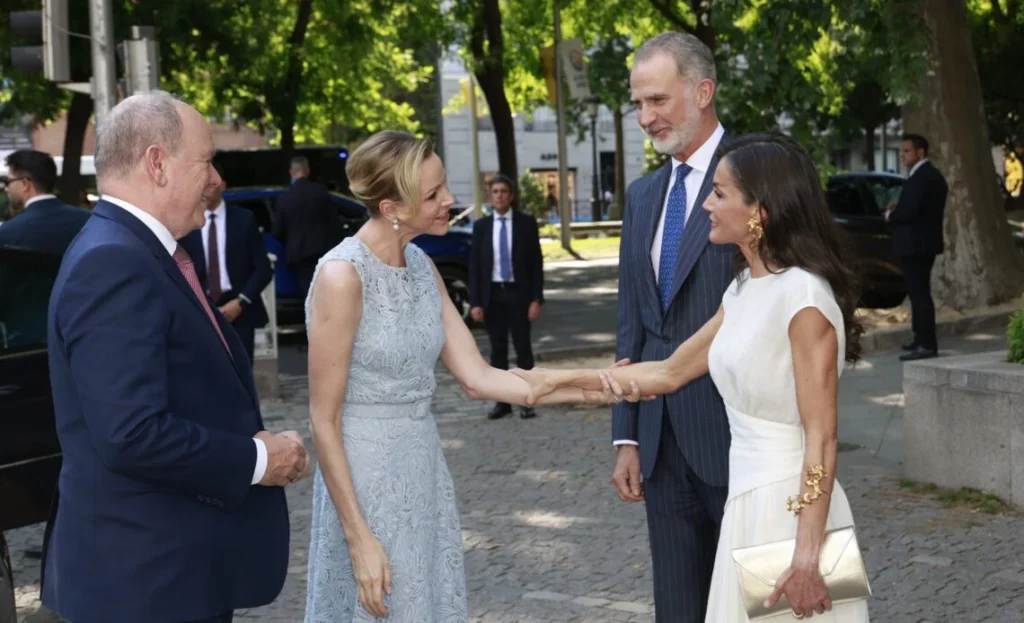

Princess Charlene of Monaco’s recent curtsy to Queen Letizia of Spain during a diplomatic visit to Madrid has ignited a nuanced discussion among royal watchers and protocol experts regarding the intricate etiquette governing interactions between European royal houses. The gesture, while seemingly a simple act of deference, has prompted a deeper examination of relative royal ranks, historical precedents, and the evolving nature of diplomatic courtesies in the modern era.
The visit, which marked 150 years of diplomatic relations between the Principality of Monaco and the Kingdom of Spain, saw Princess Charlene accompany her husband, Sovereign Prince Albert II, to the Spanish capital. During their engagements, which included attending commemorative exhibitions, Princess Charlene was observed curtsying not only to Queen Letizia but also to King Felipe VI. This act of curtsying, traditionally reserved for individuals of higher rank or in specific ceremonial contexts, has become the focal point of the ensuing debate.
Unpacking the Royal Hierarchy: Consort vs. Consort
At the heart of the discussion lies the question of whether Princess Charlene, styled as Her Serene Highness and Princess, was obliged to curtsy to Queen Letizia, styled as Her Majesty and Queen. While both women are consorts to reigning monarchs, their respective titles and the historical precedence of their nations’ monarchies have led to differing interpretations.
Some royal observers argue that as consorts, both Princess Charlene and Queen Letizia hold a comparable standing within the international royal community. In this view, the curtsy might be seen as an unnecessary demonstration of deference, suggesting a perceived difference in rank that does not exist between two individuals who are essentially spouses of heads of state. This perspective often emphasizes the modern trend towards more egalitarian interactions among European royal families.
Conversely, a significant contingent of royal protocol enthusiasts contends that the title of "Queen" inherently signifies a higher ceremonial rank than "Princess Consort," even when both are married to sovereign rulers. This viewpoint often draws upon historical precedents where the monarchical tradition of a particular nation dictates a clear hierarchy, with the Spanish monarchy boasting a longer and arguably more prominent historical lineage than that of Monaco. Under this interpretation, Princess Charlene’s curtsy to Queen Letizia would be deemed appropriate and in line with established diplomatic protocol.
A Diplomatic Exchange Rooted in History
The visit itself was a significant diplomatic occasion, designed to commemorate a century and a half since Monaco established its first diplomatic mission in Madrid. This milestone underscores the enduring relationship between the two nations, a connection that stretches back even further through centuries of shared history and cultural exchange.
The itinerary included visits to exhibitions celebrating this rich bilateral heritage. One such event, held at Madrid’s Royal Botanical Garden, focused on "Monaco and Spain: Five Centuries of Shared History." This exhibition served as a tangible representation of the deep-seated ties between the two countries, highlighting periods of alliance, cultural exchange, and mutual influence. The presence of both royal couples at such an event underscores the symbolic importance of the anniversary and the commitment to strengthening future relations.
The timing of the visit also coincided with a period of heightened diplomatic activity for both Spain and Monaco. For Queen Letizia, June 2026 was slated to be a busy month, including hosting Pope Leo XIV on his significant overseas visit to Spain. This papal visit, the Pope’s first to Europe as Pontiff after his election in May 2025, further amplifies the diplomatic significance of Spain’s role on the international stage.
Fashion Diplomacy: A Blend of Style and Substance
Beyond the protocol discussions, the event also showcased the sartorial elegance for which both Princess Charlene and Queen Letizia are renowned. The meeting was anticipated as one of the most stylish royal gatherings of the summer, and both royals lived up to expectations.
Princess Charlene opted for a sophisticated pale blue lace dress, complete with a matching belt, by the iconic designer Oscar de la Renta. This choice carried a subtle layer of diplomatic resonance, as Oscar de la Renta, the founder of the renowned fashion house, had himself studied in Madrid under the tutelage of the legendary Spanish couturier Cristóbal Balenciaga. This connection subtly weaves a thread of shared artistic heritage between Monaco, Spain, and the world of high fashion.
Queen Letizia, in turn, embraced Italian design, wearing a chic white midi dress from the Mantú x Yowe collection. The dress featured an elegant wrap-around detail at the waist, highlighting her characteristic modern and understated style. The choice of international designers by both royals underscores the global nature of contemporary fashion and its role in projecting a sophisticated and contemporary image for their respective nations.
Broader Implications and Future Considerations
The debate surrounding Princess Charlene’s curtsy, while seemingly focused on a minor detail, touches upon broader themes relevant to contemporary monarchies. In an era where royal families increasingly engage with the public through media and social platforms, the adherence to tradition and the interpretation of protocol are subjects of perennial interest.
The incident highlights the delicate balance that royal houses must strike between upholding centuries-old customs and adapting to modern expectations of accessibility and relatability. The varying opinions on the curtsy suggest a public that is both fascinated by the intricacies of royal etiquette and, at times, questioning its relevance in the 21st century.
Furthermore, the interaction underscores the importance of diplomatic nuance. Even within established hierarchies, there is often room for interpretation and personal discretion, influenced by cultural contexts, personal relationships, and the specific nature of the engagement. While official protocol provides a framework, the human element of diplomacy also plays a crucial role.
For Princess Charlene, the visit to Spain was part of her ongoing role as a prominent figure in Monegasque diplomacy. Her commitment to representing Monaco on the international stage is a testament to her dedication to her principality. The discussions surrounding her actions, while potentially distracting, do not diminish the significance of her diplomatic efforts.
Looking ahead, the interaction between Princess Charlene and Queen Letizia serves as a reminder of the enduring fascination with royal families and the complex tapestry of traditions, protocols, and personal styles that define their public lives. As royal houses continue to navigate the modern world, these discussions, however small, offer valuable insights into the evolving landscape of monarchy and its place in contemporary society.
Princess Charlene’s itinerary in June 2026 was also set to include significant events closer to home. As the Formula 1 Grand Prix returned to Monte Carlo, she would undoubtedly be a visible presence, representing Monaco at one of the world’s most prestigious sporting events. Additionally, Monaco was preparing to commemorate a significant anniversary in its own royal history: the 70th anniversary of the marriage of Princess Grace and Prince Rainier III. A new exhibition marking this milestone was slated to open, offering a poignant reminder of Monaco’s rich royal legacy.
The diplomatic dance between royalty, a blend of historical weight and contemporary presentation, continues to captivate global audiences. The curtsy in Madrid, a fleeting moment captured on camera, has inadvertently opened a window into the intricate world of royal protocol, reminding us that even the smallest gestures can carry significant meaning and spark enduring conversations.