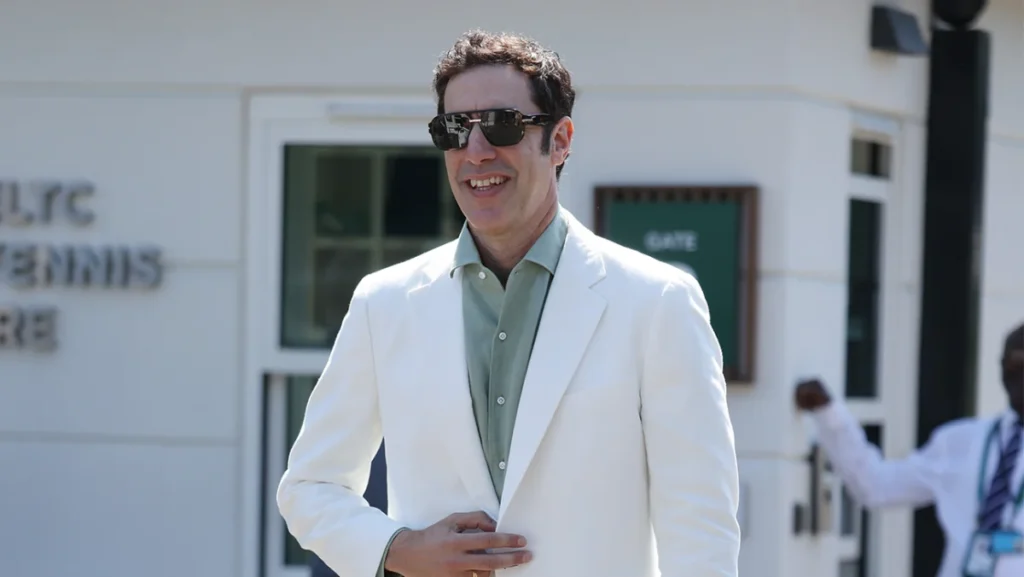

Sacha Baron Cohen’s iconic satirical character, Ali G, has made an unexpected and highly publicized return, marking his first significant appearance in over two decades. The self-proclaimed "voice of da yoof" resurfaced on Sunday with a video posted to a newly established Instagram account, ostensibly from the hallowed grounds of the 2026 Wimbledon men’s singles finals. This digital re-emergence follows recent reports that a new feature film starring the beloved, if controversial, character has secretly completed production, igniting considerable anticipation among fans and industry observers alike.
The video clip, quickly circulating across social media platforms, showcased Ali G in his signature yellow tracksuit and beanie, delivering a monologue steeped in his characteristic malapropisms and cultural misinterpretations. Addressing viewers from what he claimed was the prestigious tennis tournament, Ali G quipped, "Iz here at the men’s singles in Wimbledon, which actually, despite its name, ain’t a party for Gaylords. It’s like the World Cup of something called tennis, which is like a crap version of ping pong." He further elaborated on his entrepreneurial spirit, stating, "Them say that tennis is better played on grass, which is why I intend to sell as much of it while iz here. So if you want some herbal remedies, me got anything you want." This audacious attempt to peddle marijuana at a high-profile international sporting event is quintessential Ali G, blending absurd humor with a provocative edge. The accompanying caption on the Instagram post reinforced his return, declaring, "I iz BACK! And if u iz at dis borin wimbledore final lookin 2 get grand slammed, I iz here wif de hookup."
The choice of Wimbledon as the backdrop for Ali G’s return is particularly fitting, as it represents an apex of British tradition, decorum, and upper-class sensibility – elements ripe for subversion by the character’s boisterous, streetwise persona. His commentary highlights the inherent class divide often perceived in such events, using his unique lens to poke fun at the perceived stuffiness and elitism. The humorous anachronism of setting the scene at the "2026" finals further underscores the character’s timeless, albeit exaggerated, appeal, allowing for a flexible narrative space that transcends immediate reality.
The Genesis of a Secret Sequel
This public display of Ali G’s revival comes on the heels of reports that a new film featuring the character has already been filmed in secret. Details surrounding the project remain scarce, with no official title or release date announced. However, the news has been widely reported, suggesting a stealth approach characteristic of Sacha Baron Cohen’s previous works, where maintaining an element of surprise often enhances the comedic impact and genuine reactions from unwitting participants. The last time Ali G graced the silver screen was in the 2002 feature film Ali G Indahouse, making this upcoming project a return after more than two decades.
The decision to bring Ali G back after such a long hiatus is significant for Sacha Baron Cohen, a three-time Oscar nominee known for his deep commitment to character immersion and fearless social commentary. Throughout his career, Baron Cohen has consistently used his alter egos – including Borat Sagdiyev, Brüno Gehard, and Admiral General Aladeen – to expose prejudices, challenge social norms, and provoke uncomfortable truths about contemporary society. The return of Ali G signals a potential re-engagement with the specific brand of British youth culture satire that first propelled Baron Cohen to international fame.
A Chronology of Ali G’s Cultural Phenomenon
Ali G’s journey from a niche British television segment to a global satirical icon is a testament to Sacha Baron Cohen’s unique comedic genius.
-
1998: The Debut on The 11 O’Clock Show
Ali G first burst onto the scene in 1998 as a correspondent on Channel 4’s satirical news program, The 11 O’Clock Show. Portraying a white, middle-class man from Staines-upon-Thames who self-identifies as a Jamaican-American gangsta rapper, Ali G’s initial segments involved interviewing unsuspecting public figures on a range of serious topics. His blend of street slang, profound ignorance, and surprisingly incisive, albeit accidental, questioning quickly garnered attention. The humor stemmed from the juxtaposition of his persona with the often-earnest subjects he interviewed, exposing their discomfort, patronization, or genuine confusion. -
2000-2004: Da Ali G Show
The character’s popularity led to his own series, Da Ali G Show, which premiered in the UK in 2000 and later gained international recognition when it was picked up by HBO in the United States. The show further refined Ali G’s format, featuring him interviewing a diverse array of high-profile individuals, including politicians, academics, celebrities, and business leaders. Notable targets included former UN Secretary-General Boutros Boutros-Ghali, astronaut Buzz Aldrin, and even then-businessman Donald Trump. These interviews became legendary for their ability to elicit candid, often awkward, responses from figures unaccustomed to such a bizarre line of questioning. Ali G’s questions, seemingly simple or absurd, often inadvertently exposed the hypocrisy, pretentiousness, or sometimes genuine humanity of his interviewees. The series also introduced other Baron Cohen characters like Borat and Brüno, who would later achieve their own cinematic success. -
2002: Ali G Indahouse
In 2002, Ali G transitioned to the big screen with Ali G Indahouse. The film saw Ali G accidentally elected as a Member of Parliament, where his unorthodox ideas and street wisdom somehow manage to resolve a national crisis. While it achieved commercial success, grossing approximately $27 million worldwide on a $5 million budget, critical reception was mixed. Many critics felt that the character’s confrontational, improvisational style was better suited to short-form interviews than a full narrative feature, which required a more conventional plot structure. Despite this, the film cemented Ali G’s status as a cultural icon and introduced his unique brand of satire to an even wider global audience. -
Post-2004: Hiatus and Evolution
Following Da Ali G Show‘s conclusion in 2004, Sacha Baron Cohen largely retired Ali G, choosing to focus on Borat and Brüno, who both received their own successful feature films (Borat: Cultural Learnings of America for Make Benefit Glorious Nation of Kazakhstan in 2006 and Brüno in 2009). This strategic move allowed Baron Cohen to explore different facets of social commentary and avoid character fatigue, demonstrating his versatility as a performer and satirist. While Ali G made sporadic, brief appearances (e.g., at the 2012 British Comedy Awards), his major projects moved to other alter egos.
Sacha Baron Cohen’s Enduring Satirical Method
Sacha Baron Cohen’s comedic approach is rooted in the tradition of immersive character acting and confrontational satire, often referred to as "prank journalism" or "mockumentary." His method involves adopting fully formed personas, complete with elaborate backstories, accents, and mannerisms, and then interacting with unsuspecting real-world individuals. The humor and social commentary arise from the authentic reactions of those individuals to the absurd, provocative, or culturally insensitive behavior of his characters.
This technique is not without its risks. Baron Cohen has faced numerous legal challenges, security threats, and condemnations for his methods. However, proponents argue that the discomfort and controversy are integral to the satire’s effectiveness, forcing audiences to confront uncomfortable truths about prejudice, ignorance, and societal norms. His work often highlights the fine line between polite discourse and underlying biases, using humor as a tool for critical examination. The success of this method relies heavily on Baron Cohen’s ability to remain in character for extended periods, his quick wit, and his profound understanding of human psychology.
The Contemporary Relevance of Ali G’s Return
The decision to bring Ali G back in the mid-2020s raises intriguing questions about his potential relevance in a dramatically altered socio-political landscape. When Ali G first emerged, the internet was nascent, social media did not exist in its current form, and the public’s relationship with media and celebrities was vastly different. The current era, characterized by hyper-connectivity, a highly polarized political climate, the rise of "cancel culture," and an increased awareness of cultural sensitivity, presents both new opportunities and significant challenges for Ali G’s brand of humor.
In the late 1990s and early 2000s, Ali G’s satire often targeted issues of class, race, and identity in a pre-9/11 world, where certain forms of cultural appropriation were less scrutinized, and "political correctness" was a less pervasive societal concern. Today, Ali G could potentially tackle issues such as online echo chambers, influencer culture, misinformation, identity politics, and the complexities of globalized youth culture. His characteristic misunderstandings and provocative statements could serve as a mirror to contemporary debates, exposing new forms of pretension or absurdity.
However, the landscape is also more perilous. Public figures and institutions are more media-savvy, and the immediate viral spread of content means that missteps can have rapid and severe consequences. Baron Cohen’s challenge will be to adapt Ali G’s humor to resonate with a modern audience while retaining the character’s core identity and satirical edge, without simply rehashing old jokes or falling afoul of contemporary sensibilities. The secret nature of the film’s production suggests a deliberate strategy to control the narrative and maximize the element of surprise, crucial for Baron Cohen’s style of comedy.
Industry Anticipation and Fan Expectations
The news of Ali G’s return has been met with significant excitement within the entertainment industry and among his long-standing fanbase. Industry analysts anticipate a substantial commercial interest in the new film, driven by nostalgia for the character and Baron Cohen’s proven track record of creating culturally impactful comedies. For many, Ali G represents a specific era of boundary-pushing British comedy, and his return is seen as a welcome injection of audacious humor into a comedic landscape that some perceive as increasingly cautious.
Fans, many of whom grew up watching Da Ali G Show, are eager to see how the character has evolved – or delightfully failed to evolve – over two decades. There is a keen interest in how Ali G will interact with the modern world, what new targets he might find, and how Sacha Baron Cohen will once again use his alter ego to provoke thought and laughter in equal measure. The Instagram video serves as a tantalizing preview, confirming that the essence of Ali G remains intact: a chaotic, well-meaning, yet utterly misguided figure ready to disrupt any established order.
The return of Ali G is more than just a comedic comeback; it represents a significant moment for Sacha Baron Cohen’s legacy as a satirist. It offers an opportunity to re-examine the enduring power of character-driven comedy to comment on societal issues, even as those issues themselves transform. As the world awaits further details on the new film and Ali G’s next public appearance, one thing is certain: his return is poised to spark debate, laughter, and perhaps, a fresh look at ourselves through the hilariously distorted lens of Staines’ finest. Booyakasha!