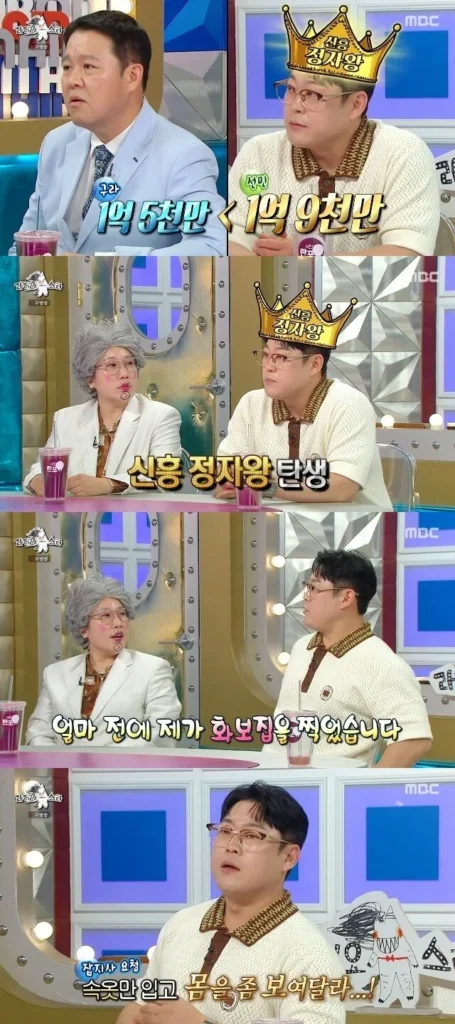

The landscape of South Korean variety television has long been characterized by its unique blend of candid personal revelations and lighthearted banter, a formula that once again took center stage during a recent broadcast of the long-running MBC program Radio Star. On the evening of July 8, the 971st episode of the popular talk show featured a diverse lineup of guests, including seasoned comedians Lee Sung Mi, Jung Sun Hee, and Kim Young Hee, alongside rising personality Lee Seon Min. While the program covered various aspects of the guests’ careers and personal lives, the discussion took a particularly notable turn when Lee Seon Min engaged in a humorous yet data-driven competition regarding male fertility, ultimately claiming a title previously associated with the show’s veteran host, Kim Gu Ra.
The Competitive Discourse on Male Fertility
During the broadcast, Lee Seon Min steered the conversation toward physical health and vitality, specifically targeting the "Sperm King" title that has been a recurring trope on the show. Addressing the main host, Kim Gu Ra, Lee Seon Min challenged the veteran entertainer to disclose his current health metrics. "Senior, please present your sperm count first," Lee requested, setting the stage for a comparative analysis of their respective medical results.
To provide context for the television audience, Lee Seon Min cited general medical statistics, noting that the average Korean male typically possesses approximately 15 million sperm per milliliter. This figure served as a baseline for the subsequent revelations. Kim Gu Ra, known for his confidence and often blunt persona, responded by estimating his own count to be in the hundreds of millions. However, Lee Seon Min quickly countered with specific documentation from his own medical examinations, revealing a count of 190 million sperm per milliliter.
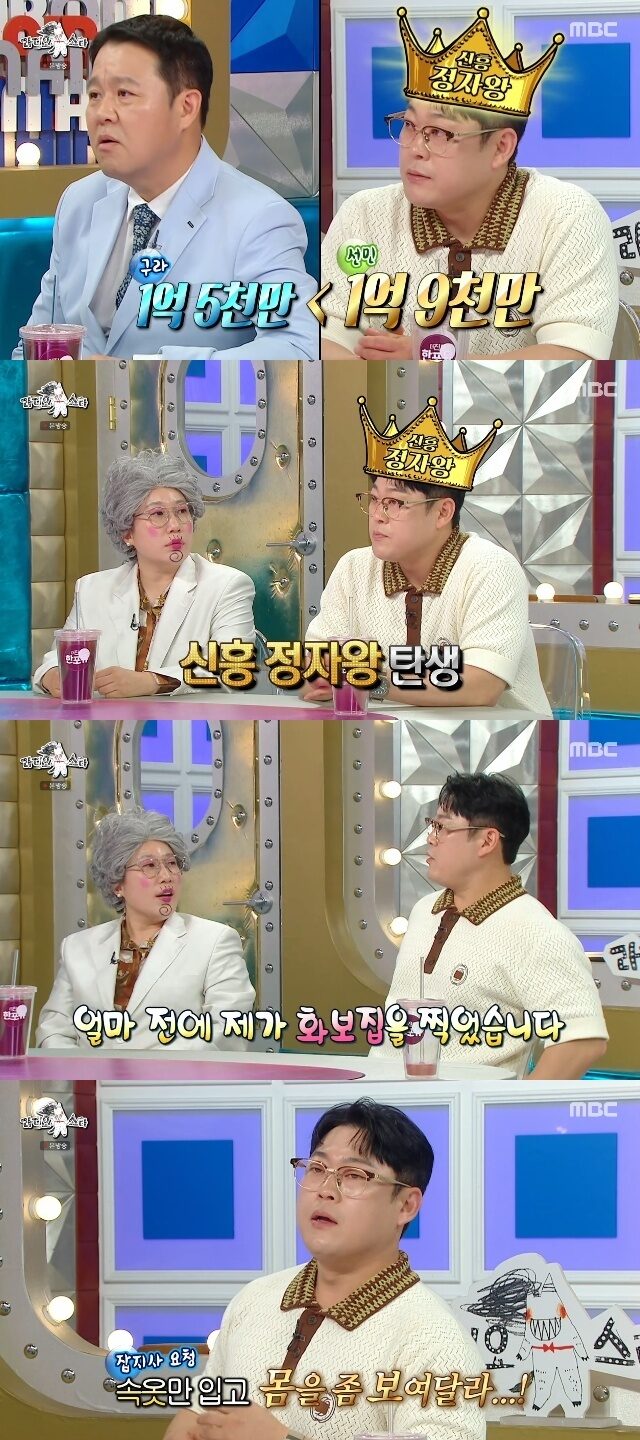
When Kim Gu Ra’s count was revealed to be 150 million—a figure that is significantly higher than the national average—it was still surpassed by Lee Seon Min’s 190 million. This 40-million-unit difference led to Lee Seon Min being playfully crowned the new "Sperm King" of the episode, a moment that highlighted the shift in the show’s hierarchy of virility.

Medical Anecdotes and Comparative Health
Lee Seon Min further enriched the discussion by describing his experience at the fertility clinic, providing a vivid, albeit humorous, account of the diagnostic process. He explained that hospitals often provide patients with video footage of their samples to demonstrate motility and concentration. In a move that displayed both pride and comedic timing, Lee described the visual density of his sample.
"The hospital shows you a sample video of the sperm, displaying the most active person’s video first, then mine," Lee explained to the panel. "I thought they were playing the same video again because mine had so many. It felt like a crowded one-room apartment with about 40 people living in it." This metaphor resonated with the audience and the panel, illustrating a high level of reproductive health through a relatable, if exaggerated, urban imagery.
The conversation took a more poignant yet equally candid turn when fellow guest Kim Young Hee shared a contrasting experience regarding her husband, who is ten years her junior. She revealed that during their own fertility testing, the results were significantly different. "It looked more like a photo than a video since everything was frozen still and the heads were cut off," Kim Young Hee shared, recalling her confusion when asking the doctor if she was looking at a still image rather than a live recording.
This revelation prompted the hosts to inquire about how the couple managed to conceive their child. Kim Young Hee responded with emotional sincerity, noting that the difficulty of the process made their daughter "so precious." This segment of the program served to balance the bravado of Lee Seon Min’s claims with a reminder of the complexities and challenges many couples face regarding reproductive health.
The Cultural Significance of Radio Star and Candid Talk
To understand the impact of this broadcast, one must consider the historical context of MBC’s Radio Star. Since its debut in 2007 as a segment of Golden Fishery, the show has evolved into a standalone powerhouse of Korean broadcasting. It is renowned for its "no-holds-barred" approach to interviewing, where hosts Kim Gu Ra, Yoon Jong Shin (formerly), and others push guests to discuss topics that are often considered taboo in the more conservative spheres of Korean society.

The topic of male fertility, while humorous in a variety show setting, touches upon broader social themes in South Korea. The country is currently grappling with the world’s lowest birth rate, a demographic crisis that has brought issues of reproductive health, marriage, and childcare to the forefront of national discourse. By discussing sperm counts and fertility challenges on a mainstream platform like Radio Star, entertainers like Lee Seon Min and Kim Young Hee are, perhaps inadvertently, contributing to the destigmatization of these topics.
Physical Fitness and the Body Profile Trend
Beyond the discussion of fertility, Lee Seon Min utilized his appearance on the show to promote his recent foray into fitness and modeling. He spoke extensively about a recently published photo book, which aligns with the "Body Profile" trend currently sweeping South Korea. This trend involves non-professional models—often celebrities or office workers—undergoing rigorous diet and exercise regimens to capture professional-grade photographs of their physiques.
Lee Seon Min expressed a high degree of personal satisfaction with the project. "They asked me to show my body wearing only underwear, and the photos came out so well," he noted. The reaction from the Radio Star panel was overwhelmingly positive, with the MCs and fellow guests praising his dedication to physical fitness. "You look great," and "You really take pride in your body," were among the comments shared as the studio viewed the images.
This segment highlighted a different facet of Lee Seon Min’s public persona. While his "Sperm King" claim was rooted in biological data, his photo book emphasized the discipline and aesthetic labor involved in modern Korean celebrity culture. The intersection of these two topics—biological vitality and physical fitness—paints a picture of a star who is deeply invested in the public projection of health and masculinity.
Analysis of Implications and Public Perception
The broadcast of Episode 971 serves as a microcosm of contemporary Korean media’s approach to masculinity and health. On one hand, the "Sperm King" competition is a classic example of variety show "banter" (known in Korea as tik-tak), where guests and hosts trade jabs to create entertainment value. On the other hand, the inclusion of specific medical data—such as the 15 million/ml average—provides an educational element that grounds the comedy in reality.
From a public relations perspective, Lee Seon Min’s performance on Radio Star was a strategic success. By engaging in the "Sperm King" narrative, he managed to create a memorable "character" for the episode, ensuring high engagement on social media and news portals. His willingness to discuss his body and his medical results with such openness aligns with the current trend of "hyper-honesty" among younger Korean celebrities, who are moving away from the highly guarded and polished images of the past.
Furthermore, the interaction between Lee Seon Min and Kim Gu Ra represents a passing of the torch. Kim Gu Ra has long been the "alpha" figure on Radio Star, often using his own life experiences and health as a baseline for the show’s humor. By challenging and surpassing Kim’s metrics, Lee Seon Min positioned himself as a formidable presence in the new generation of variety stars.
Conclusion and Future Outlook
The 971st episode of Radio Star will likely be remembered for Lee Seon Min’s bold assertions and the ensuing comedic rivalry over reproductive health metrics. However, beneath the surface of the jokes lies a reflection of a society that is increasingly comfortable discussing the realities of the human body. As South Korea continues to navigate complex demographic shifts, the role of media in normalizing health-related conversations remains vital.
Lee Seon Min’s "Sperm King" title, while informal and confined to the world of entertainment, underscores a broader cultural fascination with vitality and the "Body Profile" lifestyle. As he continues to promote his photo book and expand his presence on variety television, his appearance on Radio Star serves as a definitive moment in his career, establishing him as a personality who is unafraid to blend data, humor, and personal pride.
The episode also reinforced the enduring relevance of Radio Star as a platform where the private lives of stars are laid bare for the public’s amusement and reflection. Whether discussing the "frozen" sperm of a younger husband or the "crowded apartment" of a comedian’s sample, the program remains a unique space where the biological and the theatrical collide, providing a window into the evolving social norms of South Korea.