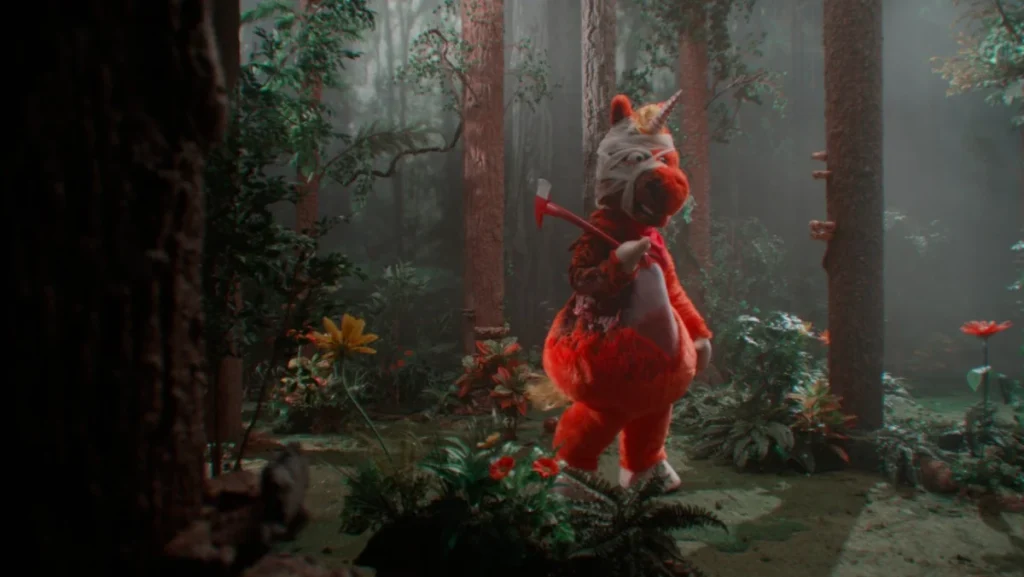

The realm of children’s entertainment is set to be irrevocably disrupted by the arrival of Buddy, a forthcoming horror-comedy from director Casper Kelly that promises to transform the innocent image of a bright orange unicorn into a harbinger of unsettling fun. Roadside Attractions is poised to release this genre-bending feature in theaters on August 28, following its initial premiere earlier this year at the prestigious Sundance Film Festival, where it began to carve out its unique identity in the independent film landscape. The film boasts an impressive ensemble cast, featuring the talents of Cristin Milioti, Keegan-Michael Key lending his distinctive voice to the titular unicorn, Topher Grace, Delaney Quinn, Patton Oswalt, and Michael Shannon, all contributing to a narrative that blurs the lines between saccharine sweetness and psychological terror.
The premise of Buddy is deceptively simple yet deeply unsettling. It centers on a seemingly beloved, bright orange unicorn who is the charismatic host of a classic children’s television program, aptly titled It’s Buddy!. The trailer itself, a masterclass in tonal juxtaposition, splices moments of joyful, innocent dancing between Buddy and his young audience on the show’s vibrant set with sudden, jarring flashes of pure terror. This stark contrast serves as a prelude to the film’s core conflict: when a single child dares to resist joining in the prescribed fun, Buddy’s cheerful demeanor shatters, revealing a darker, more sinister side to his character and the supposedly perfect world he inhabits. This shift promises to dismantle the facade of childhood innocence, plunging both the characters and the audience into a disquieting reality where imagination can turn monstrous.
From Viral Short to Feature Film: Casper Kelly’s Vision
Director Casper Kelly is no stranger to subverting expectations and crafting viral sensations. He gained widespread recognition for creating Adult Swim’s 2014 horror short, Too Many Cooks. This unexpected, eleven-minute segment, which aired in the unlikeliest of late-night slots, became an internet phenomenon, lauded for its bizarre, escalating parody of 1980s sitcom opening credits that gradually morphs into a surreal, violent nightmare. The short was celebrated for its audacious creativity, its ability to tap into collective nostalgia, and its masterful execution of a slow-burn descent into madness. Too Many Cooks wasn’t just a fleeting internet meme; it was a cultural moment, showcasing Kelly’s unique ability to blend unsettling horror with comedic absurdity and an acute understanding of media tropes.
This background provides crucial context for Buddy. Kelly’s previous work demonstrates a clear affinity for deconstructing familiar media formats and injecting them with a potent dose of the uncanny. The shift from a television short to a feature-length film like Buddy suggests an ambition to explore these themes on a grander scale, allowing for more developed characters, intricate plotlines, and sustained tension. With Buddy, Kelly, who co-wrote the script with Jamie King, appears to be applying a similar deconstructive lens to the seemingly innocuous world of children’s television. The inherent trust and innocence associated with such programming make it fertile ground for horror, and Kelly’s track record suggests he is adept at exploiting these vulnerabilities for maximum impact. The film’s executive producing team, including Kelly, King, Kevin Flanigan, Dexter Braff, Roberto Linck, Nathan McAuley, Emilio Schenker, Gideon Tadmor, Adam J. Wilde, Geoff Yaw, and Ryan J. Kelly, indicates a robust collaborative effort behind bringing this singular vision to the big screen.
The Ensemble Cast: Voices and Faces Behind the Horror
The cast assembled for Buddy is a formidable collection of talent, each bringing a unique set of skills to the horror-comedy genre. Keegan-Michael Key, primarily known for his exceptional comedic timing and improvisational prowess from shows like Key & Peele, takes on the pivotal voice role of Buddy. This casting choice is particularly inspired, as Key’s ability to imbue characters with distinct personalities and subtle inflections will be critical in conveying Buddy’s transformation from a cheerful children’s host to something far more menacing. His comedic background will likely lend itself to the film’s humorous elements, while his vocal range can undoubtedly deliver the sinister undertones required for a horror character. The challenge for Key will be to create a character that is both endearing and utterly terrifying, a tightrope walk that his previous work suggests he is more than capable of navigating.
Cristin Milioti, a versatile actress with a penchant for genre-bending projects, leads the live-action cast. Her roles in critically acclaimed works such as Palm Springs (a romantic comedy with a time-loop sci-fi twist) and Made for Love (a dark comedy exploring technology and relationships) demonstrate her comfort with narratives that defy easy categorization. Milioti often portrays characters facing surreal or absurd circumstances with a grounding sense of humanity, making her an ideal choice for a film that blends horror with comedy. Her presence suggests a protagonist who will navigate the escalating absurdity and terror with both wit and resilience.
Rounding out the principal cast are familiar faces such as Topher Grace, known for his roles in That ’70s Show and more recently for his dramatic turns, and Michael Shannon, an actor renowned for his intense and often unsettling performances in films like Revolutionary Road and The Shape of Water. Shannon’s involvement alone signals a certain level of gravitas and potential for psychological depth within the film’s horror elements. Comedian Patton Oswalt, celebrated for his stand-up and voice work, adds another layer of comedic talent, while Delaney Quinn is also part of the ensemble. The combination of comedic heavyweights and actors known for their dramatic intensity suggests a rich tapestry of performances designed to enhance both the humor and the horror of Buddy.
Sundance Premiere and Roadside Attractions’ Bet
The decision to premiere Buddy at the Sundance Film Festival earlier this year was a strategic move that placed the film squarely in the spotlight of independent cinema. Sundance is globally recognized as a premier platform for showcasing innovative and boundary-pushing films, often serving as a launchpad for emerging talent and unique storytelling. A successful run at Sundance can generate significant buzz, attract distributors, and build critical momentum ahead of a broader release. For a film like Buddy, which defies easy genre classification, a festival premiere provides an invaluable opportunity to introduce its distinct tone and vision to an audience receptive to experimental narratives.
Roadside Attractions, the film’s distributor, has a proven track record of championing independent and often critically acclaimed films. Their portfolio includes a diverse range of genres, from dramas like Manchester by the Sea to thrillers and comedies. Their acquisition of Buddy post-Sundance signals their confidence in the film’s commercial viability and its potential to resonate with audiences. Distributing a horror-comedy, especially one with a unique premise like Buddy, requires a nuanced marketing strategy that can effectively communicate its dual nature without alienating either horror fans or comedy enthusiasts. Roadside Attractions’ experience in navigating the competitive independent film market will be crucial in positioning Buddy for success in its theatrical run.
The Anatomy of a Horror-Comedy: Subverting Childhood Innocence
Buddy enters a horror landscape increasingly fascinated by the subversion of childhood innocence and familiar, comforting figures. This trope, which has seen a resurgence in popular culture, exploits the inherent vulnerability and trust associated with childhood, turning it on its head to create deeply unsettling horror. From classic examples like killer dolls (Chucky) and evil clowns (Pennywise) to more recent phenomena like the animatronics of Five Nights at Freddy’s or the warped fairy tales of Winnie the Pooh: Blood and Honey, audiences are captivated by the transformation of benign symbols into sources of terror. Buddy capitalizes on this fascination by taking the ultimate symbol of childlike wonder—a friendly, colorful unicorn—and twisting it into a figure of dread.
The horror-comedy genre itself thrives on this kind of subversion, using humor to both amplify and diffuse the terror. Films like Shaun of the Dead, The Cabin in the Woods, and Tucker & Dale vs. Evil have demonstrated the genre’s capacity for both genuine scares and uproarious laughter, often simultaneously. They often critique societal norms or genre conventions through their blend of humor and horror. Buddy‘s specific focus on a children’s television show allows it to satirize the often saccharine and overly simplistic messages presented to children, hinting at a darker underbelly beneath the veneer of manufactured happiness. The film’s premise could be interpreted as a commentary on the pressures to conform, the dangers of forced positivity, and the potential for psychological manipulation within seemingly harmless entertainment.
Keegan-Michael Key: A Voice for the Vile Unicorn
Keegan-Michael Key’s involvement as the voice of Buddy is undoubtedly one of the film’s most anticipated elements. His career has been defined by his unparalleled versatility, transitioning seamlessly between sketch comedy, improv, and dramatic roles. His ability to craft distinct voices and embody a wide range of characters, often with a subtle nuance that belies their comedic exterior, makes him perfectly suited for a role that demands such a dramatic shift in tone. For Buddy, Key will need to establish an initial persona that is genuinely appealing and comforting to children, only to then gradually—or perhaps abruptly—unleash a voice that conveys malice, frustration, and a chilling sense of control.
Voice acting in horror requires a unique skill set, as the actor must convey terror and menace purely through vocal delivery, without the aid of facial expressions or body language. Key’s comedic background, ironically, might be his greatest asset here. Comedians often possess a deep understanding of rhythm, timing, and inflection, which can be manipulated to create suspense and dread. His ability to deliver deadpan humor or sudden outbursts of absurdity could translate effectively into the unsettling nature of Buddy’s darker persona. The contrast between his familiar comedic voice and the terrifying actions of the character is likely to be a key source of both humor and horror in the film, making Buddy a truly memorable, albeit unsettling, character.
Navigating the Critical Landscape: Early Reactions to Buddy
The initial critical reception for Buddy provides valuable insight into how the film is perceived within the industry. David Rooney, chief film critic for The Hollywood Reporter, offered a nuanced review, acknowledging the film’s ambition while also pointing out its perceived shortcomings. Rooney noted that the movie "stretches its sketch-comedy idea to feature length by upping the gore and the demented detours but doesn’t go far enough to be as extreme or disturbing as it wants to be." This assessment suggests that while Kelly successfully translates his signature style from short form to feature length, the film might pull some punches in its pursuit of extreme horror, potentially tempering its impact for seasoned genre fans.
However, Rooney’s review also highlighted a significant strength: "The film’s biggest plus is the inspired voice work of Keegan-Michael Key as the title character." This affirmation underscores the importance of Key’s performance in elevating the film, confirming that his unique vocal talents are central to Buddy’s effectiveness as a compelling and unsettling antagonist. Such a critique is common for horror-comedies, which often walk a fine line between delivering genuine scares and eliciting laughter. Achieving the perfect balance is a challenge, and critics often look for films that fully commit to both aspects. For Buddy, it seems Key’s performance is a standout, proving that the casting choice was indeed inspired.
The Broader Context: Creepy Mascots and Genre Evolution
The phenomenon of "creepy mascots" in horror is not new, but its recent surge reflects a cultural fascination with distorting symbols of childhood innocence. This trend often taps into a collective nostalgia, only to twist it into something unsettling, playing on the idea that what once brought comfort can also harbor profound terror. Buddy fits squarely into this evolving subgenre, drawing parallels with other contemporary works that explore the darker side of seemingly benign figures. The success of independent horror films, particularly those that blend genres, has created an environment where unique concepts like Buddy can thrive. Film festivals like Sundance play a critical role in identifying and nurturing these voices, providing a platform for films that might otherwise struggle to find mainstream distribution. The horror genre itself has become a fertile ground for social commentary and psychological exploration, often using its tropes to reflect anxieties about media, childhood, and societal pressures. Buddy‘s premise allows for potential critiques of idealized realities and the consequences of suppressed emotions.
Production Insights: Bringing Buddy to Life
Bringing a concept as unique as Buddy to life requires a dedicated and creative production team. Tyler Davidson, Drew Sykes, Raphael Margules, J.D. Lifshitz, and Tracy Rosenblum served as producers, overseeing the complex process of turning a script into a finished film. The production likely involved a blend of live-action cinematography for the human characters and sophisticated puppetry or CGI for Buddy, necessitating careful integration to create a seamless and believable world. The juxtaposition of a colorful, almost saccharine children’s show set with scenes of burgeoning horror would have presented significant visual and thematic challenges, requiring meticulous attention to detail in production design, costume, and lighting. The practicalities of working with child actors in a film with horror elements also demands a sensitive and professional approach, ensuring a safe and appropriate environment on set. The success of Buddy in translating its wild concept to the screen will be a testament to the collaborative efforts of this production team.
Anticipating the Theatrical Release: August 28th
With its theatrical release scheduled for August 28, Buddy is positioned to capture the attention of audiences looking for something distinct as the summer blockbuster season winds down. Late August can be a strategic release window for independent films, allowing them to stand out before the more crowded fall festival circuit and awards season. Roadside Attractions will likely leverage the film’s unique premise, Casper Kelly’s cult following, and the star power of its cast, particularly Keegan-Michael Key, in its marketing efforts. The teaser trailer has already set the stage by effectively showcasing the film’s central conceit and its unsettling blend of cheer and dread, generating curiosity and debate online. The film’s success will depend on its ability to attract both horror aficionados and fans of dark comedy, proving that an orange unicorn can indeed be a terrifying and memorable figure in cinematic history.
Conclusion: The Enduring Appeal of Dark Fantasy
Buddy represents a fascinating intersection of dark fantasy, genre subversion, and independent filmmaking ingenuity. Casper Kelly’s transition from viral short-form content to a feature film is a testament to his distinct creative voice and the appetite for unconventional storytelling in contemporary cinema. With a strong ensemble cast, led by Keegan-Michael Key’s anticipated voice performance, and a distributor known for championing unique projects, Buddy is poised to make a significant impact. Whether it fully delivers on its promise to be "extreme" or "disturbing" as some critics might desire, the film undeniably offers a fresh take on the horror-comedy genre, tapping into the enduring appeal of transforming innocence into terror. As audiences prepare for the August 28 release, the question remains: are we truly ready for Buddy’s tricks, or will this orange unicorn prove to be far more unsettling than anyone could anticipate?