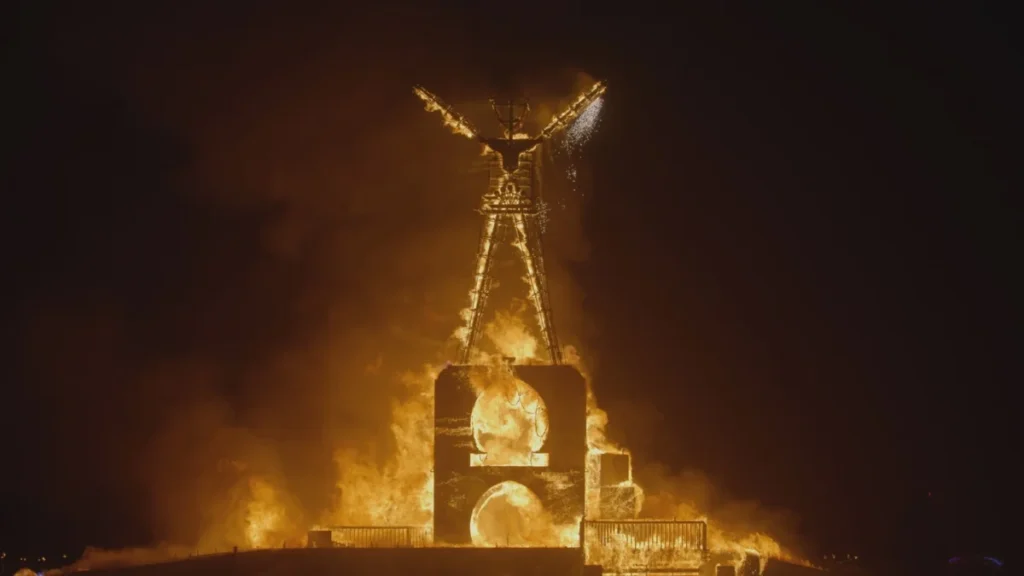

The HBO docuseries The Man Will Burn, directed by Jehane Noujaim and Vikram Gandhi, offers an expansive yet paradoxically fragmented look into the iconic Burning Man Festival. Blessed with multi-year access to the event’s intricate operations, its diverse participants, and the bureaucratic layers governing it, the four-hour series presents an engaging but often perplexing narrative. Spanning across its rushed and disjointed episodes, the documentary endeavors to capture the essence of the community fostered by Burning Man, its evolving infrastructure, and the internal political dynamics that shape its future. While it touches upon the inherent issues of privilege and homogeneity within the event’s demographic, and delves into several tumultuous years of its history, the series frequently struggles under the weight of its abundant material, lacking the incisive clarity and rigorous focus required for a truly deep dive.
Ultimately, The Man Will Burn walks a fine line, at times feeling more like an extended promotional piece for an event that scarcely requires advertisement, rather than a penetrating journalistic exploration. Despite its engaging cinematography and privileged access, it often shies away from truly dissecting the complexities it unearths. However, for viewers seeking a visually compelling and well-sourced introduction to the multifaceted world of Burning Man, the series certainly delivers a rich, albeit largely sanitized, experience.
The Genesis of a Phenomenon: Burning Man’s Roots
To understand the contemporary challenges and internal conflicts depicted in The Man Will Burn, it is crucial to revisit the origins and foundational philosophy of Burning Man. The festival began modestly in 1986 on Baker Beach in San Francisco, when Larry Harvey and Jerry James burned an 8-foot wooden effigy of a man, joined by a small group of friends. This act, rooted in themes of radical self-expression and community, quickly outgrew its impromptu beginnings. By the early 1990s, the growing event, inspired by the counter-cultural ethos of groups like the Cacophony Society (whose members John Law and Michael Mikel were instrumental in its early development), sought a new home.
From Cacophony to Black Rock City
The vast, remote playa of the Black Rock Desert in Nevada became the new, unconventional canvas for Burning Man in 1990. This move transformed the gathering from a beach bonfire into a sprawling, temporary metropolis known as Black Rock City. The sheer scale and isolation of the desert environment necessitated an unprecedented level of communal effort and radical self-reliance, which profoundly shaped the festival’s ethos. Over the years, Black Rock City grew exponentially, attracting artists, free spirits, and eventually, a global community of "burners."
The Ten Principles: Guiding the Burner Ethos
As the event expanded, its founders formalized a set of guiding tenets, known as The Ten Principles of Burning Man, in 2004. These principles are:
- Radical Inclusion: Anyone may be a part of Burning Man. No prerequisites exist for participation in our community.
- Gifting: Burning Man is devoted to acts of gift-giving. The value of a gift is unconditional.
- Decommodification: To preserve the spirit of gifting, our community seeks to create social environments that are unmediated by commercial sponsorship, transactions, or advertising.
- Radical Self-Reliance: Burning Man encourages the individual to discover, exercise, and rely on their inner resources.
- Radical Self-Expression: Radical self-expression arises from the unique gifts of the individual.
- Communal Effort: Our community values creative cooperation and collaboration.
- Civic Responsibility: We value civil society. Community members who organize events should assume responsibility for public welfare.
- Leaving No Trace: Our community is committed to leaving no physical trace of its activities wherever we gather.
- Participation: We believe that transformative change, whether in the individual or in society, can occur only through deeply personal participation.
- Immediacy: We seek to overcome barriers that stand between us and a recognition of our inner selves, the reality of those around us, participation in society, and contact with a natural world.
These principles serve as the ideological backbone of Burning Man, aiming to cultivate a utopian, anti-consumerist society, however temporary. They articulate a vision of a participatory culture distinct from mainstream society, emphasizing creativity, community, and ecological awareness.
A Decade of Transformation: Growth, Challenges, and Identity Shifts
The turn of the millennium marked a significant shift for Burning Man. In 1999, Black Rock City LLC was established, professionalizing the organization and management of the rapidly growing festival. This transition brought increased scrutiny and new challenges, as the event grappled with its own success and the inherent tensions between its counter-cultural roots and its escalating scale.
The Rise of Black Rock City LLC
The formal incorporation aimed to manage the logistical complexities of hosting tens of thousands of people in a remote desert environment. This included securing permits from the Bureau of Land Management (BLM), developing sophisticated infrastructure for sanitation, safety, and communication, and ensuring compliance with a myriad of regulations. While necessary for the event’s survival and growth, this formalization also introduced a more corporate structure, inevitably leading to questions about the preservation of its original, anarchic spirit. The documentary hints at this ongoing tension between the original founders and the "new guard" of leadership, including CEO Marian Goodell, who took the reins during this period of professionalization.
Addressing Critiques of Privilege and Exclusivity
As Burning Man grew, so did its demographic, attracting a significant number of attendees from Silicon Valley, tech entrepreneurs, and affluent individuals. This influx brought substantial resources but also fueled criticisms regarding the festival’s increasing whiteness and privilege. What began as an accessible counter-culture gathering started to be perceived by some as an exclusive playground for the wealthy, with luxury camps and private jets contradicting the principles of decommodification and radical self-reliance. The series acknowledges this underlying critique, presenting it as an inherent challenge facing Burning Man’s identity, but perhaps without the critical depth needed to fully explore its implications or the organization’s concrete efforts to diversify its participant base and leadership.
The sheer scale of the event is staggering. Pre-pandemic, attendance regularly exceeded 70,000 to 80,000 participants, transforming a barren landscape into a vibrant, temporary city larger than many permanent towns in Nevada. This annual migration generates significant economic activity, contributing millions of dollars to the state through supplies, services, and tourism, even as the event strives to maintain its decommodified ethos within its boundaries.
Navigating Unprecedented Crises: The Pandemic and Beyond
The Man Will Burn largely centers its narrative around a period of intense crisis for Burning Man: the global COVID-19 pandemic and its immediate aftermath, culminating in the infamous rain-soaked event of 2023. This chronology provides a compelling backdrop for internal debates and external pressures.
The 2021 Cancellation and its Ripple Effects
The documentary begins in the tense days leading up to a crucial decision regarding the 2021 festival. Following the unprecedented cancellation of the 2020 event due to the pandemic, the Burning Man board and community were deeply divided. The core dilemma pitted pragmatic public health concerns against the perceived necessity of upholding the festival’s values and ensuring its economic viability. Arguments ranged from advocating for another year of postponement to allow for widespread vaccination and robust mitigation strategies, to insisting on the immediate return of the event to sustain its brand, support its devoted community, and ensure its financial solvency.
A pivotal figure in this debate was Kimbal Musk, a board member and investor, notably Elon Musk’s brother. The series portrays Musk as embodying a certain "entitlement," suggesting his strong preference for the festival’s return, driven by what he believed was best for the brand and its future. Despite such pressures, the decision was ultimately made to cancel the official 2021 event, much to the chagrin of individuals like Musk and many eager participants.
The "Renegade" Burn and Community Division
The cancellation, however, did not deter everyone. In 2021, a "renegade" or "unofficial" burn emerged, attracting thousands of participants who independently gathered on the playa. This spontaneous assembly, operating outside the official Burning Man Project (BMP) organizational umbrella, highlighted both the radical self-reliance inherent in the burner community and the challenges faced by the official organization in maintaining control and ensuring safety without its sanctioned infrastructure. The documentary captures the tension between the BMP, striving to manage its brand and responsibilities, and the free-spirited burners who found alternative ways to "burn."
The series introduces viewers to Lindsay, a professor from Pasadena, and Ray, a Black veteran from rural North Carolina, both planning their first attendance at Burning Man in 2021. Their individual stories provide a relatable entry point, illustrating the diverse allure of the festival – a unique blend of culture, art, music, sex, and drugs – and the personal motivations behind becoming a "burner." Their perspectives underscore the festival’s promise of transformation and belonging, irrespective of background, even as it struggles with its demographic realities.
The Deluge of 2023: Media Scrutiny vs. Internal Narrative
Following the return of the official event in 2022, the 2023 festival faced an entirely different crisis: a historic rainstorm that transformed the playa into an impassable mud field. This event garnered widespread media attention, with sensationalized reports of stranded attendees, apocalyptic conditions, and a public health emergency. The Man Will Burn presents the internal perspective, contrasting the media’s portrayal with the lived experience of burners and organizers. The documentary features testimonies reassuring viewers that, despite the challenging conditions, the community rallied, and ultimately, "everything was perfectly fine." The cinematography captures the beauty of the flooded desert plains, seemingly reinforcing this narrative, perhaps to the point of downplaying genuine logistical and safety concerns that were certainly present. This segment exposes the ongoing tension between Burning Man’s self-perception as a resilient community and the external media’s tendency towards dramatic narrative.
Diverse Voices, Shared Vision: Key Stakeholders and Their Perspectives
The documentary attempts to weave together the narratives of various stakeholders, illustrating the complex ecosystem that is Burning Man.
Leadership and Governance: Goodell’s Vision
Marian Goodell, CEO of the Burning Man Project, emerges as a central figure, representing the formalized leadership tasked with steering the festival through its modern challenges. Her perspective, alongside that of other board members, emphasizes the dedication to preserving Burning Man’s core values while ensuring its long-term viability and safety. However, the documentary’s close involvement with the BMP might lead to a somewhat uncritical portrayal, presenting conflicts as largely "profound but benign" disagreements rather than fundamental ideological clashes.
The Influence of Silicon Valley: Kimbal Musk’s Role
Kimbal Musk’s presence highlights the significant influence of wealthy individuals and the tech industry on Burning Man. While his intentions are framed as wanting "the best for Burning Man," his perceived "entitlement" subtly underscores the tension between the festival’s decommodified ideals and its increasing reliance on the financial and logistical contributions of powerful, affluent individuals. The documentary hints at a desire for deeper insights into how the "idealists" truly perceive the "Silicon Valley millionaires and billionaires" who now play such a prominent role, suggesting a missed opportunity to explore this dynamic more thoroughly.
First-Time Burners: Lindsay and Ray’s Journey
The inclusion of first-time attendees like Lindsay and Ray is crucial for demonstrating the festival’s universal appeal and its capacity for personal transformation. Their journey serves as a microcosm of the broader burner experience, showcasing how individuals from diverse backgrounds are drawn to the promise of radical self-expression, community, and an escape from conventional society. Their initial awe and immersion into the culture provide a counterpoint to the more complex internal politics discussed by the leadership.
Local Relations: Gerlach and Law Enforcement
The series briefly touches upon the "town-and-gown" conflicts between Burning Man and the local businesses and law enforcement in Gerlach, Nevada, the small town nearest to Black Rock City. These conflicts, often centered on resource strain, environmental impact, and cultural differences, are significant but are ultimately glossed over. The documentary raises questions about issues like waste management and public services but then shifts away, leaving these crucial community relations largely unexplored beyond superficial acknowledgments.
The Docuseries’ Own Paradox: Engagement Without Depth
One of the primary critiques leveled against The Man Will Burn is its structural indecisiveness and thematic ambiguity. Despite its unprecedented access and visually stunning footage, the series often fails to translate its rich material into a coherent or deeply analytical narrative.
The Challenge of Objectivity and Access
Jehane Noujaim, known for her work on The Vow (also an HBO docuseries exploring NXIVM), has a track record of exploring complex social dynamics and cult-like structures. However, in The Man Will Burn, the close relationship between the filmmakers and the Burning Man Project seems to have precluded a more critical, interrogative stance. The documentary, while engaging, largely avoids asking the hard questions that its own material frequently brings to the surface. This can leave viewers with a sense that the filmmakers were more interested in casual participation and observation than in rigorous journalistic inquiry, resulting in a narrative that often feels like an authorized biography rather than an independent investigation.
Missed Opportunities for Deeper Interrogation
The series consistently approaches the precipice of delving into significant issues only to retreat. For instance, discussions around larger aspirations for the festival, such as acquiring surrounding desert land or establishing a "philosophical center," are introduced but then abandoned without sufficient exploration of their implications or feasibility. Similarly, hints of internal power struggles or a "burgeoning coup" among the board and traditional leadership, with Kimbal Musk potentially cast as a villain, are raised but then quickly resolved with "wholly implausible protestations of respect from seeming foes." Nearly every potential conflict or dramatic storyline involving featured characters reaches a superficially happy resolution, undermining the potential for genuine insight into the complexities of human relationships and organizational dynamics within Burning Man.
The documentary’s visually captivating style, employing drone-heavy cinematography to showcase the eclectic participants, dazzling pyrotechnics, and magnificent DIY art projects against the evocative Nevada desert, is undeniable. However, this aesthetic proficiency often masks a lack of artistic ambition within the filmmaking itself. Unlike the festival it documents, which thrives on genius, artistry, and risk-taking, The Man Will Burn largely plays it safe, failing to reflect the innovative and challenging sensibility of its subject matter. It documents the spectacle proficiently but rarely attempts to embody it.
Burning Man’s Future: Idealism Meets Reality
The Man Will Burn concludes its narrative around 2023, leaving many contemporary issues unresolved and hinting at ongoing challenges that the documentary chooses not to pursue further. This deliberate cutoff suggests a narrative closure that may not reflect the continuous evolution and struggle of Burning Man.
Economic Solvency and Long-Term Sustainability
The documentary touches upon the economic solvency concerns that contributed to the 2021 cancellation debate. Beyond 2023, Burning Man has indeed faced continued financial scrutiny, particularly regarding its non-profit status and how it balances revenue generation with its decommodified principles. The cost of permits, infrastructure, and environmental compliance continues to escalate, raising questions about the festival’s long-term financial model and its ability to remain accessible to a broad range of participants. The potential acquisition of land and the establishment of a "philosophical center" are ambitious projects that require substantial funding and strategic planning, further entangling the organization in financial complexities that the series only hints at.
The Evolution of a Counter-Culture Icon
Burning Man’s journey from a small beach bonfire to a global cultural phenomenon, attracting over 80,000 people annually (pre-pandemic), is a testament to its enduring appeal. However, this growth has also necessitated a constant re-evaluation of its identity. The tension between maintaining its counter-culture, anti-establishment ethos and the realities of managing a large-scale, internationally recognized event remains a defining challenge. The series documents this evolution, showcasing how the festival, despite its idealism, must contend with external forces like global pandemics, climate change (as seen in the 2023 floods), and the pervasive influence of technology (cell phones and social media influencers).
In its current form, Burning Man continues to be a vibrant, photogenic, and undeniably unique event. The Man Will Burn captures much of its surface brilliance and the passionate dedication of its community. However, by consistently shying away from a more critical, in-depth examination of its internal contradictions, financial challenges, and sociological implications, the docuseries ultimately presents a version of Burning Man that, while engaging and well-produced, is perhaps too polished. It offers a view that is fun, shallow, and, in its final blandness, risks becoming the very thing Burning Man has always striven to avoid: conventional. The true richness and complexity of Burning Man, with all its inherent conflicts and profound questions about idealism in the modern world, remain largely underexplored, leaving the audience with an "engaging puzzlement" rather than a definitive understanding.