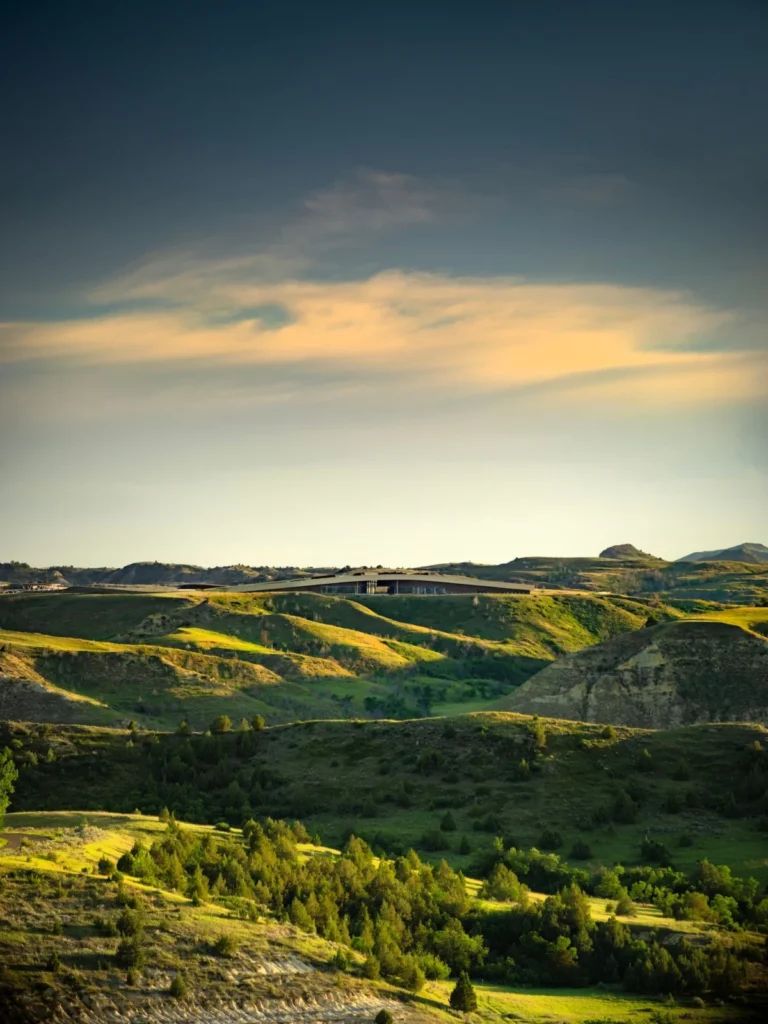

The high plateaus and rugged buttes of Medora, North Dakota, are set to become the site of a landmark architectural and historical achievement with the upcoming opening of the Theodore Roosevelt Presidential Library. Scheduled to debut on July 4, the 96,000-square-foot facility represents a departure from traditional presidential monuments, opting instead for a design that prioritizes ecological integration and the conservation legacy of the 26th President of the United States. Designed by the internationally acclaimed architecture firm Snøhetta in collaboration with the local firm JLG Architects, the library is situated on the very landscape that Theodore Roosevelt credited with his political ascent and his deep-seated commitment to preserving the American wilderness.
The building is designed to be as dynamic as the nature surrounding it. As visitors ascend the butte above remote Medora, the library’s curved, grass-covered roof emerges slowly from the horizon, punctuated by the silhouettes of hikers walking atop its surface. This "living" roof, which reaches a peak height of 39 feet, is engineered to blend seamlessly into the contours of the Badlands, making the structure appear as an extension of the earth rather than an imposition upon it. The project serves as a multifaceted hub, housing a museum, an education center, and a comprehensive digital archive of Roosevelt’s life and presidency, all while functioning as a self-sustaining ecosystem.

A Legacy Born of Grief and Grasslands
The location of the library is not merely scenic; it is foundational to the narrative of Theodore Roosevelt’s life. In 1883, a 24-year-old Roosevelt first arrived in the Dakota Territory to hunt bison. However, it was a double tragedy in 1884—the deaths of his mother, Mittie, and his wife, Alice Hathaway Lee, on the same day—that drove him back to the rugged prairie to grieve and reinvent himself. During his years as a rancher at Elkhorn Ranch, Roosevelt developed the "strenuous life" philosophy and a profound appreciation for the fragility of the natural world.
Historians often note that without his time in North Dakota, Roosevelt’s presidency might have looked remarkably different. His firsthand experience with the overhunting of bison and the degradation of the grasslands informed his later actions as Commander in Chief. During his administration, Roosevelt established the United States Forest Service and signed the Antiquities Act of 1906. By the end of his term, he had protected approximately 230 million acres of public land, including 150 national forests, 51 federal bird reserves, four national game preserves, and five national parks.
Matthew McMahon, a director of landscape architecture at Snøhetta, emphasizes that this history dictated the library’s design. While many presidential libraries serve as static monuments to a man’s career, the Medora project treats the land as the primary exhibit. "In this case, the face of the building is the land," McMahon noted. "And that is directly tied to the conservation legacy of Roosevelt."

Architectural Innovation and the "Working Landscape"
The architectural philosophy behind the library focuses on "hiding" the building within the beauty of the surrounding environment. Craig Dykers, founding partner of Snøhetta, explains that the team viewed the structure as an extension of the world around it, intentionally blurring the lines between the built environment and the natural horizon. To achieve this, the firm utilized materials and techniques that minimize environmental impact while maximizing durability and thermal efficiency.
The building’s primary structure is composed of mass timber and low-carbon concrete. One of the most striking features is the use of rammed earth walls. These walls are constructed using locally sourced sediment mixed with custom pigments and a minimal amount of cement binder. Beyond their aesthetic appeal, which mirrors the stratified layers of the Badlands’ buttes, the rammed earth walls provide significant thermal mass. This helps buffer the extreme temperature swings common in the North Dakota climate, reducing the energy required for heating and cooling.
The library’s exterior is complemented by a one-mile undulating boardwalk that weaves through the grounds. This path features scenic overlooks, outdoor classrooms, and a suspended observation net. In an effort to restore the local ecology, the project includes the "Native Plant Project," an initiative that saw local volunteers collect seeds from the surrounding area. These were grown into 400,000 native seedlings by North Dakota State University and planted across the site.

Furthermore, the site is designed to be a "working landscape." In collaboration with Atelier Ten, an environmental design studio, the project team implemented strategies for adaptive management. This includes controlled burns and modified grazing by local livestock to replicate the historic impact of bison herds. These efforts are intended to turn the library site into a carbon sink, sequestering more carbon over its lifespan than was embodied in its construction.
Sustainability and Technical Specifications
The Theodore Roosevelt Presidential Library aims to set a new standard for institutional sustainability, targeting zero carbon emissions and zero waste. The facility is designed to be energy self-sufficient through a combination of on-site and off-site renewable energy sources.
Key technical components include:

- Geothermal Energy: A network of geothermal wells provides the primary source for heating and cooling.
- Solar Power: The building generates 25% of its required renewable energy via on-site solar panels, with the remaining 75% provided by a dedicated off-site solar array.
- Energy Recovery: A low-energy HVAC system is paired with radiant flooring and a central fireplace to maintain interior comfort efficiently.
- Water Conservation: The design utilizes existing National Park Service infrastructure to minimize the disruption of the local watershed and reduce the footprint of new utility lines.
The interior of the building is divided into several functional zones. Visitors will find a cafe, modern classrooms, and a digital archive designed to be accessible to researchers and the public alike. The galleries, designed by firms such as Local Projects and Dimensional Innovations, feature interactive and narrative exhibitions that explore Roosevelt’s curiosity, his ranch life, and his legislative achievements. A 300-seat auditorium features a large picture window behind the stage, ensuring that even during indoor presentations, the landscape remains the focal point.
A Timeline of Resilience
The journey to complete the library has been marked by both legislative milestones and natural challenges. The project gained significant momentum in 2019 when the North Dakota Legislative Assembly approved a $50 million endowment for the library, contingent on the foundation raising $100 million in private donations—a goal that was swiftly met.
In 2021, shortly after work on the site began, a wildfire swept through the area. While such events can be devastating, the project team viewed it as a formative moment. Michelle Delk, a partner and landscape architect at Snøhetta, recalled watching plants reemerge from the charred earth within weeks. "It was such a turning point in the conversation about how the project supports regenerating the landscape," she said. This event reinforced the decision to use fire as a management tool for the library’s grounds, acknowledging that fire is a natural and necessary part of the prairie ecosystem.

Regional Impact and Future Implications
The opening of the library is expected to have a profound impact on the region. Medora, already a popular destination due to its proximity to the Theodore Roosevelt National Park and the nightly Medora Musical, is braced for an influx of cultural tourism. Unlike traditional museums that require a ticketed entry to a physical building, the library grounds are open to those arriving by car, mountain bike, foot, or even horseback, with hitching posts provided for local riders.
By allowing the public to experience the rooftop boardwalk and the surrounding trails without necessarily entering the exhibit halls, the library functions more like a public park than a traditional archive. This "unprescriptive" path of experience is a deliberate nod to Roosevelt’s own belief that the outdoors should be accessible to all citizens.
As the 21st century progresses, the Theodore Roosevelt Presidential Library stands as a model for how architecture can respond to the climate crisis while honoring historical legacies. By integrating advanced sustainable technology with a deep respect for local ecology and history, the project ensures that Roosevelt’s conservation message remains relevant for the next hundred years. The library does not just tell the story of a man who loved the land; it attempts to become a part of that land, preserving the spirit of the "Rough Rider" in the very soil that shaped him.