
In March, the New York design community converged upon a trendy venue in the Lower East Side for an event that, at first glance, resembled a high-concept house party. Guests navigated a space where beer bottles were kept cold in an ice-filled bathtub and towers of pizza boxes were stacked with the intentionality of sculptural fixtures. However, the center of the room revealed the true purpose of the gathering: a dramatic installation of Panthella lamps. This celebration, hosted by the manufacturer Louis Poulsen and the design-focused Substack "For Scale," marked the 100th anniversary of the birth of Verner Panton, the late Danish designer whose work remains a cornerstone of mid-century and contemporary aesthetics.
The event was characterized by a meticulous attention to detail that mirrored Panton’s own obsession with total environments. Pizza boxes were custom-branded with the slogan “100 YEARS OF PANTON,” and the walls were illuminated by flashy, Panthella-centric graphics. At approximately 11:00 pm, a cake adorned with “100” candles was served to a crowd that included some of the most influential voices in modern interior design. Attendees departed with goody bags containing colorful sticker packs, poetic zines, and custom balloons bearing the phrase, “The Panthella is everything we love.”

This New York function was merely one node in a global network of festivities honoring Panton’s personal centennial. Throughout 2024, the design world has witnessed a resurgence of interest in Panton’s catalog, thrusting his legacy into a spotlight that has never been brighter. From Basel to Copenhagen, manufacturers and museums are collaborating to preserve and re-contextualize a body of work that was once considered too radical for the mainstream but has since proven to have enduring, cross-generational influence.
The Revolutionary Philosophy of Verner Panton
Verner Panton (1926–1998) was a provocateur in a field often defined by the understated elegance of Scandinavian modernism. While his contemporaries focused on the warmth of teak and the organic shapes of bentwood, Panton looked toward the future, experimenting with synthetic materials, vibrant color theories, and avant-garde geometries.
“Many of my father’s designs were far ahead of their time and represented something new and never before seen,” says Carin Panton Von Halem, Verner’s daughter. She currently helms Verner Panton Design AG, the family-founded enterprise that manages the exclusive rights to her father’s work. Her role involves a delicate balance: preserving the historical integrity of the designs while collaborating with manufacturers like Vitra, Louis Poulsen, &Tradition, Montana Furniture, and Verpan to execute "Panton originals" for a new era.

Stine Liv Buur, Vitra’s design classics manager, notes that Panton’s decision to move in a "totally different direction" is precisely why his work remains relevant. “When you have a talent for using new materials and inventing new typologies, there’s a great possibility that your designs will last,” she explains. Panton’s philosophy was rooted in the idea that color could influence psychology and that furniture should be more than just functional—it should be an experience.
The Technical Evolution of the Panton Chair
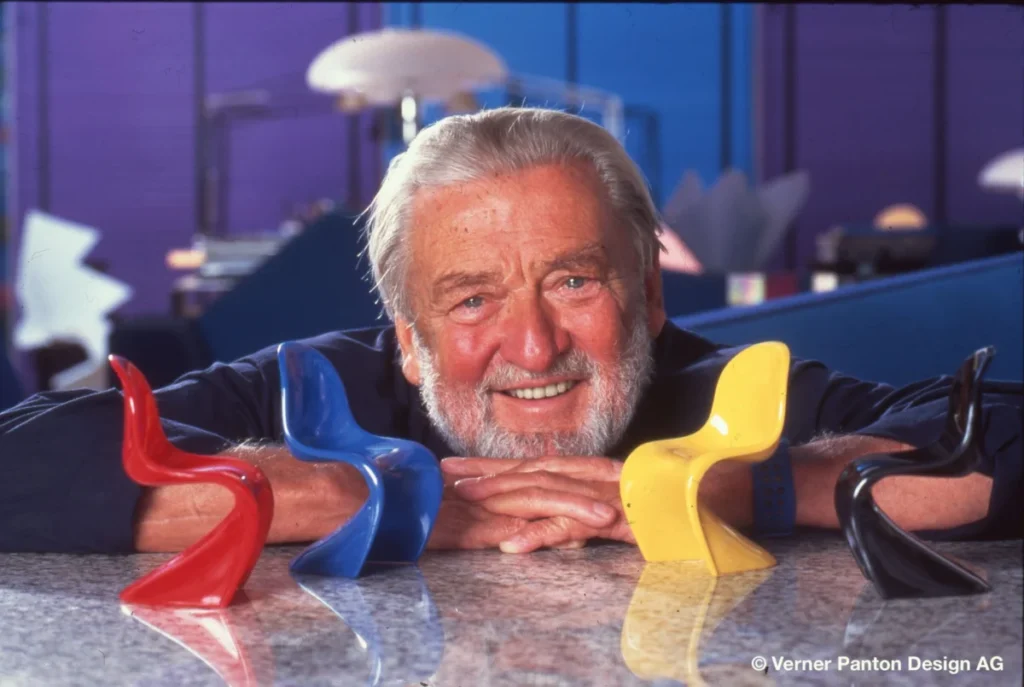
Perhaps no object better illustrates Panton’s tenacity than the Panton Chair. Conceived in 1958, the chair was the first of its kind: a cantilevered seat molded from a single piece of plastic. However, the technology of the late 1950s was not yet capable of realizing Panton’s vision. It took years of searching for a manufacturer willing to take the risk before Vitra took up the challenge in the early 1960s.
The production history of the Panton Chair is a timeline of chemical and industrial innovation:

- 1967 (Fiberglass): The first limited run of 150 pieces was produced in cold-molded, glass-fiber reinforced polyester. While aesthetically striking, the material was too brittle to support the silhouette’s structural demands over time.
- 1968 (Polyurethane Hard Foam): To increase durability, Vitra moved to polyurethane hard foam (Baydur). This version, known today as the "Panton Chair Classic," was sturdy but required labor-intensive finishing and painting.
- 1970s (Polystyrene): In an attempt to lower costs and reach a mass market, the chair was produced using injection-molded Luran S (thermoplastic polystyrene). However, this material was prone to fatigue and required reinforced seat supports, eventually leading Vitra to halt production for nearly a decade.
- 1999 (Polypropylene): Utilizing modern injection-molding technology, Vitra reintroduced the chair in polypropylene. This material provided the perfect balance of strength, flexibility, and colorfastness. It remains the standard for the contemporary Panton Chair.
Looking toward the future, Vitra has committed to integrating recycled polypropylene into the production process, ensuring the chair meets 21st-century environmental standards. In 2022, Liv Buur and Panton Von Halem further modernized the icon by releasing a dual-colored limited edition, reimagining the silhouette through color-blocked palettes that highlighted its sculptural curves.
Lighting the Future: Panthella and Flowerpot
While his seating redefined silhouettes, Panton’s contributions to lighting changed the way interiors were illuminated. The Panthella lamp, designed in 1971 and manufactured exclusively by Louis Poulsen, remains one of his most beloved works. Featuring a mushroom-like shade and a descending tulip base, the lamp was designed to reflect light off both its hemispherical shade and its trumpet-shaped stand.
Monique Faber, Louis Poulsen’s chief design officer, describes the lamp’s proportions as “perfection that was met back then.” To keep the design fresh for modern consumers, the brand has introduced variations in scale—shrinking the original 400mm and 500mm shades to create mini and portable versions. The 160mm cordless, dimmable version, launched in 2019, addresses the contemporary need for flexible, cable-free living.

Crucially, Louis Poulsen has focused on sustainability by ensuring these smaller models are repairable. “There are a lot of portable lamps on the market that people don’t know what to do with when they stop functioning because they can’t be repaired,” Faber says. By updating the mini designs with replaceable LED bulbs and batteries, the brand aims to keep these fixtures out of landfills.
Similarly, the Flowerpot light, released in 1968 by &Tradition, has undergone a sustainable transformation. Originally a symbol of the "Flower Power" movement, today’s Flowerpot models are constructed without glue. This allows for full disassembly, repair, and recycling. Marie Honda, CEO of &Tradition, emphasizes that choosing an original piece is an investment in a legacy. “Reinterpretations, such as new colors or functional updates, keep demand high, extending its lifespan without compromising the essence,” Honda notes.
Modularity and Color: The Panton Wire System
Panton’s friendship with Peter J. Lassen, the founder of Montana Furniture, led to the production of the Panton Wire shelving system. Conceived as a transparent, modular unit, the system consists of thin steel rods molded into interlockable cubes. The design allows the contents of the shelves to be visible from all angles, blurring the line between storage and display.

Joakim Lassen, the current managing director of Montana, recalls how Panton’s vibrant use of color stood out in a grey-toned era. Today, the Panton Wire system is more popular than ever, with approximately 60,000 units sold annually. To celebrate the centennial, Montana has expanded the color palette to include cobalt blue, pine green, rosehip, and a forthcoming tangerine hue.
The success of the Panton Wire system highlights a broader trend in interior design: the move away from "safe" neutrals toward "dopamine decor"—spaces filled with color and objects that spark joy. Panton, who famously said, "Most people spend their lives living in dreary, grey-beige conformity," would likely have viewed this shift as a long-overdue victory.
The Business of Legacy and Sustainability
The management of Panton’s work involves a complex interplay between historical preservation and modern manufacturing. Design houses are increasingly using these heritage pieces as platforms for environmental innovation. Herman Miller’s recent revival of the Eames Molded Plastic Dining Chair using 99% recycled plastic is a parallel example of this industry-wide shift.

Louis Poulsen now makes its annual sustainability reports public, focusing on research and development to extend product life cycles. By moving away from disposable components and toward modular, repairable parts, these companies are ensuring that Panton’s designs are as ecologically responsible as they are aesthetically groundbreaking.
Upcoming Centennial Milestones
As the centennial year progresses, the celebration of Verner Panton will move into its next phase with several high-profile international events.
- The Vitra Design Museum: A new exhibition is scheduled to open this month, offering a deep dive into Panton’s archival sketches and unrealized prototypes.
- Three Days of Design (Copenhagen): Denmark’s premier design festival will feature multiple installations dedicated to Panton’s influence on the Danish "Golden Age" and beyond.
- International Showcases: Events in Stockholm, Milan, and Paris are expected to showcase limited-edition reissues of Panton’s more obscure furniture, such as the Pantonova outdoor sofa and various textile designs.
Carin Panton Von Halem reveals that her father, despite his maximalist output, was a man who preferred to stay in the background. “He liked to be a bit in the background, which you maybe don’t expect when you see his work,” she says. “Of course, he also would have been very happy, honored, and proud.”

The enduring appeal of Verner Panton at 100 lies in his refusal to accept the world as it was. His work remains relevant not just because of its iconic shapes, but because it represents a spirit of fearless experimentation. As modern design houses continue to innovate within his framework—introducing sustainable materials and smart technologies—Panton’s vision of a more colorful, more imaginative world continues to illuminate the way forward. For collectors and enthusiasts, his centennial is a reminder that while materials may change, true innovation never goes out of style.