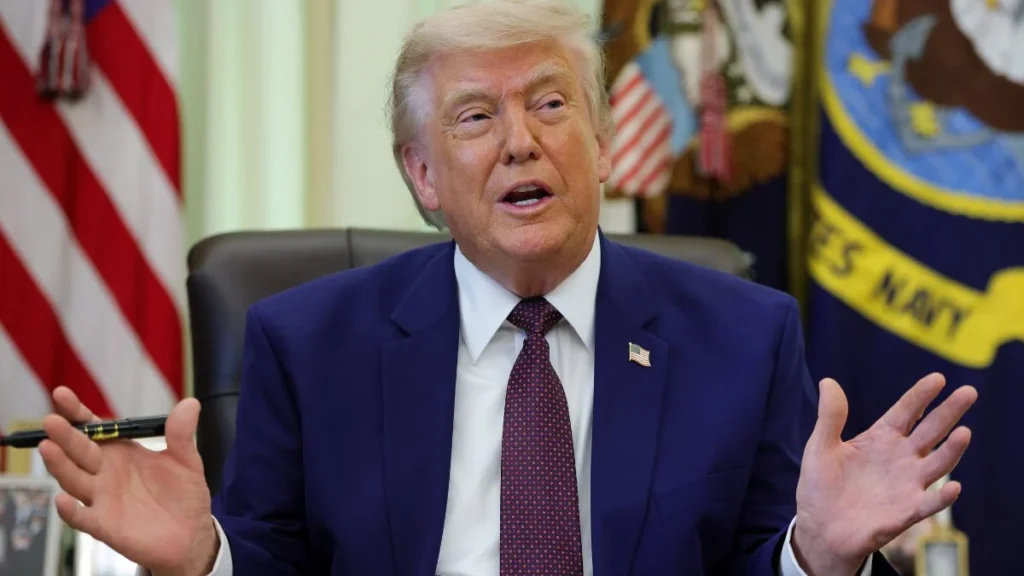

The physical health and appearance of high-profile political figures have long been subjects of intense public scrutiny, and a recent media appearance by former President Donald Trump has reignited this discourse. During an interview on the New York Post’s "Pod Force One" podcast, hosted by Miranda Devine, observers quickly pointed to a visible physical anomaly: a significantly swollen right eye. The appearance, which took place in early June 2026, occurred just days after the former president had publicly touted the results of a physical examination and a cognitive test, which he claimed demonstrated "extreme intelligence" and "extremely good" health. As clips of the interview circulated across social media platforms, particularly X (formerly Twitter), the visual evidence of puffiness and inflammation led to a wave of speculation regarding his underlying medical condition and the transparency of his recent health disclosures.
Visual Observations and the Digital Firestorm
The interview on "Pod Force One" was intended to focus on the former president’s political views and his outlook on the current state of the nation. However, as soon as the video was released, the conversation shifted from policy to physiology. High-definition screen grabs and short video loops began trending, with users highlighting the noticeable asymmetry in his facial features. The right eye appeared significantly more recessed and surrounded by puffy, inflamed tissue compared to the left.
The reaction on social media was swift and divided. Supporters and critics alike weighed in on the footage. One user on X, Lucas Sanders, posted a clip with the caption, "Look – Donald Trump’s right eye looks completely swollen during his latest podcast appearance! What could be the cause of it?" Another user, posting under the handle @docblock66, remarked, "Trump’s eyes are practically swollen shut. Picture of health they tell us," reflecting a skeptical stance toward the official health narratives being promoted by the Trump camp.
While some observers suggested the swelling could be the result of a common minor ailment—such as a stye, allergies, or a lack of sleep—others viewed it through a more critical political lens. In the modern era of 24-hour news and high-resolution digital media, even minor physical changes in a political leader can become focal points for debates regarding their fitness for office or the honesty of their medical staff.
A Chronology of Recent Health Disclosures
To understand the intensity of the reaction to the "Pod Force One" appearance, it is necessary to look at the timeline of events leading up to the interview. The former president has a long history of making bold claims regarding his physical and mental prowess, often using these claims as a rhetorical tool against his political opponents.
In late May 2026, just days before the podcast interview, Trump took to his Truth Social account to provide an update on his medical status. He informed his followers that he had undergone a physical examination and that the results were "extremely good." He did not release a full medical report from a physician at that time but instead offered a summary that emphasized his vitality and readiness for the rigors of public life.
On June 1, 2026, the rhetoric intensified when he shared details about a cognitive test he had reportedly taken. Trump claimed to have scored a perfect 30 out of 30 on the assessment, a score he described as being indicative of "extreme intelligence." He used the post to contrast himself with other U.S. Presidents, stating, "Unlike other U.S. Presidents, none of whom have ever taken an approved, high difficulty, Cognitive Test, I scored a perfect 30 out of 30."
Furthermore, he utilized the platform to criticize members of the Democratic Party, whom he referred to as "Dumocrats," asking if they were "surprised" by his performance. He asserted that such a score was "rare" and claimed he had achieved similar results "four times in a row." He concluded his post by demanding that high-ranking politicians be "forced" to undergo similar cognitive evaluations to ensure their mental fitness for service.
The contrast between these assertions of peak physical and mental condition and the visible swelling during the June 3rd interview created what many analysts describe as a "narrative disconnect." The puffiness observed by the public seemed to contradict the image of "perfect health" that had been projected just 48 hours earlier.
Supporting Data: Understanding the Cognitive and Physical Benchmarks
The "perfect 30 out of 30" score mentioned by the former president likely refers to the Montreal Cognitive Assessment (MoCA). The MoCA is a widely used screening tool designed to detect mild cognitive impairment and early signs of dementia. It assesses several domains, including:
- Visuospatial/Executive: Clock drawing and shape copying.
- Naming: Identifying animals.
- Memory: Delayed recall of a list of words.
- Attention: Repeating sequences of numbers.
- Language: Repeating complex sentences.
- Abstraction: Finding similarities between objects.
- Orientation: Stating the date, month, year, and city.
While a score of 30 is the maximum possible, medical professionals generally note that the test is a screening tool, not a measure of "extreme intelligence" or IQ. It is designed to confirm that an individual is within the normal range of cognitive functioning for their age group.
Regarding the physical observation of the swollen eye, medical experts (speaking generally and not specifically about the former president’s case) note that periorbital edema (swelling around the eye) in individuals over the age of 70 can be caused by various factors. These include:
- Blepharitis: Inflammation of the eyelids.
- Allergic Conjunctivitis: Reactions to environmental allergens.
- Fluid Retention: Often linked to diet, medication, or cardiovascular health.
- Trauma or Minor Infection: Such as a stye or a scratch.
- Fatigue: Extreme exhaustion can lead to temporary puffiness.
Without a formal statement from a medical professional, the cause of the swelling remains speculative, yet its presence during a high-stakes interview inevitably invites public inquiry.
Official Responses and Political Strategy
As of the days following the interview, the former president’s communications team has not released a specific medical explanation for the eye swelling. Historically, the Trump camp has favored a strategy of projecting strength and dismissing health-related inquiries as "fake news" or partisan attacks.
In past instances where physical anomalies were noted—such as a series of red marks on his hands in early 2024 or instances of perceived frailty on ramps—the official response was either silence or a redirection toward the perceived weaknesses of his opponents. By emphasizing his cognitive test scores and using aggressive language like "forced" testing for others, Trump effectively shifts the conversation from his own health to the health of the broader political establishment.
This strategy serves two purposes: it solidifies his base by portraying him as a victim of unfair media scrutiny and it creates a "strength-based" brand that is central to his political identity. However, the recurring nature of these health "mysteries" continues to provide fodder for political commentators who argue that all candidates for the highest office in the land should be subject to standardized, independent medical evaluations.
The Broader Impact and Implications of Health Optics
The incident highlights a growing trend in modern politics: the weaponization of health optics. In an era where every movement is captured on video and every blemish is magnified by social media, the physical "body language" of a candidate has become as important as their policy platform.
For a 79-year-old politician, the stakes are particularly high. The American electorate has shown increasing concern over the age of its leaders. When a candidate appears with a visible physical ailment, it triggers a broader conversation about aging, stamina, and the rigors of the presidency.
Moreover, the lack of standardized health reporting for presidential candidates creates a vacuum filled by social media speculation. While the former president claims "extreme intelligence" and "good health," the absence of a detailed, independent medical report allows for various interpretations of visual evidence like the swollen eye. This lack of transparency can lead to a decrease in public trust, as voters are left to decipher the truth from partisan social media posts and carefully curated interview appearances.
Analysis: The Intersection of Health and Public Perception
The "Pod Force One" interview serves as a case study in how physical appearance can overshadow political messaging. Despite the interview covering significant national issues, the "swollen eye" became the primary takeaway for a large segment of the digital audience. This suggests that for public figures, the "visual narrative" often carries more weight than the "verbal narrative."
If the swelling was indeed a minor issue—such as a seasonal allergy or a temporary reaction—the decision not to address it directly may have inadvertently fueled the very speculation the Trump team sought to avoid. In the absence of a simple explanation, the public often assumes the most complex or concerning possibility.
As the political cycle continues toward 2026 and beyond, the health of senior political figures will likely remain a dominant theme. The demand for transparency is clashing with the traditional desire for privacy and the strategic need to project "perfect" health. Until a more formal and independent system for evaluating the health of high-ranking officials is established, the public will continue to rely on "eye tests" and social media analysis to gauge the fitness of their leaders.
In conclusion, while Donald Trump’s recent appearance on "Pod Force One" was intended to reinforce his political standing, it instead became a flashpoint for health-related concerns. The juxtaposition of his boastful health claims on Truth Social with the visible swelling of his right eye underscores the ongoing tension between political stagecraft and biological reality. As the discussion continues on platforms like X, it serves as a reminder that in the modern political arena, everything—including a puffy eye—is a matter of national debate.