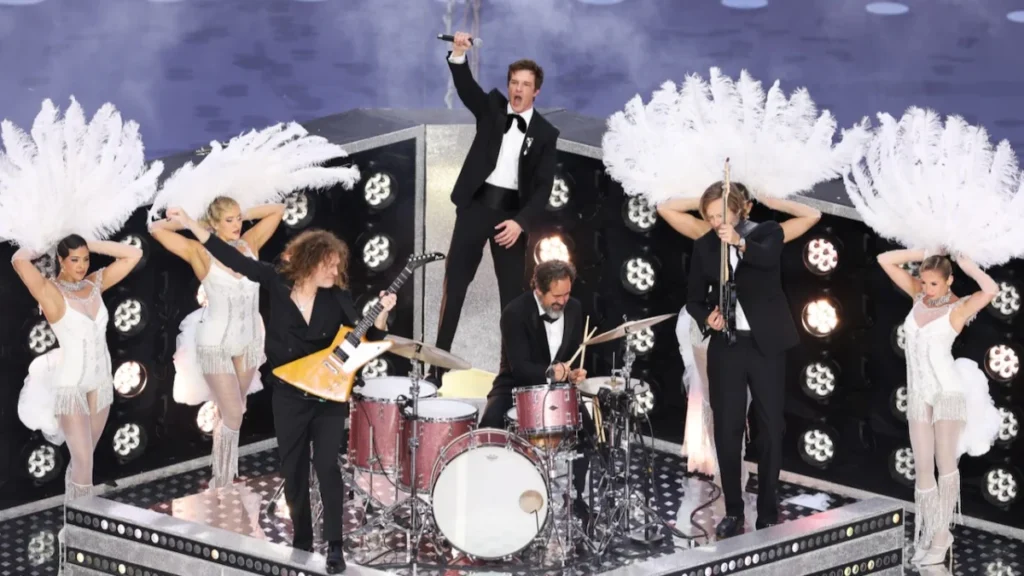

Las Vegas rock stalwarts The Killers electrified the UEFA Champions League Final on Saturday, delivering a dynamic, greatest hits-laden performance that set the stage for the highly anticipated match between Arsenal FC and Paris Saint-Germain in Budapest. The pre-game spectacle, a hallmark of major global sporting events, saw the quartet bring their signature brand of anthemic rock to a massive international audience, transforming the football pitch into a temporary concert arena.
The Spectacle Unfolds in Budapest
The performance, which served as the official opening ceremony for European club football’s most prestigious fixture, was meticulously choreographed to captivate both the live stadium audience and billions watching worldwide. Against the backdrop of Budapest’s state-of-the-art Puskás Aréna, The Killers, led by charismatic frontman Brandon Flowers, launched into a setlist designed to maximize impact and engagement. Their stage presence was amplified by a cadre of backing dancers, artfully styled as classic Las Vegas showgirls, a nod to the band’s Nevadan origins and their reputation for high-energy live shows. This visual element underscored the blend of sporting grandeur and entertainment spectacle that has become synonymous with events of this magnitude.
The decision to host the final in Budapest, a city renowned for its architectural beauty and vibrant cultural scene, further enhanced the event’s appeal. The Puskás Aréna, with its capacity exceeding 67,000, provided an ideal venue for both the sporting contest and the accompanying musical showcase. UEFA’s strategy in selecting host cities often considers not only the logistical capabilities but also the aesthetic and cultural resonance, aiming to create a memorable experience that transcends the game itself. The atmosphere in Budapest was palpable, with fans from both Arsenal and PSG converging on the Hungarian capital, contributing to an electric ambiance that The Killers harnessed for their performance.
A Setlist of Anthems
The band’s selection of songs was a deliberate choice to deliver maximum impact within the condensed timeframe of a pre-match show. They showcased four of their most iconic tracks, each a testament to their two-decade-long career of crafting stadium-filling anthems:
- "When You Were Young": A powerful track from their 2006 album Sam’s Town, known for its soaring chorus and driving guitar riffs. It quickly became a fan favorite and a staple of their live performances, perfectly suited for an energetic opening.
- "Human": Released in 2008 from Day & Age, this synth-pop infused track with its philosophical lyrics and infectious beat proved to be a global hit, demonstrating the band’s versatility and appeal across different musical landscapes.
- "All These Things That I’ve Done": From their debut album Hot Fuss (2004), this song features one of their most recognizable refrains – "I’ve got soul, but I’m not a soldier" – which has become a rallying cry for fans and often elicits enthusiastic sing-alongs.
- "Mr. Brightside": Arguably their most famous song, also from Hot Fuss, "Mr. Brightside" is an enduring rock anthem that has achieved an almost mythical status, particularly in the UK where it holds records for chart longevity. Its raw emotionality and explosive chorus make it an unparalleled closer for any high-stakes performance, guaranteed to leave an indelible impression.
Each song was delivered with The Killers’ characteristic blend of rock gravitas and pop sensibility, amplified by the state-of-the-art sound and lighting systems installed for the event. The choice of these particular tracks underscored UEFA’s desire to feature universally recognized music that would resonate with a diverse global audience, regardless of their familiarity with The Killers’ broader discography.
The Killers’ Enduring Legacy
Formed in Las Vegas in 2001, The Killers have consistently proven their prowess as one of the most successful rock bands of the 21st century. Comprising Brandon Flowers (lead vocals, keyboards), Dave Keuning (guitar, backing vocals), Mark Stoermer (bass, backing vocals), and Ronnie Vannucci Jr. (drums, percussion), the band rose to international fame with their debut album, Hot Fuss, in 2004. Their sound, a blend of new wave, post-punk revival, and heartland rock, has earned them numerous accolades, including multiple Grammy nominations and BRIT Awards.
Their performance at the UEFA Champions League Final is not their first foray into high-profile sporting events. The band has a history of headlining major festivals and performing at significant cultural moments, demonstrating their broad appeal and ability to command large stages. Their discography, spanning several studio albums like Sam’s Town, Day & Age, Battle Born, and Wonderful Wonderful, showcases a consistent ability to produce critically acclaimed and commercially successful music. Their connection to Las Vegas, often a theme in their music and visual presentation, adds a unique theatrical flair to their performances, which was evident in the showgirl-themed backing dancers. This performance further cemented their status as a band capable of delivering electrifying entertainment on the grandest global platforms.
The Intersection of Music and Sport
The integration of world-class musical acts into major sporting events like the UEFA Champions League Final has become an established tradition, transforming these contests into comprehensive entertainment spectacles. This trend reflects a strategic effort by sports organizations to broaden their appeal beyond traditional fan bases, attracting casual viewers who might tune in for the pre-match show as much as for the game itself. The synergy between music and sport enhances the overall fan experience, building excitement and creating memorable moments that extend beyond the athletic competition.
UEFA, much like the NFL with its Super Bowl halftime show, understands the power of these cultural crossovers. By featuring globally recognized artists, they tap into existing fan bases and generate significant social media buzz, driving viewership figures and increasing brand engagement. For the artists, these platforms offer unparalleled exposure to billions of viewers across different demographics and geographical regions, serving as a powerful promotional tool for their music and tours. The choice of The Killers, a band with a robust international following and a reputation for energetic live performances, aligns perfectly with this strategy. Their anthemic songs naturally lend themselves to the electric atmosphere of a major final, helping to build anticipation and create a carnival-like mood before kick-off.
Global Viewership and Engagement
The UEFA Champions League Final consistently ranks among the most-watched annual sporting events globally. Previous finals have drawn estimated television audiences upwards of 350-400 million viewers, with digital streaming adding significantly to these numbers. The inclusion of a performance by an act like The Killers is calculated to boost these figures even further, particularly among demographics who might not be primary football fans but are drawn to the musical talent.
Social media engagement surrounding such performances is also immense. Hashtags related to the band, the event, and specific songs performed trend globally, creating a ripple effect that amplifies the event’s reach. Discussions range from the quality of the performance to the choice of songs, the visuals, and the overall spectacle. This digital conversation not only provides immediate feedback but also generates invaluable marketing data for both UEFA and the performing artists, offering insights into audience preferences and engagement patterns. The "Watch" element in the article’s title itself points to the modern expectation of immediate, shareable content, reinforcing the role of digital platforms in amplifying live events.
Looking Ahead: The World Cup Connection
The UEFA Champions League Final serves as a significant precursor to another monumental global sporting event: the FIFA World Cup. As noted in the original report, the World Cup officially kicks off on June 11th, a mere few weeks after the Champions League Final. This proximity highlights a busy period for international football and associated entertainment.
The World Cup, with its even broader global reach and longer duration, is known for its elaborate opening and closing ceremonies, as well as performances throughout the tournament. Past World Cups have featured a diverse array of musical superstars, from Shakira and Ricky Martin to Pitbull and Jennifer Lopez, and more recently, artists like BTS and Madonna have been linked to potential future performances. This continuous stream of high-caliber musical talent underscores a broader trend in global sports: the intertwining of athletic competition with cultural celebration. The success of The Killers’ performance at the Champions League Final likely reinforces the precedent for booking major acts for these tournaments, ensuring that the entertainment value remains on par with the athletic drama. The anticipation for the World Cup, already immense, is further stoked by these pre-tournament spectacles, setting a high bar for the celebrations to come.
Implications and Future Trends
The successful execution of The Killers’ performance at the UEFA Champions League Final carries several implications for the future of sports entertainment. It solidifies the model where global sporting events are treated as comprehensive entertainment packages, offering something for everyone. This approach is crucial in an increasingly competitive media landscape where attracting and retaining audience attention requires multifaceted engagement strategies.
For artists, securing a slot at events like the Champions League Final or the World Cup offers a unique career boost, providing exposure that traditional marketing campaigns simply cannot replicate. It allows them to present their work to an unprecedented number of casual listeners, potentially converting them into new fans or re-engaging existing ones. For sports organizations, these performances are vital for brand building, demonstrating their commitment to delivering world-class experiences both on and off the field.
Looking forward, one can anticipate an even greater emphasis on technological integration in these performances, potentially incorporating augmented reality, interactive elements, or more sophisticated visual storytelling. The standard has been set high by acts like The Killers, who successfully merged their distinct rock identity with the pomp and circumstance of a global sporting final. As the line between sport and entertainment continues to blur, these pre-match and halftime shows will only grow in significance, becoming integral components of the overall event narrative and a vital part of their enduring legacy. The Killers’ performance in Budapest was not just a concert; it was a testament to the evolving nature of global spectacles, where music and sport converge to create unforgettable moments.