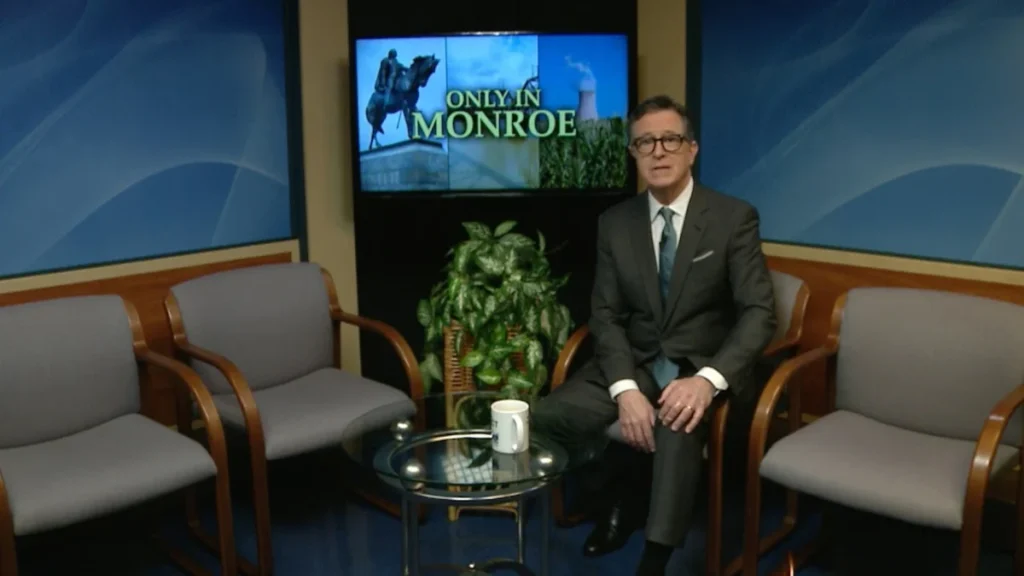

Barely 23 hours after concluding his celebrated 11-year tenure as host of The Late Show, Stephen Colbert made an immediate and unexpected return to the airwaves, not on a major network, but on the decidedly more grassroots platform of public access television in Monroe, Michigan. The surprise appearance, which aired on Friday night, May 22nd, 2026, saw the veteran comedian guest-hosting Only in Monroe, a regularly featured segment on Monroe Community Media, delivering an hour of unadulterated, star-studded local entertainment that served as both a comedic capstone to his network run and a pointed commentary on the evolving media landscape.
A Swift, Symbolic Return to the Airwaves
Colbert’s rapid reappearance was a deliberate and symbolic act, eschewing the traditional post-finale hiatus often taken by departing late-night hosts. His choice of venue, Monroe Community Media, was not arbitrary; a true Colbert historian would recall his previous hosting stint on Only in Monroe way back in 2015. That earlier appearance had similarly garnered national attention, then seen as a playful nod to his roots and a brief respite from the pressures of mainstream media. His return in 2026 carried far greater weight, coming on the heels of a significant professional transition marked by corporate upheaval.
The comedian’s opening remarks immediately set the tone for the evening, laced with his characteristic blend of humor and biting social commentary. “I am grateful to be able to be here on Monroe Community Media before they also get acquired by Paramount,” Colbert quipped, a direct jab at the media consolidation trends that reportedly led to the cancellation of The Late Show. This statement underscored the pervasive influence of corporate giants in the entertainment industry and highlighted the vulnerability even of community-based platforms to such economic forces.
The Curtain Falls on "The Late Show"
Colbert’s departure from The Late Show, which concluded its run on Thursday, May 21st, 2026, after an impressive 11-year run, sent ripples through the late-night television world. The finale itself was a star-studded affair, reportedly crafted as an allegory for the importance of diverse television programming and a subtle critique against the encroaching monoculture in media. The announcement of the show’s ending had come nearly a year prior, in July 2025, when CBS News cited "financial concerns" as the primary reason for ceasing production of the long-running series.
These "financial concerns" are part of a broader narrative of challenges facing traditional broadcast television in the mid-2020s. Declining linear TV viewership, driven by the proliferation of streaming services and on-demand content, has significantly impacted advertising revenues for networks. Late-night, once a reliable staple, has found itself in an increasingly competitive and fragmented landscape, with audiences migrating to digital platforms for entertainment and news. The high production costs associated with major network talk shows, including the host’s salary, house band, extensive staff, and elaborate sets, have made them prime targets for cost-cutting measures by media conglomerates.
Corporate Pressures and Political Undercurrents
Beyond the general economic pressures, reports within the industry pointed to more specific, complex corporate maneuvers at play. The potential acquisition of Warner Bros. by Paramount Global was a significant factor, with widespread unconfirmed reports suggesting that the approval of this merger was intricately linked to political considerations. Specifically, it was rumored that former President Donald Trump held considerable influence over regulatory decisions that could greenlight or scuttle such a massive media consolidation. This political dimension added a layer of intrigue and tension to the "financial concerns" narrative, implying that the decision to end The Late Show might have been influenced by broader strategic corporate realignments rather than solely the show’s individual performance. Such a scenario would represent a chilling example of how external political and corporate interests can directly impact creative output and journalistic platforms within major media organizations.
Colbert, known for his sharp political satire and often critical stance against various administrations, including Trump’s, had become a prominent voice in the late-night landscape. His departure, therefore, was not merely a programming change but was interpreted by many as a potential consequence of a shifting media power structure, where journalistic independence and critical commentary could be seen as liabilities in an era of consolidation and political influence.
Colbert’s Farewell Statements and Gestures
In the weeks leading up to The Late Show‘s final episode, Colbert had already begun to articulate his frustration and defiance through various public gestures. In a memorable segment that quickly went viral, he was seen on the roof of the historic Ed Sullivan Building, the long-time home of The Late Show, tossing furniture off with his predecessor, David Letterman. This act, both comedic and cathartic, symbolized a literal throwing off of the trappings and burdens of network television. Furthermore, in a moment that resonated deeply with his audience, Colbert pointedly reminded his CBS executives that he "no longer has any fucks to give," a stark and unfiltered declaration of his artistic liberation from corporate constraints. These actions underscored a desire to break free from the system that had both elevated him and ultimately, in his view, stifled him.
An All-Star Public Access Extravaganza
The Monroe public access special was not merely a solo act; Colbert leveraged his extensive network to recruit an impressive lineup of celebrity guests, transforming the local broadcast into an unexpected all-star event. Each guest’s contribution was carefully crafted to fit the quirky, often improvisational spirit of public access television, while also carrying subtle meta-commentary on mainstream media.
Michigan’s Own and Hollywood Heavyweights Converge
Michigan native and rock icon Jack White delivered a masterclass in deadpan humor, serving as the episode’s resident DJ. His stoic demeanor, juxtaposed against the low-fi charm of public access, created a unique comedic dynamic, with White spinning records and offering minimal, yet perfectly timed, commentary. His presence, deeply rooted in Michigan’s vibrant music scene, further solidified the local authenticity of the broadcast.
Hollywood veteran Steve Buscemi brought his distinctive intensity to a promotional spot for "Buscemi’s Pizza." The segment, likely a parody of local business advertisements, capitalized on Buscemi’s unique acting style to create a memorably absurd piece of local marketing.
Another beloved Michigan native, actor Jeff Daniels, made an appearance to teach viewers how to make his now-famous "signature zany sandwich." This segment was a direct callback to an earlier, much-discussed appearance on The Late Show, where Daniels first revealed the eccentric culinary creation. Its reappearance on public access served as a clever meta-reference, blurring the lines between high-profile network television and community broadcasting, and demonstrating how a unique cultural artifact could find new life in an unexpected venue.
The Catharsis of Destruction: Eminem and the Set
Perhaps the most climactic and symbolically charged guest spot was reserved for legendary rapper Eminem, who appeared in the guise of a local "fire marshal." In a twist fitting the anarchic spirit of the episode and Colbert’s own recent frustrations, Eminem, rather than promoting fire safety, instructed the entire cast to systematically obliterate the set in the episode’s grand finale.
Colbert himself spearheaded the destruction, articulating the underlying catharsis: "Since they are no longer using this set, it would actually be helpful for me to destroy it," he declared, wielding a tool with relish. He continued, "Which is pretty great news, because right now, for no particular reason, I would very much like to break something." This statement, delivered with a mix of genuine frustration and comedic timing, perfectly encapsulated his sentiments regarding the end of The Late Show. The physical demolition of the public access set became a powerful metaphor for his own desire to tear down the remnants of his network experience, a visceral act of liberation from the pressures and perceived injustices of the corporate media world. Eminem’s involvement, as a figure synonymous with raw, rebellious energy and Detroit’s working-class grit, amplified the segment’s impact, grounding the symbolic act in Michigan’s defiant spirit.
Celebrating Local Spirit and Authentic Connections
Amidst the celebrity cameos and symbolic destruction, Colbert also dedicated significant airtime to genuinely local Monroe-based coverage, underscoring the authentic mission of public access television. He reported on local news stories that, while perhaps mundane by network standards, are the lifeblood of community media: a local hunter processing a deer, and the grand opening of a new dance studio. These segments served as a stark contrast to the high-stakes political and cultural discussions that often dominated The Late Show, reminding viewers of the simple, relatable narratives that bind communities together.
A Toast to Resilience and Community
The heart of the local segment, however, was Colbert’s interaction with Only in Monroe‘s actual hosts, Michelle Baumann and Kaye Lani Rafko-Wilson. The trio engaged in a celebratory toast, sucking down "spirit shots" from the nearby River Raisin Distillery, chased with helium, in celebration of Baumann’s cancer being in remission. This deeply personal and profoundly human moment offered a poignant counterpoint to the corporate machinations and celebrity spectacle. It was a genuine celebration of life, resilience, and community support, highlighting the vital, often unseen, role that local media plays in connecting people and sharing their most intimate stories. This segment powerfully reinforced Colbert’s earlier message and the article’s broader implication: that local journalism, in its purest, most unvarnished form, matters immensely, fostering connections and celebrating the triumphs and tribulations of everyday life in a way that national networks often cannot.
A Statement on the State of Media
Colbert’s decision to return to public access immediately after his network show’s cancellation was more than a comedic stunt; it was a profound artistic and political statement. It served as a critique of media consolidation, a protest against the "monoculture" of corporate-controlled entertainment, and an affirmation of the enduring value of independent, community-based media.
The Anti-Monoculture Manifesto
By choosing Monroe Community Media, Colbert implicitly championed the diversity of voices and formats that public access television represents. In an era where media consumption is increasingly funneled through a handful of giant corporations, leading to a homogenization of content and perspectives, Only in Monroe became a temporary bastion of creative freedom. His sarcastic remark about Paramount acquiring local media was not just a joke; it was an alarm bell, warning against the erosion of distinct local identities and independent platforms under the weight of corporate expansion. The entire hour-long broadcast functioned as an "anti-monoculture manifesto," demonstrating that compelling, entertaining, and even star-studded content can thrive outside the confines of big media budgets and restrictive corporate oversight.
The Future of Late-Night and Alternative Platforms
The event also sparked wider conversations about the future of late-night television and the potential for alternative platforms. As traditional network models continue to face economic headwinds and shifting audience habits, artists like Colbert may increasingly seek out unconventional venues for their creative expression. Public access, streaming platforms, podcasts, and other digital formats offer a degree of autonomy and creative control that is often lacking in traditional network television. Colbert’s move could inspire other established talents to explore similar avenues, potentially revitalizing community media and demonstrating new models for independent content creation. It also highlighted the inherent value of local news and community storytelling, often overlooked in the national media discourse, yet essential for the fabric of democratic society.
Conclusion: The Unfiltered Return
Stephen Colbert’s hour on Only in Monroe was far more than a simple guest appearance; it was a richly layered event that blended high-profile celebrity with grassroots community spirit, sharp political commentary with heartfelt human connection, and symbolic rebellion with genuine affection for local life. It underscored the comedian’s enduring commitment to authentic expression, even as he navigated the tumultuous waters of a changing media landscape. His swift, unfiltered return to public access television, following the corporate-driven end of his network show, cemented his status as a unique voice in entertainment, one willing to challenge the status quo and remind us all of where true community and creativity can still be found.
The full episode, "Only In Monroe — May 22, 2026," remains available for viewing, serving as a testament to this remarkable and unconventional chapter in Stephen Colbert’s career. Welcome back, Stephen, if only for one more hour, to the airwaves that truly matter.