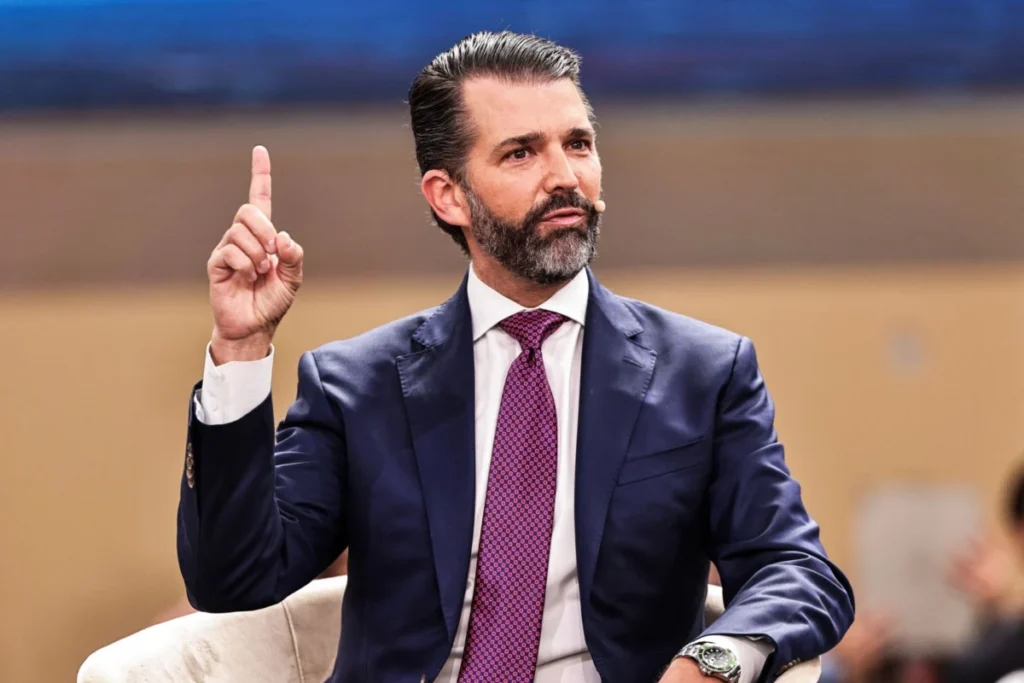

Renowned rapper Curtis "50 Cent" Jackson is reportedly slated to headline an exclusive event at the Executive Branch, a private Washington D.C. club co-owned by Donald Trump Jr., on July 3rd. The performance is positioned as a celebration on the eve of the United States’ 250th anniversary, a significant national milestone. This development, first reported by The Daily Beast, marks a notable shift in 50 Cent’s public stance regarding political engagements, particularly those associated with the Trump family, following a period where he explicitly expressed reluctance to intertwine his career with politics.
The Executive Branch Club: An Exclusive Washington D.C. Enclave
The Executive Branch club, situated in Washington D.C., has garnered attention for its high-profile ownership and clientele. Co-owned by Donald Trump Jr., the eldest son of former President Donald Trump, the venue is described as an exclusive establishment catering to a specific demographic. Reports indicate that membership to this elite club commands a substantial annual fee, reportedly around $500,000. Such a steep price point immediately signals an intent to attract ultra-high-net-worth individuals, political power brokers, and influential figures within conservative and Republican circles. The club’s very name, "Executive Branch," subtly underscores its political leanings and aspirations to be a hub for those connected to or aspiring to influence governmental affairs.
The club’s location in Georgetown, a historic and affluent neighborhood in D.C., further solidifies its image as a nexus for the city’s elite. Private clubs in the nation’s capital have historically served as informal meeting grounds for politicians, lobbyists, and business leaders, facilitating networking and discussions outside the formal channels of government. The Executive Branch appears to be positioning itself within this tradition, but with a distinctly partisan flavor. Its existence and the nature of its events reflect a broader trend of politically aligned social venues emerging to cater to specific ideological groups, fostering community and influence among their members. The substantial membership fee is not merely for access to a venue but for entry into a curated social and professional network.
50 Cent’s Evolving Political Stance: A Timeline of Engagements and Retractions
The reported performance by 50 Cent at Donald Trump Jr.’s club represents a complex chapter in the rapper’s intermittent engagement with the political sphere, characterized by both endorsements and explicit withdrawals of support. His political leanings have often appeared fluid, driven by a mix of personal conviction, financial considerations, and an evident apprehension about the potential professional repercussions of taking a firm political stance.
2020 Presidential Election:
50 Cent first made significant headlines for his political commentary during the lead-up to the 2020 U.S. presidential election. In October 2020, he publicly expressed support for then-President Donald Trump. This endorsement was notably driven by his concerns over the tax policies proposed by Democratic candidate Joe Biden. Specifically, 50 Cent reacted to reports about Biden’s tax plan, which suggested higher taxes for high-income earners in states like New York and New Jersey. On Instagram, he posted a screenshot of a news graphic detailing these tax rates, adding the caption, "WHAT THE F! (VOTE for TRUMP) IM OUT, F NEW YORK The KNICKS never win anyway. I don’t care Trump doesn’t like black people 62% of you would have to be working for free." This statement, while controversial, clearly indicated a financial motivation behind his initial leanings.
However, this endorsement was short-lived. Following public criticism, including from his former girlfriend Chelsea Handler, who offered to pay his taxes if he reconsidered, 50 Cent quickly retracted his support. Just days after his initial post, he again took to Instagram, stating, "F*** Donald Trump, I never liked him." He attributed his change of heart to Handler’s comments and the broader backlash, humorously suggesting he didn’t want to be "on the wrong side of history." This rapid reversal highlighted his sensitivity to public perception and the potential impact of political alignment on his brand.
2024 Political Landscape and Declining Offers:
Fast forward to 2024, and 50 Cent’s rhetoric regarding political involvement seemed to harden into a more cautious approach. During an interview on "The Breakfast Club," a prominent radio show, he revealed that he had turned down a substantial offer of $3 million to perform at a rally for then-President Donald Trump. He also disclosed that he had declined an invitation to perform at the Republican National Convention in the same year.
His reasoning at the time was explicit: he expressed being "afraid" of politics, articulating a belief that political affiliations could negatively affect a rapper’s career. This sentiment resonated with many artists who navigate the complex landscape of public opinion, where taking a definitive political side can alienate significant portions of their fanbase or lead to boycotts and professional ostracization. His statements in 2024 projected an image of an artist prioritizing his career longevity and broad appeal over partisan engagement.
The Apparent "About-Face" in 2026:
Given this documented history—an initial financially motivated endorsement followed by a swift retraction, and then a firm public declaration against political performance gigs due to career concerns—the reported decision by 50 Cent to headline an event at Donald Trump Jr.’s exclusive club in 2026 appears to be a significant "about-face." While a private club performance might be differentiated from a public political rally, the venue’s explicit association with a prominent political family, and its role as a gathering place for politically aligned individuals, undeniably imbues the event with a political subtext. The performance’s timing, on the eve of the nation’s 250th anniversary, further amplifies its symbolic weight. This shift invites scrutiny into the potential motivations behind his reported acceptance of this particular gig.
Precedent: Other High-Profile Performers at Executive Branch
The Executive Branch club has previously hosted other notable figures from the music industry, establishing a pattern of attracting prominent artists to its exclusive events. According to The Daily Beast report, rappers Busta Rhymes, Ja Rule, and Timbaland have all reportedly performed at the Georgetown club. This history suggests that the club has a strategy of engaging well-known musical acts to enhance its allure and provide entertainment for its high-paying members.
The presence of these artists, particularly from the hip-hop genre, indicates an effort by the club to curate a diverse entertainment experience, potentially aiming to broaden its appeal beyond strictly political figures to include cultural influencers and those who appreciate high-caliber performances. For the artists, such gigs, while potentially carrying political undertones due to the venue’s ownership, are often lucrative private engagements that offer significant financial compensation without necessarily requiring a public endorsement of political figures or ideologies. This distinction between a private performance and a public political rally is often cited by artists and their representatives as a way to maintain professional neutrality while still engaging in paid opportunities. However, the optics of performing for a club so directly linked to a specific political faction remain a subject of public discourse and interpretation.
The Semiquincentennial Celebration: America’s 250th Anniversary
The timing of 50 Cent’s reported performance on July 3rd, 2026, is particularly significant as it precedes the United States’ 250th anniversary on July 4th, 2026. This milestone, often referred to as the Semiquincentennial, represents a profound moment of national reflection and celebration. The 250th anniversary marks a quarter-millennium since the signing of the Declaration of Independence, a pivotal event in American history that declared the nation’s independence from Great Britain.
National anniversaries, especially those of such magnitude, typically evoke widespread patriotism, historical retrospection, and discussions about national identity and future direction. Governments, cultural institutions, and private entities often organize elaborate celebrations, educational programs, and public events to commemorate these occasions. For a club like the Executive Branch, with its inherent political connections, hosting an event on the eve of this anniversary carries significant symbolic weight. It positions the club as a venue for celebrating American heritage and potentially for shaping narratives around what that heritage means in contemporary political discourse. The choice of a high-profile performer like 50 Cent for such an occasion could be seen as an attempt to lend cultural cachet and broad appeal to what might otherwise be perceived as a politically exclusive gathering.
Inferred Statements and Anticipated Reactions
Given the circumstances, various parties might offer specific perspectives or reactions, even if not yet officially released.
From 50 Cent’s Camp (Anticipated):
Representatives for 50 Cent would likely emphasize the purely professional nature of the engagement. A common defense in such situations is that the artist is performing for a fee at a private event, and the performance should not be interpreted as a political endorsement of the club’s owners or their political affiliations. They might state that "business is business," and that 50 Cent is an entertainer whose services are available to various clients, regardless of their political leanings. They might also stress that his previous statements regarding politics were about public political endorsements or rallies, and a private club performance falls into a different category. The focus would be on the contractual agreement and the separation of art from politics, or at least from explicit political advocacy.
From Executive Branch / Donald Trump Jr.’s Camp (Anticipated):
The club and its co-owner would likely frame the event as a celebration of American independence and a non-partisan gathering focused on entertainment and camaraderie. They might highlight the diversity of artists who have performed at the club, suggesting that it is a venue for all, regardless of political background. They could emphasize the festive atmosphere intended for the 250th anniversary eve, positioning it as a patriotic event rather than a political one. The selection of a prominent artist like 50 Cent could be touted as an effort to bring top-tier talent to their members and guests for a significant national holiday.
Public and Fan Reaction (Anticipated):
The public and 50 Cent’s fanbase are likely to have mixed reactions.
- Criticism: Some fans and political observers might criticize 50 Cent for what they perceive as hypocrisy, given his previous statements about being "afraid" of politics and declining Trump-related performance offers. They might argue that performing at a club owned by Donald Trump Jr. is, by association, a tacit endorsement or at least a significant compromise of his previously stated principles. This could lead to accusations of being financially motivated over ideologically consistent.
- Support/Neutrality: Others might defend 50 Cent, echoing the "business is business" argument, stating that artists have the right to accept lucrative private gigs. They might argue that a private performance is fundamentally different from campaigning or performing at a political rally. Some fans might simply not care about his political associations, focusing solely on his music and entertainment value.
- Media Scrutiny: Media outlets and political commentators will likely dissect the event, analyzing its implications for the intersection of celebrity, wealth, and politics, particularly in an election year (2024 has passed, but the lead up to 2026 will involve discussions about 2024 and 2028 elections).
Fact-Based Analysis of Implications
The reported performance carries several implications across the entertainment, political, and cultural landscapes.
For 50 Cent’s Brand and Career:
This performance could potentially solidify 50 Cent’s reputation as an artist willing to navigate politically charged environments for financial gain, while attempting to maintain an official stance of neutrality. It challenges his previous statements about avoiding politics to protect his career, suggesting that the nature of the engagement (private, high-paying) might be a key differentiator. It risks alienating segments of his fanbase who are staunchly anti-Trump or who expect artists to maintain a consistent political stance. Conversely, it might appeal to audiences who appreciate his perceived entrepreneurial spirit and willingness to transcend partisan lines for business opportunities. The long-term impact will depend on how he and his team manage the narrative surrounding the event.
For the Trump Brand and Executive Branch Club:
Hosting a globally recognized artist like 50 Cent provides significant cultural validation for the Executive Branch club and, by extension, for the Trump family’s post-presidency endeavors. It helps to project an image of a vibrant, appealing, and well-connected social hub, capable of attracting top-tier talent. This helps to normalize the presence of prominent cultural figures within their sphere, potentially softening their image among demographics that might otherwise be less receptive. It reinforces the idea that the Trump brand continues to wield considerable influence and appeal, even outside traditional political rallies.
Broader Political-Cultural Landscape:
The event underscores the increasing intertwining of celebrity, wealth, and politics in modern American society. High-profile private events, often away from public scrutiny, serve as critical spaces for networking, fundraising, and cultural exchange among political and economic elites. It highlights the nuanced ways in which artists engage with political figures – often through paid performances that are distinct from outright endorsements, yet still contribute to the public perception and branding of political entities. This blurring of lines challenges the traditional understanding of celebrity political engagement and reflects a landscape where financial incentives can heavily influence artists’ choices, regardless of their stated political apprehensions. The event also symbolizes the ongoing efforts by various political factions to leverage popular culture and celebrity appeal to strengthen their image and outreach, particularly around significant national events like the Semiquincentennial.
Conclusion
The reported engagement of 50 Cent to perform at Donald Trump Jr.’s Executive Branch club on the eve of the United States’ 250th anniversary is a development rich with implications. It casts a spotlight on the rapper’s evolving relationship with politics, the strategic positioning of exclusive political-social clubs, and the broader intersection of celebrity culture, wealth, and partisan affiliations. While the specifics of the performance, including any official statements from 50 Cent or the club, are yet to be fully detailed, the report from The Daily Beast has already sparked considerable discussion. This event, should it materialize as reported, will undoubtedly be analyzed for its symbolic significance, its financial underpinnings, and its potential impact on the careers and public perceptions of all involved, further blurring the lines between entertainment and the often-contentious world of American politics. Meanwhile, 50 Cent continues to diversify his professional portfolio, with other ventures including a reported role in the upcoming Street Fighter film, demonstrating his multifaceted career beyond music.