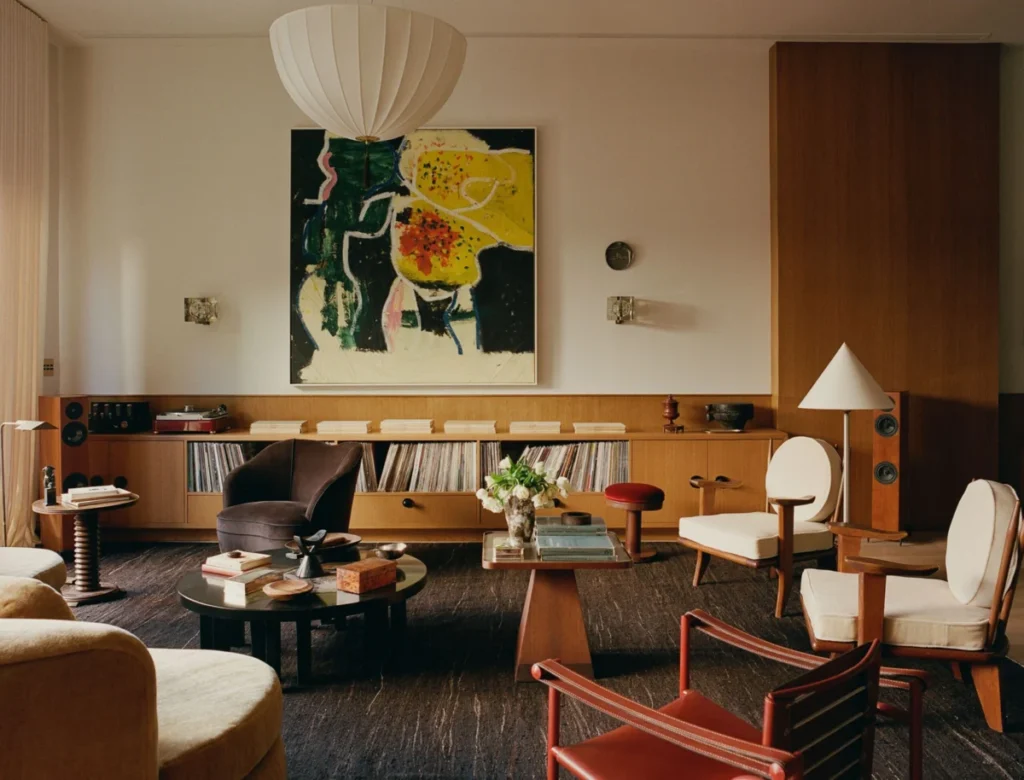

Somerset House, a boutique collectible design gallery situated in Queens, New York, has developed a reputation for a unique professional hazard: clients who arrive seeking a single piece of furniture often find themselves commissioning the firm to reimagine their entire living environment. This phenomenon recently played out in a 3,600-square-foot Brooklyn residence, where a couple, having outgrown the spatial limitations of a traditional historic brownstone, sought the expertise of gallery co-founders Alan Eckstein and Haley Loewenthal. What began as a casual inquiry into sourcing vintage pieces evolved into a comprehensive interior design collaboration that challenged the conventional aesthetics of the modern home.
The project highlights a growing trend in high-end residential design, where homeowners are increasingly moving away from the "minimalist playground" aesthetic that dominated the 2010s. Instead, there is a renewed emphasis on "lived-in luxury"—spaces that prioritize tactile warmth, historical layering, and functional durability without sacrificing visual sophistication.

A Departure from Conventional Minimalism
The homeowners, who maintain careers in the music and fashion industries, initially faced a common dilemma for residents of large, gut-renovated urban properties: the space offered an impressive footprint and natural light but lacked character. The property’s high ceilings and garden-facing vistas provided a solid foundation, but the sterile, "cookie-cutter" interiors required a significant intervention.
Alan Eckstein, whose background includes both music studies and a successful tenure in the fashion industry, established an immediate rapport with the clients. This connection proved vital during the design process. The project’s timeline spanned several months, beginning with initial consultations and culminating in a design scheme that is roughly 80 percent vintage. Approximately half of the furniture was sourced directly from the Somerset House inventory, reflecting a curated approach to interior curation that bridges various design eras.
"I did not want bare. I did not want cold," Eckstein noted during a retrospective of the project. His objective was to move away from the prevailing trend of stark, monochromatic interiors in favor of a narrative-driven design that feels personal and permanent.

The Architectural Intervention: Plywood Wainscoting
The defining feature of the renovation is the extensive use of oak plywood wainscoting, an unconventional choice that serves as the home’s primary source of texture. This design decision was inspired by the 1920s interiors of the town house of Marie-Laure and Charles de Noailles in Paris, designed by Jean-Michel Frank.
Implementing this design was a complex technical undertaking. The project required close collaboration with Studio BAD to ensure the woodwork, finished with rounded bullnose trim, was executed to a high standard. The process was not without its difficulties; the variability in wood staining meant that multiple iterations were required to achieve the desired tone. According to the homeowners, the six-month development phase for the wainscoting was the most challenging aspect of the project, yet it remains the element that provides the home with its essential character.
This choice underscores a broader shift in contemporary architecture: the return of wood cladding as a means to achieve warmth in modern spaces. While plywood is often viewed as a utilitarian material, its application here demonstrates how architectural detailing can elevate a raw material into a luxury finish when paired with refined craftsmanship.

Curation and Synthesis of Eras
The interior design of the residence functions as a dialogue between different historical periods. In the dining area, for instance, a 1950s Ico Parisi dining table is paired with Dutch oak chairs upholstered in mohair, anchored by 1930s copper "PH3" pendants by Poul Henningsen. These pendants, which had previously hung in a private residence for nearly nine decades, represent the intersection of historical preservation and modern utility.
To enhance the spatial flow, Somerset House incorporated a mirrored cabinet by Paolo Buffa. The reflective surface serves a dual purpose: it connects the open-plan room and broadens the visual perception of the space. This strategic use of mirrors and metallic accents is a hallmark of the firm’s design philosophy, which seeks to maximize light in urban environments.
The kitchen, meanwhile, saw a departure from the neutral palettes of the living areas. The cabinetry was painted in Farrow & Ball’s "Minster Green," a bold choice that the design team believes offers lasting appeal. The backsplash features handmade Cemento Collection zellige tiles, providing a handcrafted, organic contrast to the precision of the cabinetry.

Personalized Spaces: The Dressing Room and Guest Quarters
The project’s scope extended to highly personalized zones, most notably a dedicated dressing room. The clients’ initial vision for a monochromatic, "Prada-store" inspired space led to the selection of Benjamin Moore’s "Bluebelle." This room, which features a wall-to-wall Patterson Flynn "Miro" carpet and a 1930s Murano glass ceiling light by Napoleone Martinuzzi, is described by the owners as a "tonal fantasy."
The guest room, which doubles as a home office, represents the design team’s approach to multi-functional spaces. In a city where square footage is at a premium, the designers sought to avoid the "empty bed" syndrome by creating a room that feels intentionally designed for use. Dubbed the "red room" by the husband, the space utilizes color to create an atmosphere of luxury and warmth, drawing inspiration from mid-century smoking rooms.
Broader Impact and Industry Implications
The completion of this residence serves as a case study for the evolving expectations of affluent urban homeowners. The emphasis on "non-precious" luxury—where high-value antiques are treated as functional items capable of withstanding daily life—reflects a move toward sustainability and durability in interior design.

From a market perspective, the success of this project highlights the rising influence of collectible design galleries in the residential sector. By shifting from mere retailers of objects to providers of spatial design services, firms like Somerset House are capturing a segment of the market that prioritizes provenance, historical context, and bespoke architectural elements.
Data from the interior design sector suggests that projects incorporating custom woodwork and vintage, multi-era furnishings are seeing a marked increase in client satisfaction scores. This is largely due to the "curatorial" nature of the process, which allows homeowners to feel that their residence is a reflection of their personal history rather than a catalog-curated showroom.
Conclusion
The collaborative effort between the homeowners and Somerset House resulted in a residence that balances historical reverence with contemporary lifestyle requirements. By focusing on fundamental design principles—warmth, texture, and the thoughtful integration of disparate design eras—the project effectively proves that a "cookie-cutter" layout can be successfully transformed into a home with a unique, enduring narrative.

As the industry continues to move away from the ephemeral nature of fast-furniture trends, the focus on high-quality, long-lasting materials and curated, vintage-led interiors is likely to remain a dominant influence in the luxury residential market. For the homeowners, the project was more than a renovation; it was the creation of a home that remains, in their words, "gorgeous, considered, and immaculate, but not untouchable."