
Narrative Chronology and Thematic Development
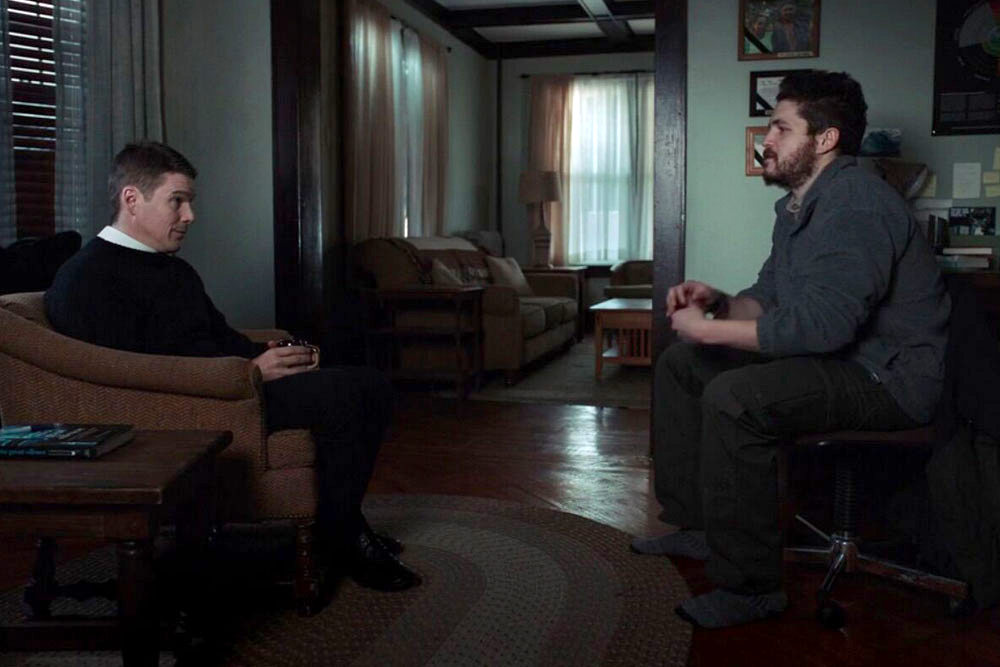
The story of First Reformed is structured as a slow-burn descent into radicalization and despair, framed through the private journals of Reverend Toller. The chronology begins with Toller’s decision to keep a diary for one year, an exercise intended to provide spiritual clarity but which ultimately documents his unraveling. His routine is disrupted when Mary (Amanda Seyfried), a pregnant parishioner, asks him to counsel her husband, Michael (Philip Ettinger). Michael is a radical environmentalist who has become paralyzed by the conviction that the Earth is on the brink of ecological collapse, leading him to question the morality of bringing a child into a dying world.
The pivotal moment in the film occurs when Toller discovers Michael’s suicide vest and subsequently finds Michael’s body in a local park after he takes his own life. This event acts as a catalyst, transferring Michael’s ecological anxieties onto Toller. As the Reverend prepares for the 250th-anniversary celebration of his church—an event funded by Edward Balq (Bill Raymond), a corporate mogul whose industries are primary polluters—Toller’s internal conflict intensifies. He finds himself increasingly at odds with his mentor, Pastor Joel Jeffers (Cedric Kyles), the leader of the affluent "Abundant Life" megachurch, who maintains a pragmatic and politically safe relationship with corporate interests.
In the final act, Toller’s physical health (implied to be stomach cancer) and spiritual health reach a breaking point. He plans a suicide bombing at the anniversary service, intending to use Michael’s vest to kill himself and the gathered dignitaries, including Balq. However, the sight of Mary entering the church forces him to abandon the plan. The film concludes with a jarring, ambiguous sequence in which Toller wraps himself in barbed wire and prepares to drink a corrosive cleaning fluid, only to be interrupted by Mary’s sudden appearance in his room, leading to a passionate, surreal embrace as the screen abruptly cuts to black.
Cinematic Style and Technical Execution
Paul Schrader employed a specific "Transcendental Style" for First Reformed, a technique he first theorized in his 1972 book of the same name. This style, influenced by filmmakers like Robert Bresson and Yasujirō Ozu, utilizes "slow cinema" elements to evoke a sense of the divine or the existential.
Visual Composition
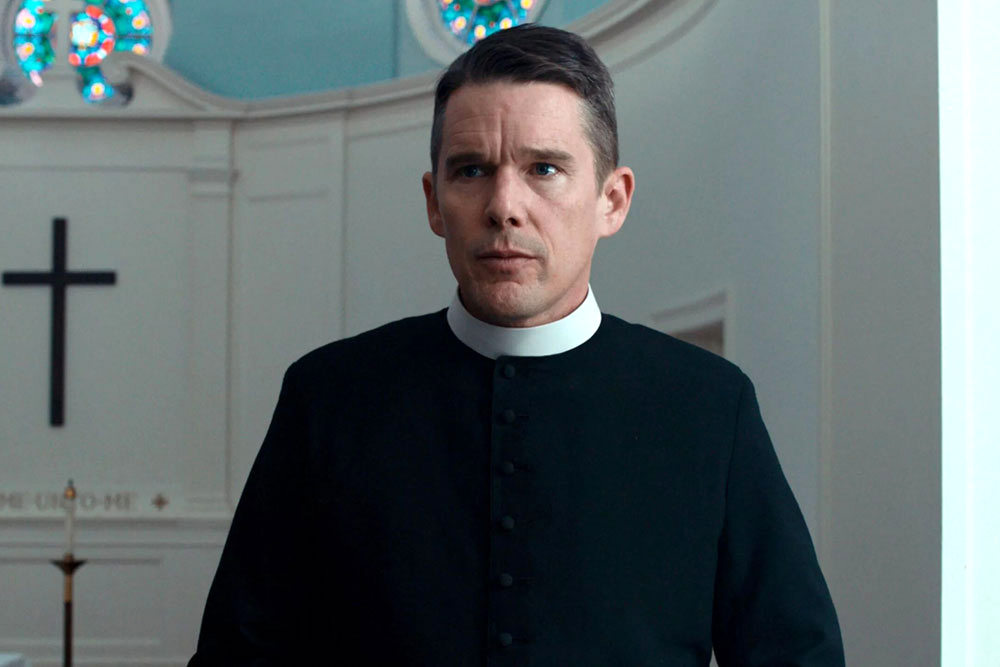
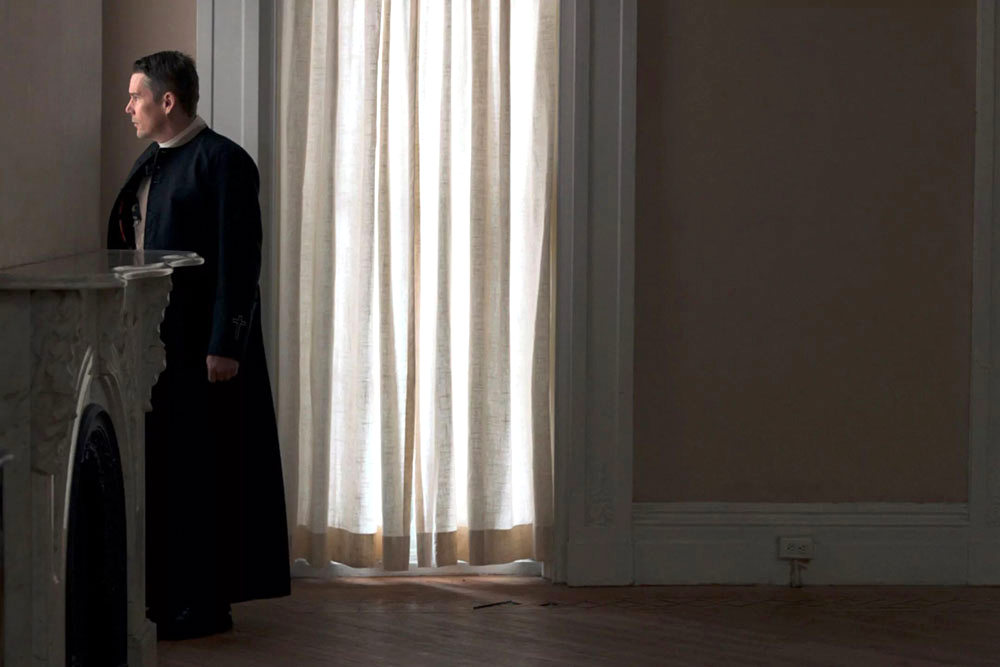
Cinematographer Alexander Dynan shot the film in a 1.37:1 aspect ratio, often referred to as the Academy ratio. This nearly square frame creates a sense of confinement and verticality, emphasizing the isolation of the characters and the stark architecture of the church. The camera remains largely static, with almost no pans or zooms, forcing the audience to sit with the discomfort of the scenes.
Lighting and Color Palette
The color palette is deliberately muted, dominated by grays, whites, and deep shadows. Dynan’s lighting strategy focused on unlit rooms during the day, where the natural light from windows struggles to penetrate the gloom of the interiors. This visual metaphor underscores the film’s central question: whether hope (light) can exist within a world defined by suffering (shadow).
Theological and Environmental Analysis
First Reformed is noted for its sophisticated engagement with Christian theology. The central tension lies between the "theology of the cross," which acknowledges suffering and the brokenness of the world, and the "theology of glory" or prosperity gospel, represented by the Abundant Life megachurch.
Stewardship vs. Exploitation
The film poses a question that has resonated deeply with modern religious scholars: "Will God forgive us for what we have done to His creation?" Toller’s radicalization is not merely political; it is a spiritual crisis born from the belief that humanity has committed a sin against the Creator by destroying the environment. The conflict between Toller and Pastor Jeffers highlights the divide between a faith that challenges power and a faith that accommodates it.
The Role of Despair
Schrader explores the thin line between holy devotion and nihilistic despair. Toller’s journal entries reveal a man who is "praying without ceasing" but finding no answer. The film suggests that in the absence of a divine response, a person may turn to extreme action—either self-destruction or violence—as a way to force a reckoning with the absolute.
Production Background and Industry Reception
First Reformed was produced on a modest budget of approximately $3.5$ million and was shot over a 20-day period in Brooklyn and Queens, New York. Despite its limited resources, the film achieved significant critical acclaim and industry recognition.
Critical Response
The film holds a 97% approval rating on Rotten Tomatoes and a score of 85 on Metacritic, indicating "universal acclaim." Critics praised Ethan Hawke’s performance as the best of his career, noting his ability to convey internal turmoil through subtle facial expressions and a rigid physicality.
Awards and Nominations
First Reformed received numerous accolades, including:
- Academy Awards: Nomination for Best Original Screenplay (Paul Schrader).
- Critics’ Choice Movie Awards: Best Original Screenplay (Winner).
- Independent Spirit Awards: Best Male Lead (Ethan Hawke, Winner).
- National Board of Review: Best Original Screenplay (Winner) and Top Ten Films of the Year.
Broader Impact and Interpretations of the Ending
The ending of First Reformed remains one of the most debated sequences in modern film. Schrader himself has offered two conflicting interpretations, both of which are supported by the text:
- The Visionary Interpretation: Toller drinks the drain cleaner and dies. The final scene of Mary appearing and the subsequent embrace is a "dying vision"—a moment of grace granted by God in his final seconds. This interpretation aligns with the film’s focus on the "long kiss" of heaven as a release from worldly suffering.
- The Miraculous Interpretation: A literal miracle occurs. Mary’s presence physically stops Toller from completing his suicide, suggesting that human connection and love are the only forces capable of countering total despair.
The film’s relevance has only grown since its 2017 debut. In an era marked by increasing "eco-anxiety" and political polarization, Toller’s struggle represents a broader cultural malaise. The film does not offer easy answers; instead, it forces the viewer to confront the possibility that the world may indeed be beyond saving, while simultaneously asking if one can still find the strength to love in the face of that reality.
Conclusion
First Reformed is a rigorous examination of the human condition at the intersection of faith and catastrophe. Through its meticulous direction, haunting cinematography, and Ethan Hawke’s transformative performance, the film transcends the boundaries of a standard drama to become a philosophical inquiry into the nature of hope. It remains a cornerstone of Paul Schrader’s filmography and a vital document of the spiritual and environmental anxieties of the 21st century. By refusing to provide a clear resolution, the film ensures its longevity, inviting viewers to revisit its cold, shadowed halls in search of their own interpretation of grace.