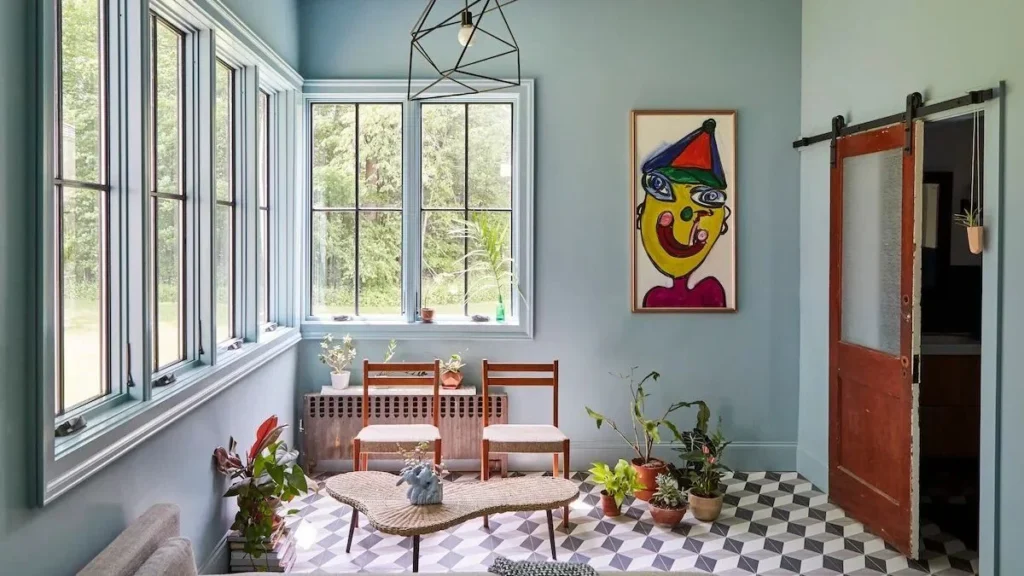

The landscape of American hospitality has undergone a radical transformation over the last decade, shifting from standardized hotel chains to highly curated, architecturally significant short-term rentals. As travelers increasingly prioritize unique experiences over mere convenience, a new tier of properties has emerged that functions as a masterclass in architecture and interior design. These stays, scattered across all 50 states, are no longer just accommodations; they are destinations in their own right, blending historical preservation, modernist innovation, and ecological integration.
The Shift Toward Experiential Architecture
The rise of "design-led" travel is supported by significant market data. According to industry analysts, the global short-term rental market is projected to exceed $100 billion by 2030, with a notable surge in demand for the "Design" and "Iconic" categories. This trend reflects a broader cultural shift where the "Instagrammability" of a space—defined by its aesthetic cohesion and architectural novelty—directly correlates with its commercial success. Property owners are increasingly collaborating with professional architects to create sculptural cabins, glass houses, and reimagined historic estates that blur the line between private residence and art installation.
Architectural Highlights of the American South and Mid-Atlantic
In the Southern United States, design-focused rentals often lean into the relationship between water and structure. In Crane Hill, Alabama, a contemporary lake house on Smith Lake exemplifies this. Priced from $640 per night, the property utilizes blonde wood floors and floor-to-ceiling windows to frame a private cove. The design moves away from the traditional "rustic cabin" trope, opting instead for a clean-lined, nautical-modern aesthetic.
Further north, in the Mid-Atlantic, the focus shifts to historical restoration. In Lewes, Delaware, a charming carriage house on a four-acre estate offers an English country house atmosphere. The design incorporates 100-year-old milled floors and custom brass lighting, proving that luxury can be found in the meticulous preservation of 19th-century details. Similarly, in Charleston, South Carolina, "The Monroe" serves as a "jewel box" in the historic district. This 19th-century home, starting at $822 per night, balances original hardwood floors with contemporary velvet upholstery and rattan accents, reflecting the city’s blend of old-world charm and modern sophistication.
Modernism and Organic Design in the West
The Western United States has long been a laboratory for experimental architecture, particularly organic modernism. In Topanga, California, an architectural stunner built in 1984 and remodeled in 2018 epitomizes the "California Living" ideal. Featured in major publications like The New York Times, the home utilizes wood-clad interiors and high ceilings across three levels to create a sanctuary in the hills. With rates starting at $1,294 per night, it prioritizes wellness, offering a yoga studio and a cedar hot tub rather than traditional entertainment like televisions.
In the desert landscapes of the Southwest, architecture must respond to extreme environments. The Abiquiu Adobe in El Rito, New Mexico, is a traditional Santa Fe-style structure located near the former home of artist Georgia O’Keeffe. Built with adobe bricks and giant wooden beams, the home relies on thermal mass rather than modern air conditioning to regulate temperature—a hallmark of sustainable, indigenous-inspired design.
Utah’s Zion EcoCabin in Hildale offers a different approach to the desert. This A-frame structure features a convertible window wall that opens the entire living space to the sandstone cliffs of southern Utah. At $1,034 per night, it represents the "glamping" evolution, where minimal square footage is compensated for by maximum immersion in the landscape.
The Midwest: A Legacy of Architectural Giants
The Midwest holds a unique position in American architectural history, largely due to the influence of Frank Lloyd Wright. Two of the most significant design-minded Airbnbs in the country are Wright-designed properties.
The Goetsch–Winckler House in Meridian Charter, Michigan, was designed in 1940 as part of a planned Usonian community. Wright’s Usonian philosophy aimed to create affordable, beautiful housing that integrated seamlessly with the environment. Today, guests can stay in this single-level masterpiece for approximately $508 per night, experiencing original Wright-designed furniture and the hallmark horizontal lines of the Prairie style.
In Two Rivers, Wisconsin, the Schwartz House—another Wright creation from 1938—offers a larger-scale experience. Featuring a 63-foot living room and trademark interior brick walls, the four-bedroom home allows travelers to live within a piece of architectural history for $836 per night. These properties represent a growing trend of "preservation through hospitality," where rental income provides the funds necessary to maintain aging architectural icons.
Urban Sophistication: The Industrial and the Historic
In major metropolitan areas like Chicago and New York, design-minded rentals often focus on the adaptive reuse of industrial spaces or the revitalization of historic townhomes.
Chicago’s Fulton Market district features a three-bedroom penthouse loft that merges industrial bones—exposed brick, timber, and steel-framed windows—with plush, modern decor. Starting at $398 per night, the space reflects the neighborhood’s transition from a meatpacking hub to a center for tech and luxury living.
In Brooklyn, New York, a brownstone professionally designed by Jarret Yoshida demonstrates the power of interior curation. The one-bedroom home, priced from $388 per night, functions almost as a gallery, mixing midcentury, vintage, and antique furniture against a backdrop of bold, poppy-hued walls. Such properties highlight the role of professional interior designers in the short-term rental market, where a distinct "point of view" can set a listing apart in a crowded urban field.
The Pacific Northwest and the "Cabin" Evolution
The Pacific Northwest has redefined the "cabin in the woods" through a lens of Scandinavian minimalism and "off-grid" luxury. In Sandpoint, Idaho, a modern lakeside oasis starting at $1,301 per night utilizes massive stretches of glass to provide views of Lake Pend Oreille. Meanwhile, in Olympia, Washington, an architectural forest retreat (from $220 per night) uses a Danish Morsø wood stove and amber wood paneling to create a sanctuary that feels isolated yet technologically equipped with high-speed Wi-Fi and modern appliances.
Vermont and New Hampshire continue this trend in the Northeast. The "Tiny Home" in Warren, Vermont, is a glass-clad structure that reframes the cabin concept by making the forest the primary "decor." These small-scale structures (starting at $500 per night) emphasize that high-quality design does not require excessive square footage, but rather a thoughtful relationship with the site.
Economic and Cultural Implications
The proliferation of these high-design rentals has broader implications for local economies and the architectural profession.
- Economic Impact: Luxury rentals often attract high-spending tourists to rural or overlooked areas (such as Story, Arkansas, or Lake Andes, South Dakota). This "design tourism" can stimulate local businesses, though it often raises concerns regarding housing affordability for local residents.
- Architectural Democratization: Previously, experiencing a Frank Lloyd Wright home or a professionally designed modern masterpiece was reserved for the elite or those visiting museums. Short-term rentals have "democratized" these spaces, allowing anyone with the budget to live—if only for a night—within a work of art.
- Sustainability and Prefabrication: Many of the newer properties, such as the modern cabin in Lost City, West Virginia, are prefab modules. This indicates a shift toward more sustainable, less invasive construction methods in remote areas.
Industry Outlook
As the market matures, industry experts predict that the "Design" category will continue to bifurcate. We are likely to see more "starchitect" collaborations with rental platforms, as well as a greater emphasis on "wellness architecture"—spaces specifically designed to regulate circadian rhythms, reduce stress through biophilic design, and provide digital detox environments.
The properties listed above—from the sculptural "Bloomhouse" in Austin, Texas, to the wellness-minded "Nooq Mountain Chalet" in Montana—represent the current pinnacle of this movement. They prove that in the modern travel era, the space itself is the story. Whether it is a grain bin in South Dakota reimagined as a farmhouse-style retreat or a three-story architectural marvel in the hills of Reno, Nevada, the best Airbnbs in the U.S. are those that challenge our perceptions of what a "home" can be.
Summary of Notable Properties and Rates
- Topanga, CA: Organic modernism (from $1,294/night)
- Two Rivers, WI: Frank Lloyd Wright’s Schwartz House (from $836/night)
- Nashville, TN: The Josephine, vintage-inspired luxury (from $602/night)
- Hildale, UT: Zion EcoCabin, A-frame desert immersion (from $1,034/night)
- Austin, TX: The Bloomhouse, sculptural/experimental (from $754/night)
The trend toward design-centric travel shows no signs of slowing. As travelers continue to seek out spaces that offer inspiration and a sense of place, architecture will remain at the forefront of the hospitality industry’s evolution.