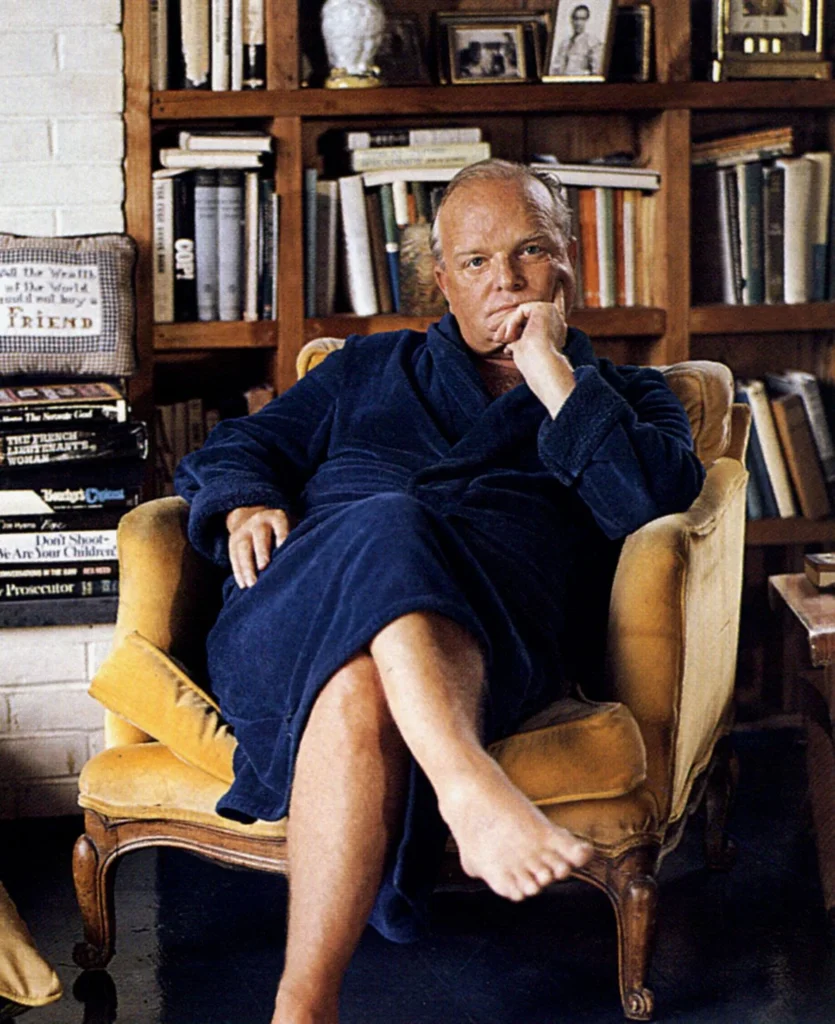

For decades, the private world of Truman Capote remained an enigma, protected by the sprawling potato fields of Sagaponack and the writer’s own desire for solitude. Now, a significant portion of that world is set to be dispersed to the public. Gerald Clarke, the journalist and author of the definitive 1988 biography Truman Capote, has announced that he is downsizing his estate and auctioning nearly 400 personal artifacts belonging to the late literary icon. This sale offers an unprecedented glimpse into the life of the man who redefined American journalism with In Cold Blood and captivated high society with his razor-sharp wit and presence.
The collection, managed by the Cornell Auction house in Bellport, New York, is scheduled to go under the hammer on November 21. Potential bidders will be able to preview the items and begin placing bids online starting October 26. This auction is not merely a sale of vintage goods; it is a historic repatriation of the objects that defined Capote’s domestic life during his most prolific years.

A Historical Archive of Domesticity
The provenance of these items is particularly noteworthy. Many of the pieces included in the auction were captured in a seminal 1976 Architectural Digest feature, which documented Capote’s secluded Long Island retreat. For collectors, this provides a rare opportunity to acquire items that were not only owned by the author but were also integral to his carefully curated living space.
The collection is eclectic, reflecting the duality of Capote’s personality: at once a disciplined literary craftsman and a flamboyant socialite. Among the standout lots are his extensive collection of paperweights—an obsession he developed later in life. Some of these, remarkably, were handmade by the author himself, including one crafted from stones sourced directly from the Kansas farm that served as the setting for his true-crime masterpiece, In Cold Blood.
Other items hitting the block include a signed copy of To Kill a Mockingbird, inscribed by his lifelong friend and fellow literary giant, Harper Lee. The auction also features more intimate, mundane objects such as a bronze frog inkwell and the very keys to his Sagaponack home, offering a tactile connection to the man who penned Breakfast at Tiffany’s.

The Sagaponack Sanctuary: A Retrospective
To understand the significance of these items, one must understand the environment in which they were kept. In 1962, Capote commissioned a house on six acres of farmland in the Hamptons. He famously described the area as "Kansas with a sea breeze." The house, a flat-roofed, cedar-shingled structure, was designed to his exact specifications, favoring "run-down comfort" over ostentatious luxury.
During the mid-1970s, the Sagaponack home served as both a workspace and a fortress. It was here that Capote retreated from the "social butterfly" persona he was known for in Manhattan. While he was a fixture of New York’s elite circles, his life in the Hamptons was remarkably quiet. He spent his days writing, walking his English bulldog, Maggie, and observing the rural rhythm of the South Fork.
The interior of the house was a reflection of his aesthetic philosophy: a mix of Victorian antiques, inexpensive wicker furniture, and personal mementos. There were no "don’t touch" signs. His possessions were meant to be used. The blue-green floors of his living room, which he compared to a "big lake," were constantly repainted, and his walls were lined with mirrors to reflect the surrounding dunes and the sea. The upcoming auction catalog, though not yet fully public, is expected to feature many of these functional art pieces that defined his workspace.

Chronology of a Literary Icon
The trajectory of Capote’s life and the preservation of his legacy have followed a distinct timeline:
- 1962: Construction of the Sagaponack home is completed.
- 1966: Publication of In Cold Blood, cementing Capote’s reputation as a pioneer of the "non-fiction novel."
- 1976: Architectural Digest publishes a feature on the Sagaponack home, providing the visual record for many of the items currently being auctioned.
- 1984: Truman Capote passes away at the age of 59. Much of his personal estate is left to his friend and biographer, Gerald Clarke.
- 1988: Clarke publishes his comprehensive biography, Truman Capote.
- 2005: The biopic Capote, starring Philip Seymour Hoffman, renews public interest in the author’s life and work.
- 2024: The miniseries Feud: Capote vs. the Swans introduces a new generation to the complex social dynamics of the author’s final years.
- 2026: The Cornell Auction sale of 400 personal items is scheduled for November 21.
The Implications of the Sale
The decision by Gerald Clarke to auction these items is viewed by historians as a natural evolution of a private archive. At 89, Clarke’s decision to downsize ensures that these artifacts are moved from storage into the hands of curators, collectors, and institutions where they can be properly displayed and studied.
The market for Capote-related memorabilia has been consistently strong. Following the success of recent dramatizations like Feud: Capote vs. the Swans, the "Capote brand" has seen a resurgence in popularity. Analysts suggest that the auction will draw interest from two distinct groups: serious literary historians seeking to preserve documents and objects for academic study, and high-end interior designers and private collectors attracted by the provenance of the "Hamptons aesthetic" that Capote helped define.

"Most of the items that we have in the Truman Capote auction were photographed almost exactly 50 years ago in 1976," a spokesperson for the auction house noted in a promotional video. This temporal proximity to the original architectural spread adds a layer of cultural weight to the sale. It is not just an auction of furniture; it is the dispersal of a historical set-piece.
The Cultural Weight of Personal Effects
Why do we collect the keys, inkwells, and paperweights of a writer? The answer lies in the human desire to bridge the gap between the myth of the celebrity and the reality of the individual. Capote’s personal belongings—his Windex-blue prescription glasses, his collection of paperweights, and his worn wicker chairs—serve as relics of a time when the literary world held a central place in American popular culture.
The "witchcraft altar" he maintained in his living room, which included a Cocteau-designed needlepoint mask pillow and an antique wood cat, provides a window into the more superstitious and interior side of his life. These items remind us that beneath the facade of the socialite who courted the "Swans" of New York society, there was a man who found comfort in simple, tactile objects.

Final Preparations for the November Auction
As the date of the auction approaches, the Cornell Auction house is finalizing the comprehensive catalog. The event is expected to be one of the most significant literary sales of the decade. For those unable to attend in person, the inclusion of an online bidding platform ensures that the global community of Capote scholars and enthusiasts can participate in the acquisition of these items.
The legacy of Truman Capote continues to evolve, shifting from the pages of his novels to the screens of modern television, and now, into the collections of those who wish to keep a piece of his world. As the items leave the private collection of Gerald Clarke, they begin a new chapter, transitioning from personal effects to historical artifacts, forever tied to the writer who, in his own words, was "always drawn back to places where I have lived."