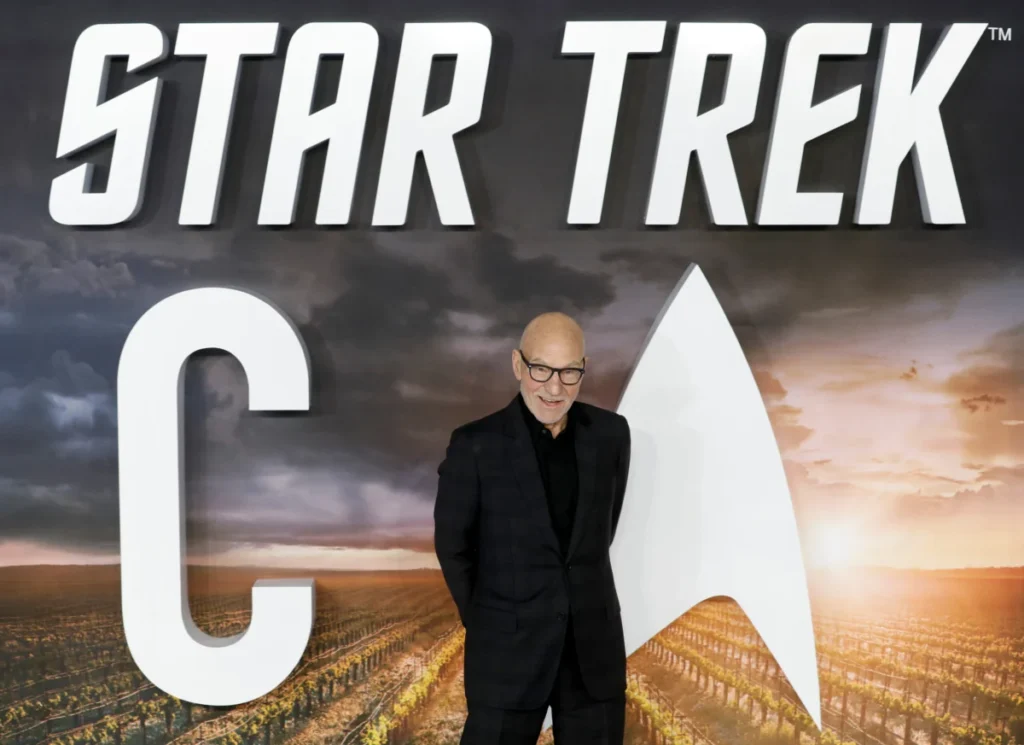

The passing of the British titan, whose career spanned more than six decades of stage and screen excellence, was confirmed by his family in a heartfelt statement shared on social media on Thursday evening. Sir Patrick, who breathed his last at his home in Los Angeles under the devoted care of his wife, Sunny, leaves behind a legacy defined by profound artistry, intellectual rigor, and an unwavering commitment to humanitarian causes.
His death marks the end of an era for both the Royal Shakespeare Company, where he first honed his craft in the 1960s, and the global science-fiction community, which revered him as the definitive face of leadership in the 24th century.
A Life Defined by Artistic Versatility
Born in 1940 in the industrial town of Mirfield, West Yorkshire, Patrick Stewart’s early life was marked by the grit and resilience that would later define his performances. He joined the Royal Shakespeare Company in 1966, a pivotal move that cemented his reputation as one of the finest classical actors of his generation. For 16 years, he navigated the complex emotional landscapes of the Bard’s works, earning critical acclaim and two supporting actor Olivier Awards—first for his turn in Antony and Cleopatra in 1979, and later for his performance in Hamlet in 2009.
Despite his theatrical pedigree, it was the role of Captain Jean-Luc Picard in Star Trek: The Next Generation, originating in 1987, that transformed Stewart into a global household name. For seven seasons, he commanded the USS Enterprise, imbuing the character with a sense of moral gravity and philosophical depth that elevated the sci-fi genre. He reprised this iconic role in cinematic outings such as Star Trek Generations (1994) and Star Trek: First Contact (1996), ensuring that Picard became a fixture in popular culture.
As the new millennium dawned, Stewart successfully pivoted to blockbuster franchise cinema. He took on the role of Professor Charles Xavier in the X-Men film series, a character he portrayed with a blend of paternal warmth and intellectual sharpness. His involvement in the Marvel Cinematic Universe, from the inaugural X-Men film in 2000 to his upcoming appearance in the December 2024 release of Avengers: Doomsday, demonstrated his remarkable longevity as an actor capable of bridging generations of cinema-goers.

A Journey with Progressive Illness
The announcement of Sir Patrick’s death noted that his final months were marked by a struggle with two complex, progressive neurological conditions: Alzheimer’s disease and dementia with Lewy bodies (DLB).
According to the Alzheimer’s Society, Alzheimer’s remains the most prevalent form of dementia, affecting millions globally. However, the mention of DLB provides a sobering context for his final days. DLB is a condition caused by the buildup of alpha-synuclein proteins in the brain, which can significantly impair cognitive function, movement, and mood. Unlike the more commonly understood progression of Alzheimer’s, DLB can cause fluctuations in alertness and visual hallucinations, presenting a uniquely challenging set of symptoms for patients and their caregivers.
The statement released by his family emphasized the grace with which he faced this transition. "He has been held in the warm embrace of family and friends, surrounded by live music, prayers, tears, laughter and the kind of profound emotion that only he could inspire after a lifetime of devotion to all of us," the statement read. His family has requested that, in lieu of flowers, supporters contribute to the Johns Hopkins Alzheimer’s Disease Research Centre Fund and the Alzheimer’s Foundation of America to support ongoing research into these devastating conditions.
A Legacy of Philanthropy and Activism
Beyond the stage and the screen, Sir Patrick was a formidable advocate for social justice. His work with the charity Refuge, for which he served as a long-standing ambassador, was deeply personal. Having witnessed domestic abuse during his own childhood, Stewart used his platform to break the silence surrounding the issue, campaigning tirelessly to support survivors and dismantle the societal taboos that often prevent victims from seeking help.
Hetti Barkworth-Nanton, chairwoman of trustees for Refuge, noted that his dedication was rooted in a profound love for his mother. "Patrick became a Refuge ambassador in 2007, and I was privileged to watch his endless devotion and passion to the cause," she stated. "In lending his voice, he raised much-needed awareness and broke down barriers on the subject of domestic violence."
His commitment extended to animal welfare—specifically his well-documented love for rescued pit bulls—and the support of veterans’ mental health services. These efforts, combined with his role as a chancellor and a vocal supporter of the Huddersfield Town football club, painted a picture of a man whose interests were as broad as his acting range.

Official Responses and Industry Tributes
The global reaction to the news has been one of universal mourning, reflecting the deep affection the industry held for him. Marvel Studios, which had long been home to his portrayal of Professor Xavier, issued a formal tribute highlighting his "extraordinary grace, intelligence, and humanity." The studio noted that Stewart was not only a "singular talent" but also a "generous collaborator" who redefined the X-Men franchise for a modern audience.
Michelle Dyson, chief executive officer of the Alzheimer’s Society, reflected on the broader impact of his passing. "His death is a heartbreaking reminder of the devastating impact dementia has on people and families across the globe," she said, acknowledging the actor’s contribution to the arts and the sadness felt by those who followed his long, distinguished career.
Looking Back: A Chronology of a Remarkable Career
- 1940: Born in Mirfield, West Yorkshire.
- 1966: Joins the Royal Shakespeare Company, beginning a 16-year tenure.
- 1979: Wins first Olivier Award for Antony and Cleopatra.
- 1987: Debuts as Captain Jean-Luc Picard in Star Trek: The Next Generation.
- 1996: Wins a Grammy Award for Best Spoken Word Album for Children for Peter and the Wolf.
- 2000: Stars as Professor Charles Xavier in the first X-Men film.
- 2007: Becomes an ambassador for the domestic abuse charity Refuge.
- 2009: Receives a knighthood for services to drama, subsequently knighted by Queen Elizabeth II in 2010.
- 2023: Releases his memoir, Making It So, reflecting on his life and career.
- 2024: Final appearance as Professor Xavier in Avengers: Doomsday.
Implications and Lasting Impact
The loss of Sir Patrick Stewart is not merely the loss of an actor; it is the loss of a cultural touchstone who helped shape the landscape of modern entertainment. His ability to navigate between the high-brow intensity of Shakespeare and the speculative wonder of science fiction allowed him to command a level of respect rarely seen in contemporary celebrity.
His final professional contributions, including his recordings of Shakespeare’s sonnets released earlier this year, serve as a testament to his enduring love for the written word. In his final social media post in May, he remarked on his desire to communicate the "multiple features that love might have," a sentiment that seems fitting for a man who spent his life exploring the nuances of the human condition.
As fans prepare for his final on-screen appearance in December, the narrative surrounding Sir Patrick will likely shift toward an appreciation of his "invincible grace." He leaves behind a blueprint for how an artist can use their platform to foster compassion, advocate for the vulnerable, and maintain a standard of excellence that spans decades. For those who knew him, and for the millions who only knew him through the lens of a camera, Sir Patrick Stewart remains a standard-bearer for the best of what acting can achieve: the ability to make us feel, think, and aspire to something greater.