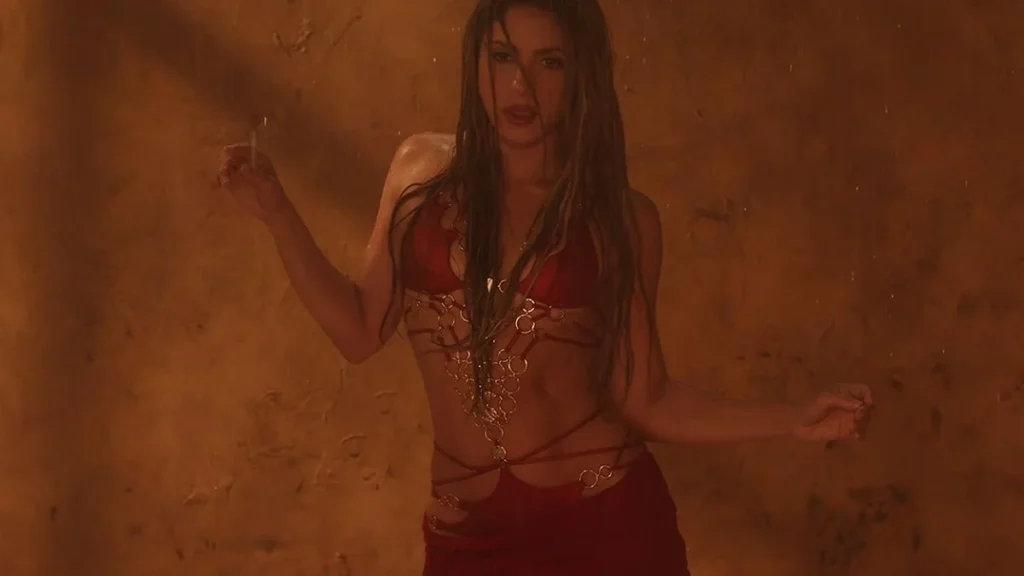

Global music icon Shakira has once again commanded international attention with her distinct sartorial choices, showcased in her latest visual project alongside fellow Latin superstar Maluma. Known just as much for her trendsetting visual aesthetics as for her record-breaking musical catalog, the Colombian singer-songwriter captivated audiences by stepping out in a custom crimson ensemble crafted by luxury lingerie pioneer Agent Provocateur. The daring attire, characterized by an intricate construction of ultra-fine straps and polished metallic hardware, highlights a growing high-fashion trend that blurs the boundaries between intimate apparel and statement outerwear.
The visual project, which features the high-profile collaboration between Shakira and Maluma, has quickly risen through global streaming charts, drawing praise not only for its musical composition but also for its high-production-value styling. As the intersection of pop culture, luxury lingerie design, and high-octane music videos continues to evolve, this latest sartorial statement offers a compelling lens through which to examine modern celebrity branding, costume design, and the commercial impact of high-end fashion partnerships within the Latin music industry.
Main Facts of the Ensemble and Visual Production
The centerpiece of Shakira’s visual styling in the project is a custom deep-red outfit sourced from the British luxury lingerie brand Agent Provocateur. Rather than adhering to conventional red-carpet tailoring or standard stage costumes, the garment challenges traditional apparel construction. The ensemble comprises a micro minidress designed primarily from minimalist components: a micro-sized halter top connected securely by slender crimson straps and gleaming gold-toned O-rings.
Extending downward from the bodice, a delicate cascade of metallic rings drapes across her bare midriff, effectively functioning as an integrated body-chain accessory that catches the ambient lighting. The lower half of the ensemble features a matching ultra-low micro skirt that rests low on the hips. Eschewing traditional fabric panels and solid waistbands, the skirt is held together exclusively by a complex lattice of crisscrossing strings and interlinked metallic loops. This unconventional structural approach ensures that the hardware serves a dual purpose, acting simultaneously as structural architecture and decorative ornamentation.
Complementing the avant-garde garment, Shakira’s beauty and grooming choices were curated to amplify the fiery, sun-drenched aesthetic of the video. Her hair was styled in wet-look, beach-textured waves that tumbled past her shoulders, evoking a sense of effortless coastal glamour. Her makeup featured smoldering dark eyeliner, sharply defined brows, and a subdued nude lip to maintain visual equilibrium against the intense crimson hue of the dress. Posing against a warm, rustic backdrop under carefully calibrated moody lighting, the artist projected an atmosphere of commanding confidence.
In several key sequences of the visual, Shakira is joined by Maluma, who complemented her warm-toned aesthetic by wearing an unbuttoned black shirt layered with classic gold chain necklaces. The visual synergy between the two artists reinforces a polished, cohesive Latin pop aesthetic that has come to define their frequent and commercially successful collaborations.
Chronology of Shakira and Maluma Collaborations
To understand the cultural significance of this latest visual release, it is necessary to examine the professional history shared by Shakira and Maluma. The two Colombian artists have established a formidable creative partnership over the past decade, consistently delivering chart-topping hits that blend reggaeton rhythms with pop melodies.
The timeline of their musical synergy began in earnest with the release of "Chantaje" in October 2016. The track, the lead single from Shakira’s eleventh studio album El Dorado, became a global phenomenon. Its accompanying music video, characterized by a playful game of cat-and-mouse in a Barcelona hardware store and vibrant street settings, showcased an undeniable chemistry between the two performers. "Chantaje" shattered streaming records, spending multiple weeks at the top of the Billboard Hot Latin Songs chart and eventually earning multi-platinum certifications across the globe.
Following the immense success of their initial collaboration, the duo reunited on tracks such as "Trap" (released in 2018 as part of the same album cycle) and later joined forces with other artists, most notably on the massive global hit "Medellín" from Madonna’s 2019 album Madame X, which featured Maluma with production and vocal contributions that further cemented his international status.
The release of their latest collaborative visual project continues this established timeline of high-profile joint ventures. Each successive release has seen both artists elevate their visual presentation, incorporating high-fashion houses, cutting-edge cinematography, and complex choreography. The debut of Shakira’s Agent Provocateur ensemble within this framework marks a new pinnacle in their shared visual history, proving that their artistic partnership remains as commercially viable and culturally resonant as it was nearly a decade ago.
Supporting Data and Market Impact
The intersection of music videos and high fashion has long served as a powerful catalyst for the luxury retail market. According to recent data from digital fashion tracking platforms, the inclusion of specific designer labels in high-rotation music videos can trigger immediate spikes in consumer search queries and direct e-commerce sales.
Agent Provocateur, renowned for its contribution to luxury innerwear since its founding in London in 1994, experienced a notable surge in digital engagement following the rollout of promotional stills and video clips featuring the custom micro minidress. While standard luxury collections often rely on traditional runway presentations, the modern music video acts as an alternative, highly accelerated digital runway. For artists of Shakira’s magnitude—boasting tens of millions of monthly listeners on streaming platforms and massive social media followings—every visual frame functions as high-impact marketing media.
Furthermore, economic analyses of the Latin music sector indicate exponential growth over the past five years. Latin music revenues have consistently outpaced broader industry averages, driven largely by global cross-border collaborations. When top-tier artists like Shakira and Maluma release joint projects accompanied by striking visual aesthetics, the halo effect extends beyond audio streams to encompass branded merchandise, luxury fashion sponsorships, and global tour ticket sales. The deliberate choice to wear a high-end, intricately constructed designer garment reinforces the positioning of Latin music superstars at the very apex of global pop culture and fashion influence.
Evolution of Lingerie as Outerwear in Modern Pop Culture
The stylistic decision to wear a lingerie-inspired garment as standalone outerwear is not entirely unprecedented, but its execution in this project represents a sophisticated evolution of the trend. Historically, elements of undergarments—such as corsetry, lace-trim slips, and satin robes—began transitioning into mainstream evening wear during the 1990s, championed by fashion icons and designers alike.
In recent years, however, the trend has shifted from subtle undergarment allusions to literal, high-craft intimacy apparel worn explicitly as red-carpet or performance attire. Brands specializing in luxury lingerie, such as Agent Provocateur, La Perla, and Savage X Fenty, have increasingly collaborated with celebrity stylists to produce bespoke stage and video costumes. These garments challenge traditional notions of modesty and structural integrity by exposing the mechanics of clothing—such as the strings, loops, and metal rings utilized in Shakira’s micro minidress.
Fashion historians and critics often note that this sartorial shift embodies a reclamation of agency and bodily autonomy. By turning structural fasteners into focal points of the design, the garment celebrates the engineered nature of fashion while highlighting the wearer’s physical presence. The deliberate contrast between the harsh, metallic geometry of the O-rings and the soft, organic flow of Shakira’s wet-look hair and warm-toned skin creates a visual tension that defines contemporary pop styling.
Broader Implications and Industry Analysis
The ongoing collaboration between global music icons and luxury fashion houses carries significant implications for both industries. As physical retail spaces face continuous transformation, digital platforms—particularly YouTube, Instagram, and TikTok—have become the primary storefronts for high-end fashion houses seeking to capture younger, digitally native demographics.
For Shakira, maintaining an image of relentless modernity and fearless stylistic evolution is crucial for sustaining a career spanning multiple decades. Having emerged on the international music scene in the mid-1990s with a distinctly rock-infused, bohemian aesthetic, her ability to continually reinvent her visual identity—transitioning seamlessly into cutting-edge, high-fashion luxury—demonstrates acute media savvy and an understanding of contemporary visual standards.
Industry analysts suggest that the integration of avant-garde lingerie pieces into mainstream music videos will likely accelerate, encouraging further collaborations between haute couture ateliers and performance stylists. As artists continue to leverage their platforms to showcase experimental designs, the boundaries between private intimates and public spectacle will continue to dissolve. Shakira’s confident display in her custom Agent Provocateur ensemble serves as a definitive case study in how modern pop stars utilize high-fashion statements to command attention, dictate cultural conversations, and set the definitive standard for visual style in the digital age.