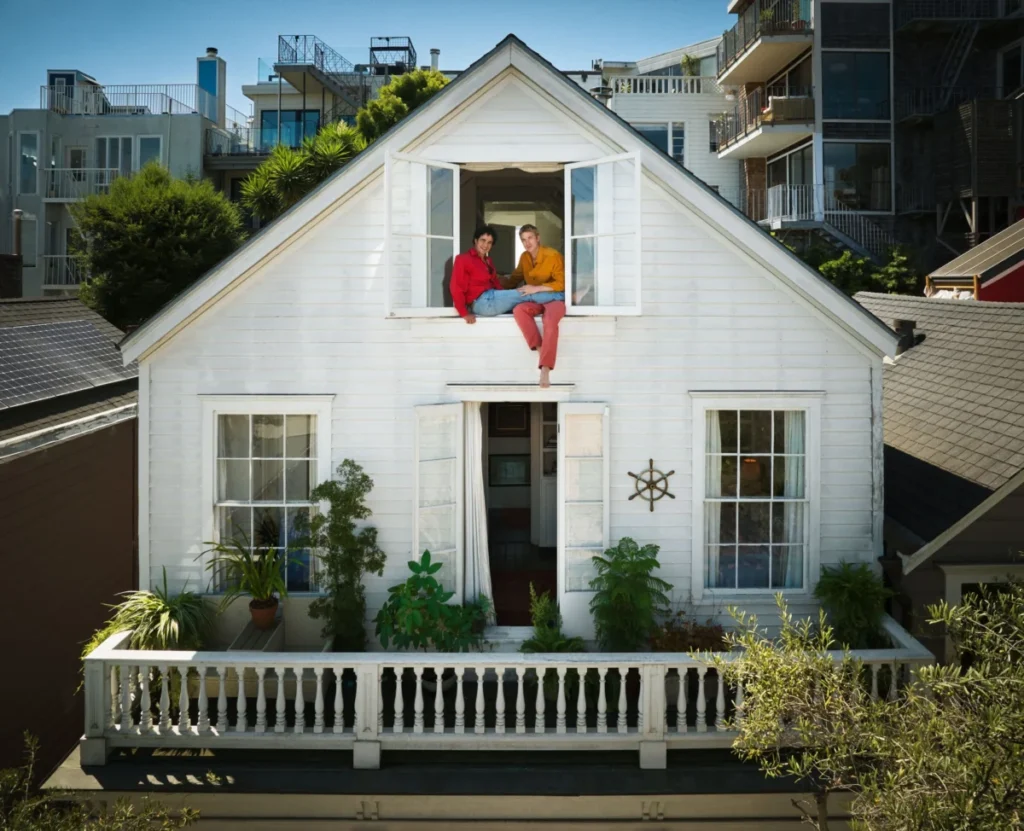

The landscape of San Francisco real estate is often defined by its architectural pedigree and the high-stakes competition of its rental market. However, a unique intersection of creative history and contemporary interior design has emerged in the city’s historic Telegraph Hill neighborhood, where fashion designer Zac Posen and actor Harrison Ball have transformed an 1850s captain’s cottage into a bicoastal sanctuary. This project, executed in collaboration with AD100 interior designer Ken Fulk, represents a significant departure from the polished, over-curated aesthetic often associated with celebrity residences. Instead, the property serves as an exercise in "anti-decoration," prioritizing historical layering and organic, lived-in comfort over sterile perfection.

The Chronology of a Cross-Country Transition
The project’s genesis dates back approximately two and a half years, triggered by Posen’s appointment as executive vice president and creative director at Gap Inc. and chief creative officer at Old Navy. This corporate relocation necessitated a significant shift in lifestyle for the couple, who have been together for four years. While Posen established his presence at the company’s San Francisco headquarters, Ball, a retired principal dancer with the New York City Ballet who has transitioned into acting, managed the logistical transition.

Accompanied by the couple’s two miniature poodles, Tsuki and Bizet, and a modest collection of personal artifacts—including a painting discovered in Bucks County, Pennsylvania—Ball navigated the journey from the East Coast to the West. This relocation was framed by Posen as a modern pioneer narrative, characterized by a spirit of discovery and the blending of two distinct cultural identities: the fast-paced, high-fashion world of New York and the storied, maritime-influenced character of San Francisco.
Architectural Context and Historical Significance

The cottage itself is a relic of 19th-century San Francisco, having served a variety of occupants ranging from its original sea captain to a Russian aristocrat and later functioning as a speakeasy during the Prohibition era. Its location on Telegraph Hill places it in a neighborhood steeped in literary and social history, with residents having included figures such as author Armistead Maupin, whose Tales of the City series immortalized the unique spirit of San Francisco living.
When Posen and Ball first encountered the property, it was structurally sound but lacked a cohesive identity, suffering from what the couple described as an "Airbnb vibe." The interior was furnished with generic pieces that failed to reflect the building’s century-and-a-half-old legacy, and the exterior garden had fallen into disrepair. The restoration process was as much about "undecorating" as it was about design; the goal was to strip away the impersonal layers to reveal the cottage’s inherent charm while introducing elements that honored its history.

The Role of Design Collaboration: The Ken Fulk Influence
The partnership with Ken Fulk began organically following a dinner conversation shortly after the couple’s arrival in California. Fulk, a renowned figure in the design world, brought a philosophy to the project that rejected the standard corporate approach to interior design. There were no formal mood boards, lengthy presentations, or rigid conceptual frameworks.

Fulk’s intervention was described by the parties involved as an exercise in "bohemian" improvisation. By integrating high-end vintage finds with personal family heirlooms—such as artwork by Posen’s father, the artist Stephen Posen—the team created a space that feels as though it has been inhabited for decades. The design strategy relied on what Fulk calls "the anti-decorator’s decorator" approach, focusing on the belief that modern residential design has become too focused on flawless surfaces and digital-first aesthetics, often at the expense of human comfort and genuine character.
Detailed Interior Analysis

The home’s interior is a complex tapestry of textures and eras. In the living room, deep blue velvet armchairs from Les Trois Garçons and a red velvet sofa from the Banana Republic Home line create a seating area anchored by a vintage burl-wood coffee table. The primary bedroom features a 1930s faux-bamboo-and-cane bed from Show Pony Palm Beach, softened by a Libeco Home coverlet and vintage kilim pillows.
The kitchen retains its historical integrity, featuring original 1960s cabinetry and a classic 1950s O’Keefe & Merritt stove. In the "crow’s nest"—the attic guest room—whitewashed beams and sloping ceilings evoke the feeling of a coastal retreat, further emphasizing the home’s connection to the bay. Throughout the residence, campaign desks and unique lighting fixtures, such as a 1960s sea urchin lamp by Curtis Jeré, serve as focal points that nod to the cottage’s maritime roots.

The garden, curated personally by Ball, acts as an extension of the living space. By introducing species such as pink begonia, Brugmansia, and Ligularia, he effectively revitalized a once-dormant outdoor area. The inclusion of a Winged Victory-inspired sculpture from Ken Fulk adds a classical element that contrasts with the lush, wild greenery of the backyard.
Economic and Cultural Implications of "Anti-Curation"

The project reflects a growing trend in luxury residential design: the rejection of "over-curation." In a market where high-net-worth individuals often employ designers to create showroom-ready homes, the Posen-Ball residence stands as a counter-narrative. By utilizing leftover materials—such as the canvas used for the office walls, which were remnants from a Banana Republic pop-up concept—the couple demonstrated a resourceful, sustainable approach to high-end design.
This philosophy of "accidental" design has broader implications for the interior design industry. As consumers become increasingly fatigued by the homogenized aesthetics propagated by social media platforms, there is a visible shift toward spaces that communicate a narrative of personal history and eclectic acquisition. The use of vintage textiles, antique furniture, and non-traditional art arrangements suggests that the value of a home is increasingly derived from its uniqueness and ability to house the owner’s personal journey rather than its market value or adherence to contemporary trends.

The Reality of Rental Living
Despite the sophisticated execution of the design, it is important to note that the property is a rental. This constraint forced the team to be selective, focusing on non-permanent changes that could be easily reversed. This reality serves as a model for urban dwellers who wish to invest in their living spaces without the capital commitment of property ownership. It challenges the assumption that long-term comfort and aesthetic quality are exclusive to homeowners.

The success of the cottage’s transformation suggests that "home" is not defined by the permanence of the structure, but by the intentionality of the objects and memories brought into it. As Posen and Ball continue to balance their careers between New York and San Francisco, the cottage serves as a vital anchor, a place that feels "lived-in" because it is a direct reflection of the lives, tastes, and histories of its inhabitants.
Conclusion: A New Paradigm for Domesticity

The collaboration between Posen, Ball, and Fulk has resulted in a space that feels both profoundly personal and historically resonant. By embracing the "delightfully imperfect" nature of an 1850s cottage, the trio has successfully avoided the traps of modern minimalism. The house stands as a testament to the idea that true luxury is found in the ability to curate a life that feels authentic, whether in a sprawling estate or a small coastal cottage.
For those observing the current state of interior design, the Telegraph Hill project offers a compelling lesson: the most enduring homes are those that prioritize the spirit of the occupant over the dictates of the designer. As the design world continues to evolve, the influence of this "anti-decorator" movement may well serve as a blueprint for future residential projects, signaling a move toward more sustainable, eclectic, and deeply personal living environments.