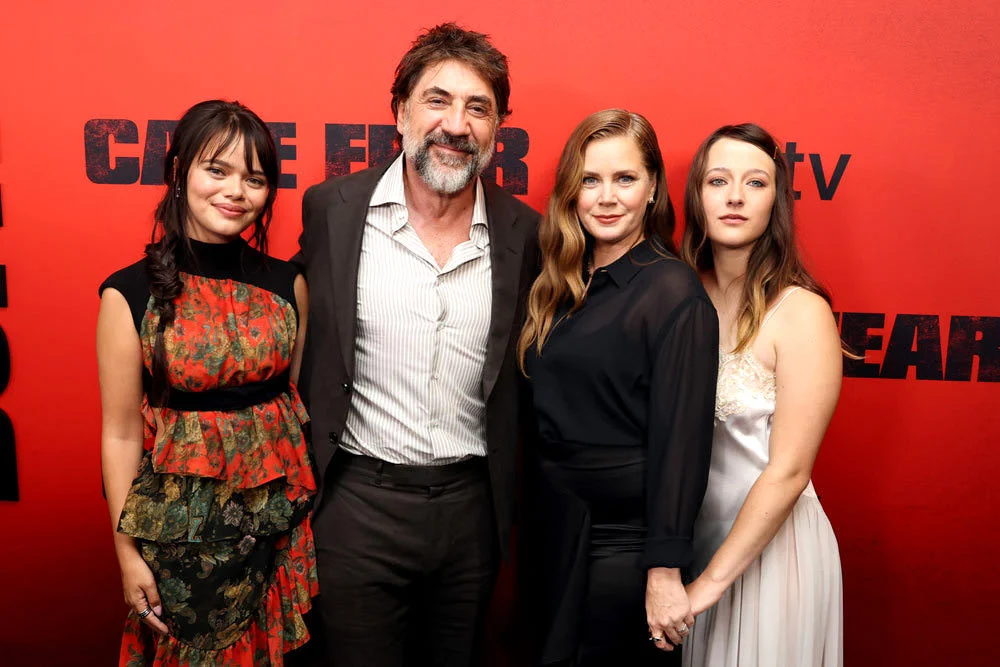

The series, which serves as a contemporary reimagining of the 1991 film directed by Martin Scorsese and the original 1962 film starring Gregory Peck and Robert Mitchum, represents a unique collaboration between industry titans Steven Spielberg and Scorsese, both of whom serve as executive producers. Developed for television by showrunner Nick Antosca, the ten-episode series expands upon the themes of vengeance, legal ethics, and domestic security originally found in John D. MacDonald’s 1957 novel, The Executioners. The New York screening functioned not only as a promotional event for the finale but also as a showcase for the series’ distinctive aesthetic, which was reflected in the avant-garde and high-fashion choices of the attending cast members.

Historical Context and the Evolution of Cape Fear
To understand the significance of the New York screening, one must look at the long-standing legacy of the Cape Fear property. The story of Max Cady, a convicted rapist who seeks to dismantle the life of the lawyer he blames for his imprisonment, has remained a cornerstone of the American thriller genre for over sixty years. The 1962 version was a stark, black-and-white noir that challenged the censorship standards of its time. The 1991 remake, produced by Spielberg’s Amblin Entertainment and directed by Scorsese, transformed the story into a Southern Gothic spectacle, earning Academy Award nominations for Robert De Niro and Juliette Lewis.
The decision to adapt this narrative into a ten-hour limited series for Apple TV+ was met with both curiosity and scrutiny from critics. Moving from a two-hour feature film to a long-form television structure allowed showrunner Nick Antosca to delve deeper into the psychological profiles of the Bowden family. In this iteration, Amy Adams portrays Anna Bowden and Patrick Wilson plays Tom Bowden, a legal power couple whose marriage is tested by the emergence of Max Cady, portrayed with menacing intensity by Javier Bardem. The expanded runtime has permitted the series to explore the legal intricacies of Cady’s release and the moral gray areas of the Bowdens’ past, though industry analysts have noted that the challenge of maintaining tension over ten episodes is a significant creative hurdle.

Red Carpet Fashion and Stylistic Choices
The New York screening served as a platform for the cast to exhibit fashion-forward looks that often mirrored the deconstructed and gritty nature of the series itself. Fashion on the red carpet at such events is frequently used to signal the "prestige" status of a production, and the Cape Fear cast utilized a mix of established luxury houses and experimental designers.
Amy Adams, a six-time Oscar nominee, appeared in a curated ensemble from AMI Paris. The look featured a sophisticated top paired with a skirt that drew immediate attention for its unconventional construction. The skirt utilized raw, unfinished edges along a prominent slit, a design choice intended to evoke a sense of "undone" elegance. While some observers noted that the silhouette offered a more rectangular profile than Adams’ typical red carpet fare, the choice highlighted a move toward the "quiet luxury" and "deconstructed chic" trends currently dominating the Parisian fashion scene. Her hair and makeup remained classic, providing a grounded contrast to the experimental nature of the garment.

Javier Bardem, who has received critical acclaim for his transformative performance as Max Cady, opted for a more traditional yet relaxed approach to red carpet attire. Wearing a dark suit with a subtle textural variation between the jacket and trousers, Bardem’s appearance suggested a move away from the rigid formalities of Hollywood premieres toward a more contemporary, "lived-in" luxury. Industry stylists have observed that Bardem often favors silhouettes that prioritize comfort and character over strict tailoring, a trend that aligns with his persona as an actor who prioritizes substance over artifice.
The younger members of the cast, Malia Pyles and Lily Collias, brought a more experimental energy to the event. Pyles appeared in a creation by Ottolinger, a brand known for its radical approach to knitwear and deconstructed florals. The garment featured a complex arrangement of patterns and asymmetrical cuts, reflecting the chaotic psychological landscape of the series. Collias, meanwhile, chose a minimalist aesthetic that leaned into the "slip dress" revival of the 1990s, though paired with footwear choices that sparked conversation regarding the blending of formal and casual styles in high-profile media events.

Production Timeline and Development
The journey of Cape Fear to the small screen began in 2017 when Nick Antosca signed an overall deal with UCP, a division of Universal Studio Group. Antosca, known for his work on The Act and Candy, specialized in true crime and psychological tension, making him a natural fit for the project. The series was developed through Antosca’s production banner, Eat The Cat, alongside Amblin Television.
Principal photography for the series took place over several months, with Morten Tyldum, the Academy Award-nominated director of The Imitation Game, helming the pilot episode. Tyldum’s involvement was instrumental in establishing the visual language of the show—a blend of high-end cinematic gloss and claustrophobic tension. The production faced the task of modernizing a story that relies heavily on the concept of a "stalker," an archetype that has changed significantly in the era of digital surveillance and modern privacy laws. By centering the narrative on two attorneys, the series also integrated a procedural element that distinguishes it from its cinematic predecessors.

The screening in New York marks the culmination of this development cycle. As the series heads toward its finale, Apple TV+ has utilized a staggered release schedule to build word-of-mouth momentum. Data from streaming analytics suggests that the show has performed particularly well among demographics that favor "prestige" dramas and psychological thrillers, benefiting from the star power of Adams and Bardem.
Analysis of Industry Implications
The transition of Cape Fear into a limited series is indicative of a broader trend in the entertainment industry: the "IP-to-Series" pipeline. As streaming platforms compete for subscriber retention, established intellectual properties (IP) with built-in brand recognition are seen as safer investments than original concepts. By taking a property previously associated with Scorsese and Spielberg and reimagining it for a modern audience, Apple TV+ has positioned itself as a home for high-end, adult-oriented drama.

However, the expansion of the narrative into ten episodes also highlights the ongoing debate regarding "streaming bloat." While the series allows for greater character development—specifically for the roles of the daughter (Collias) and the private investigator (CCH Pounder)—it also requires a slower pacing that differs from the relentless drive of the 1991 film. Critics have argued that this format shifts the focus from a "survival thriller" to a "family disintegration drama," a move that may alienate some fans of the original films while attracting a new audience interested in long-form character studies.
Furthermore, the involvement of Universal Studio Group and Amblin Television underscores the collaborative nature of modern television production. Major studios are increasingly willing to license their most valuable properties to streaming giants like Apple, provided the creative pedigree is high enough to maintain the brand’s integrity.

Conclusion and Future Outlook
As the Cape Fear New York screening concluded, the focus shifted to the impending series finale. The show has successfully reintroduced Max Cady to a new generation, utilizing Javier Bardem’s unique screen presence to create a villain that is both physically imposing and intellectually cunning. The presence of Amy Adams has anchored the emotional stakes of the series, providing a nuanced look at a woman fighting to protect her family while grappling with her own professional and personal secrets.
The series is expected to be a strong contender in the upcoming awards season, particularly in the acting categories. For Apple TV+, Cape Fear represents another successful entry in its portfolio of high-budget, talent-driven content. Whether the ten-hour format will be seen as the definitive way to tell this story remains to be seen, but the New York screening confirmed that the appetite for high-stakes psychological drama remains as strong as it was when the story first appeared on bookshelves in the 1950s. The legacy of the "storm coming for the Bowdens" continues to evolve, proving that some fears are truly timeless.