
The annual Wall Street Journal Magazine Innovator Awards returned for its prestigious late-October installment in 2026, bringing together global icons from the worlds of art, entertainment, fashion, technology, and literature. Held at the Museum of Modern Art in New York City, the invitation-only gala honors pioneers who have fundamentally reshaped their respective industries over the past year. Beyond celebrating commercial and creative breakthroughs, the red carpet has evolved into a premier runway for high-concept fashion, drawing intense scrutiny from international style critics, designers, and luxury houses alike. The 2026 iteration proved to be no exception, as prominent female celebrities stepped out in striking archival designs, custom tailoring, and avant-garde statements that pushed the boundaries of traditional evening wear.
Background Context and Event Significance
Established in 2010, the WSJ. Magazine Innovator Awards have steadily grown in stature to become one of the autumn season’s most anticipated cultural events. Often dubbed the "Nobel Prizes of style and culture," the gala honors honorees across diverse fields such as architecture, entertainment, fashion, humanitarianism, and technology. Previous honorees and attendees read as a roster of global cultural heavyweights, ranging from visionary directors to legendary supermodels and leading entrepreneurs.

The red carpet at the Innovator Awards differs fundamentally from traditional Hollywood award shows or the Met Gala. While the Met Gala mandates adherence to a specific, highly theatrical historical theme, the WSJ. red carpet encourages guests to interpret "innovation" through their sartorial choices. Attendees frequently collaborate with emerging designers or showcase runway looks that challenge conventional red-carpet norms, favoring conceptual tailoring, architectural silhouettes, and unexpected fabrications over standard princess gowns and classic tuxedos.
Chronology of the Evening and Arrival Highlights
The festivities commenced in the late afternoon of October 30, 2026, with an exclusive VIP cocktail reception preceding the formal dinner and awards ceremony. Celebrities, industry moguls, and cultural leaders arrived sequentially at the venue, greeted by a phalanx of international photographers representing agencies such as Getty Images. The sequence of arrivals established a tone of sophisticated experimentation, with attendees showcasing designs from heritage Parisian and London houses alongside works by contemporary independent visionaries.
Detailed Fashion Analysis: Navigating the 2026 Red Carpet

The evening’s sartorial offerings provided a comprehensive cross-section of current luxury trends, reflecting a dialogue between structured tailoring and fluid, deconstructed elegance. Industry observers noted a distinct preference for dark palettes punctuated by unexpected textures, metallic accents, and sculptural outerwear.
Cara Delevingne in Erdem
British model and actor Cara Delevingne arrived in a look conceptualized by London-based luxury label Erdem. Delevingne wore a sharp, impeccably tailored jacket that commanded attention through precise construction and classic British heritage detailing. However, the lower half of the ensemble drew mixed reviews from fashion commentators, who criticized the pairing of the tailored upper garment with unconventional, heavily textured trousers. The look was accessorized with a controversial fringed scarf—a motif that has seen frequent runway iterations in recent seasons, prompting debates among critics regarding its overexposure. Delevingne’s beauty look, featuring an updated hairstyle with clean lines, successfully anchored the complex ensemble, drawing universal praise for its effortless framing of her face.
Ciara in LaPointe

Recording artist and entrepreneur Ciara opted for a contemporary aesthetic by choosing a design from luxury contemporary label LaPointe. Known for her bold and high-octane red carpet presence, Ciara selected a gown defined by extensive cutouts—a design element that has dominated evening wear collections over the past several years. While excessive cutouts often draw criticism for lacking sophistication, fashion analysts noted that this particular execution achieved a surprising level of elegance, elevating a potentially polarizing silhouette through disciplined color theory and precise tailoring that accommodated the performer’s athletic frame.
Dua Lipa in Chanel
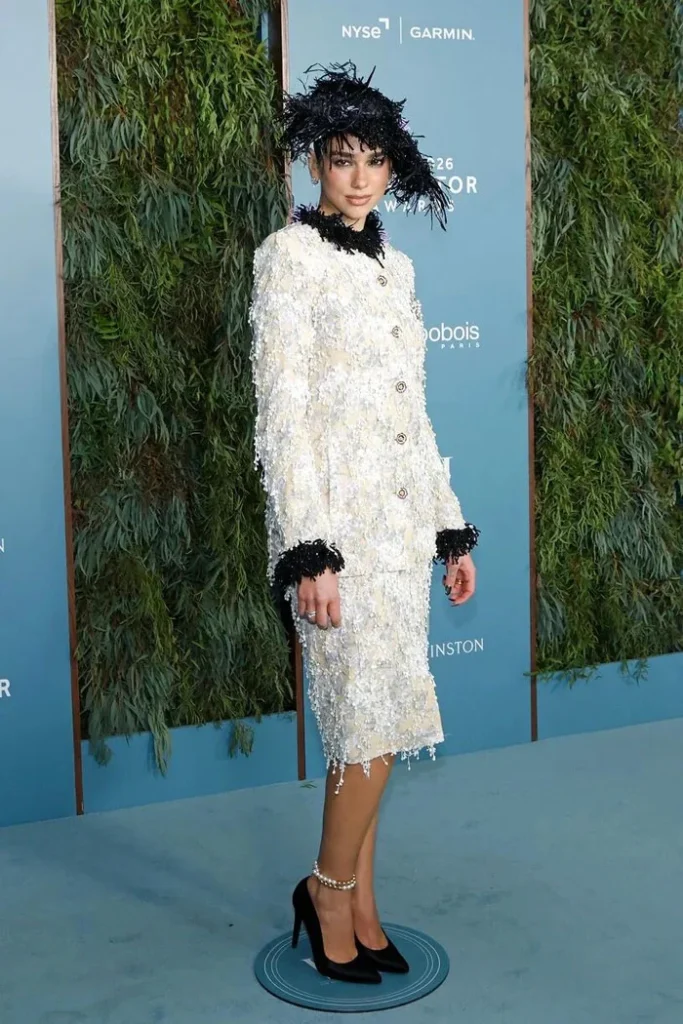
Pop superstar Dua Lipa delivered one of the evening’s most talked-about appearances, stepping out in a striking, highly textural creation from French luxury powerhouse Chanel. The avant-garde piece immediately drew whimsical comparisons from commentators, who joked that the look resembled a high-fashion, rain-weathered iteration of classic mid-century style. Despite its unconventional texture, the garment was widely acknowledged as a masterclass in modern statement dressing. Practical considerations aside—such as the inherent stiffness and auditory impact of the heavily embellished fabric—the look proved to be a formidable photographic moment. Dua Lipa completed the ensemble with statement ankle jewelry, a styling choice that defied traditional proportions but aligned cohesively with the audacious spirit of the overarching design.
Emmy Rossum in Hermès

Emmy Rossum embraced understated luxury, selecting a minimalist yet deeply sensual gown from the storied French leather goods and ready-to-wear house Hermès. The dress relied on clean lines, flawless drape, and supreme fabric quality rather than heavy embellishments to make its impact. By keeping the garment structurally simple, Rossum allowed the inherent craftsmanship of the house to take center stage. Her beauty styling—notably featuring her signature voluminous, cascading hair—served as the ideal textural counterpoint to the sleek, polished silhouette of the dress, demonstrating a masterclass in classic red-carpet restraint.
Lupita Nyong’o in Brandon Maxwell
Academy Award-winning actor Lupita Nyong’o made a triumphant return to the major event circuit, wearing an elegant creation by American designer Brandon Maxwell. Nyong’o, long celebrated for her fearless and vibrant approach to color and silhouette, chose a sophisticated gown notable for its architectural neckline and sculpted collar. The meticulous construction of the upper bodice showcased Maxwell’s tailored precision. While the overall reception of the look was overwhelmingly positive—particularly regarding her immaculate hair and beauty direction—minor critiques were directed at the unorthodox hem length, which some observers felt interrupted the otherwise continuous vertical line of the garment.
Rosalía in Schiaparelli

Spanish singer-songwriter Rosalía brought surrealist flair to the proceedings in a custom ensemble from Schiaparelli. True to the historic fashion house’s theatrical heritage, the design featured sculptural elements and trompe l’œil details that blurred the line between clothing and fine art. The structured jacket showcased intricate tailoring, though critics debated whether the slight tension in the fabric’s fit was an intentional, deconstructed design choice or a sizing miscalculation. Regardless, the look reinforced Rosalía’s standing as one of contemporary music’s most adventurous style ambassadors, willing to embrace high-concept fashion that challenges traditional notions of red-carpet beauty.
Broader Impact and Implications for the Fashion Industry
The fashion choices displayed at the 2026 WSJ. Magazine Innovator Awards offer valuable insight into the current trajectory of the luxury apparel market. As consumer preferences shift toward investments in artisanal craftsmanship, archival revivals, and conceptual design, red-carpet dressing is increasingly utilized as a commercial and artistic testing ground.
Data from luxury retail analytics indicate that high-profile red-carpet placements at cultural galas directly influence digital search volume and immediate e-commerce demand for participating brands. For independent and mid-tier luxury houses like Erdem and LaPointe, exposure alongside heritage giants such as Chanel and Hermès underscores a democratized landscape where conceptual innovation frequently rivals historical prestige in capturing public attention. Furthermore, the prominence of structured tailoring, textural contrasts, and architectural silhouettes signals a definitive move away from traditional, hyper-feminine evening wear toward a more robust, gender-fluid vocabulary of elegance.

As the fall awards season progresses, the standards set at the Museum of Modern Art will undoubtedly reverberate through upcoming international film festivals and fashion weeks, guiding how stylists and celebrities approach the intersection of commerce, art, and personal branding on the global stage.