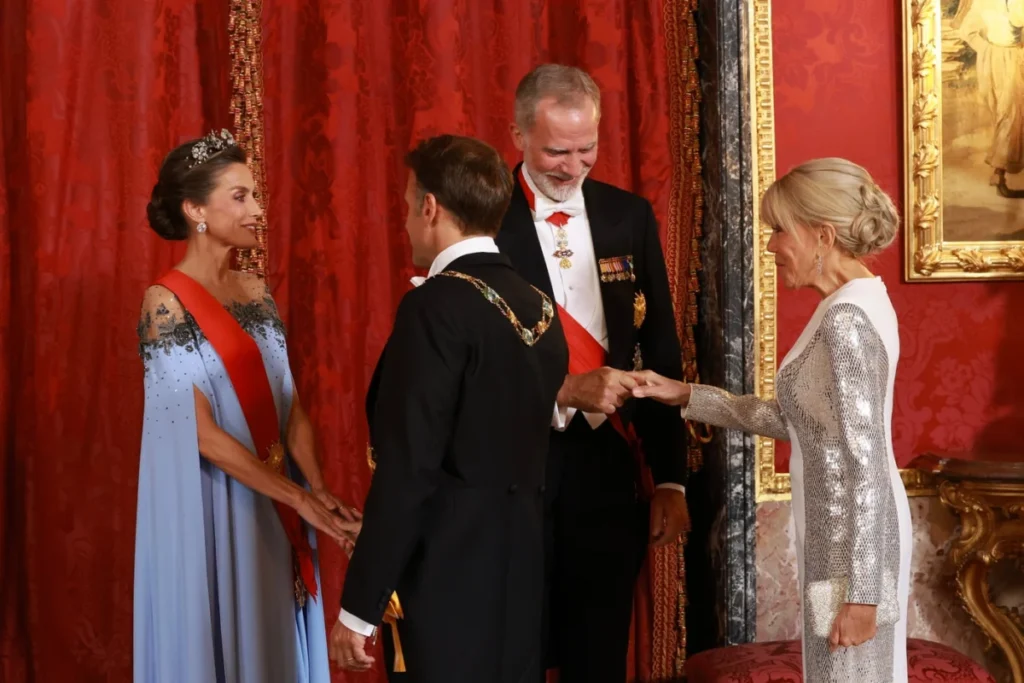

The Royal Palace in Madrid played host to a grand diplomatic gathering as King Felipe VI and Queen Letizia welcomed French President Emmanuel Macron and First Lady Brigitte Macron for a high-profile two-day state visit. Amidst the formal speeches, diplomatic exchanges, and celebrations of shared European heritage, Queen Letizia captured international attention by stepping out in one of her most cherished and historically significant royal heirlooms: the diamond Floral Tiara.
The glittering event, designed to reinforce bilateral ties, economic partnerships, and cultural cooperation between Spain and France, offered a masterclass in modern royal diplomacy. Selecting a delicate yet storied piece of jewelry, paired with an exquisite creation from Spanish luxury house Carolina Herrera, Queen Letizia balanced the solemnity of state traditions with a nuanced nod to republican protocol.
A Diplomatic Wardrobe: Balancing Tradition and Republican Protocol
The choice of the Floral Tiara was far from accidental. State visits involving republican nations—where heads of state do not possess or wear royal regalia—often require a delicate sartorial balancing act. Protocol generally dictates that monarchs scale back their traditional display of jewels to avoid overshadowing guests from non-monarchical states.
This diplomatic sensitivity is a well-established precedent across European royal houses. When French President Emmanuel Macron hosts visiting monarchs, tiaras are rarely, if ever, worn. Notably, when King Felipe and Queen Letizia undertook a state visit to France, the Spanish Queen opted against wearing a diadem. Similarly, Britain’s Queen Camilla chose not to wear a tiara during the state visit of King Charles III to France, breaking slightly with historical traditions once upheld by the late Queen Elizabeth II, who frequently wore tiaras during her international tours.
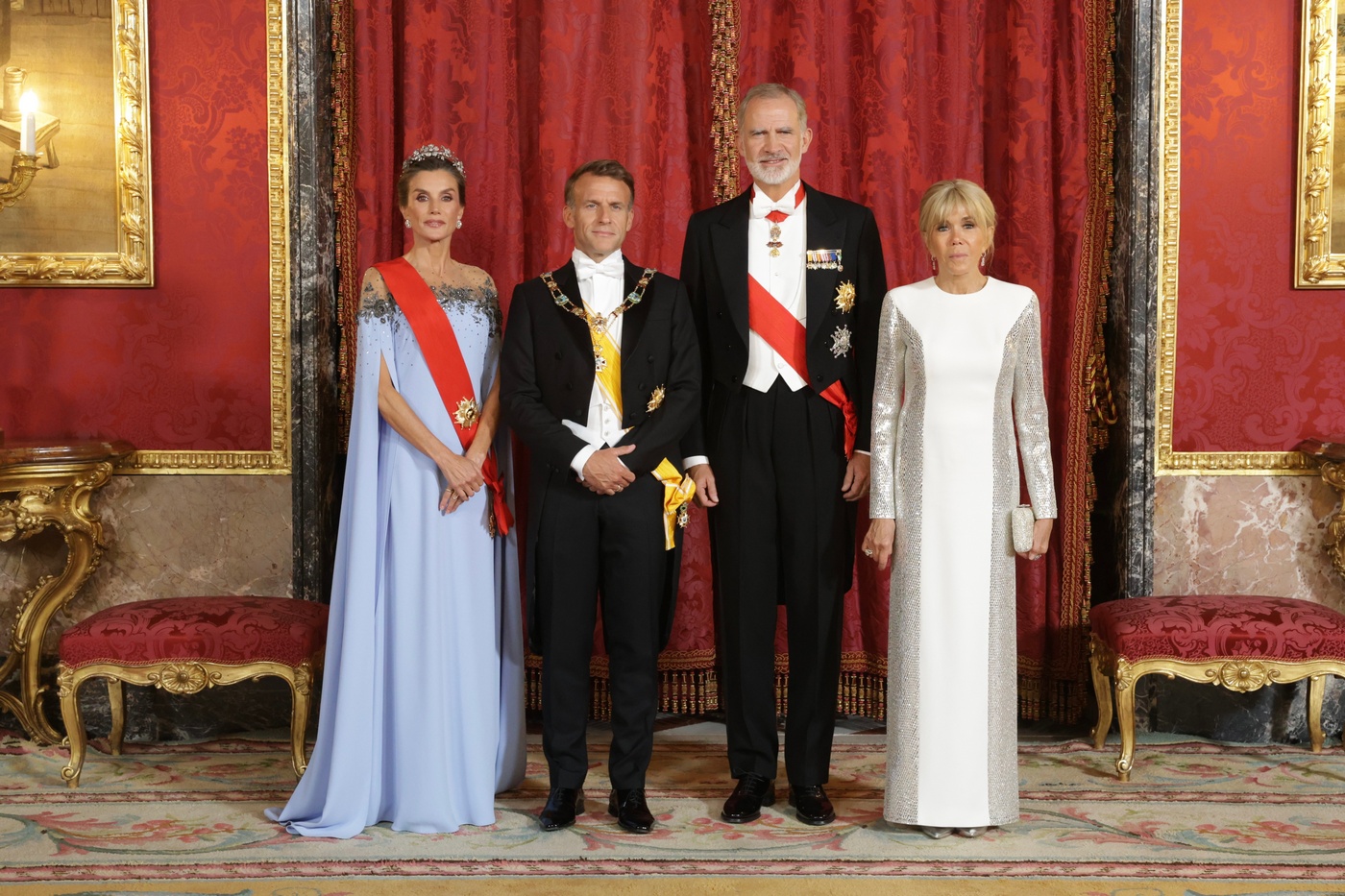
By selecting the Floral Tiara—widely regarded as one of the lighter, more understated pieces in the Spanish royal vault—Queen Letizia demonstrated diplomatic courtesy while maintaining the majestic standards expected of a European queen consort. The diadem’s delicate construction features a sequence of diamond-encrusted floral motifs, presenting a refined elegance that complements, rather than dominates, high-level diplomatic settings.
Sartorial Diplomacy: Celebrating Spanish Fashion
In addition to her historic headwear, Queen Letizia utilized the international spotlight to champion the Spanish fashion industry. For the glittering state banquet, she donned a breathtaking pale blue evening gown designed by Carolina Herrera. The sophisticated dress featured a sheer bodice blanketed in subtle sparkles, dramatic cape-style sleeves, and intricate, labor-intensive embroidery that showcased the pinnacle of Spanish design expertise.
The Spanish press widely lauded the Queen’s choice, praising her consistent efforts to elevate domestic designers on the global stage. This commitment to local fashion had been clearly established earlier in the day, when Queen Letizia stepped out in a polished dress by another renowned Spanish design house, Pertegaz. Through her carefully curated wardrobe, the Queen effectively transformed the state banquet into a showcase of modern Spanish craftsmanship.
The History and Provenance of the Floral Tiara
The tiara chosen for the evening carries a rich and complex provenance spanning more than a century of European history. Created in the 19th century, the diadem entered the Spanish royal collection as a prestigious wedding present. King Alfonso XII gifted the sparkling floral piece to his bride, Archduchess Maria Christina of Austria, upon their marriage.
The tiara’s journey through the 20th century reflects the tumultuous political shifts in modern Spanish history. Following the changes in the Spanish monarchy, the piece was sold outside the royal collection in the early decades of the 20th century. However, it was later repurchased during the Franco era and repurposed as a royal gift. General Francisco Franco presented the historic diara to Princess Sofia of Greece as a wedding gift ahead of her marriage to Juan Carlos of Spain.
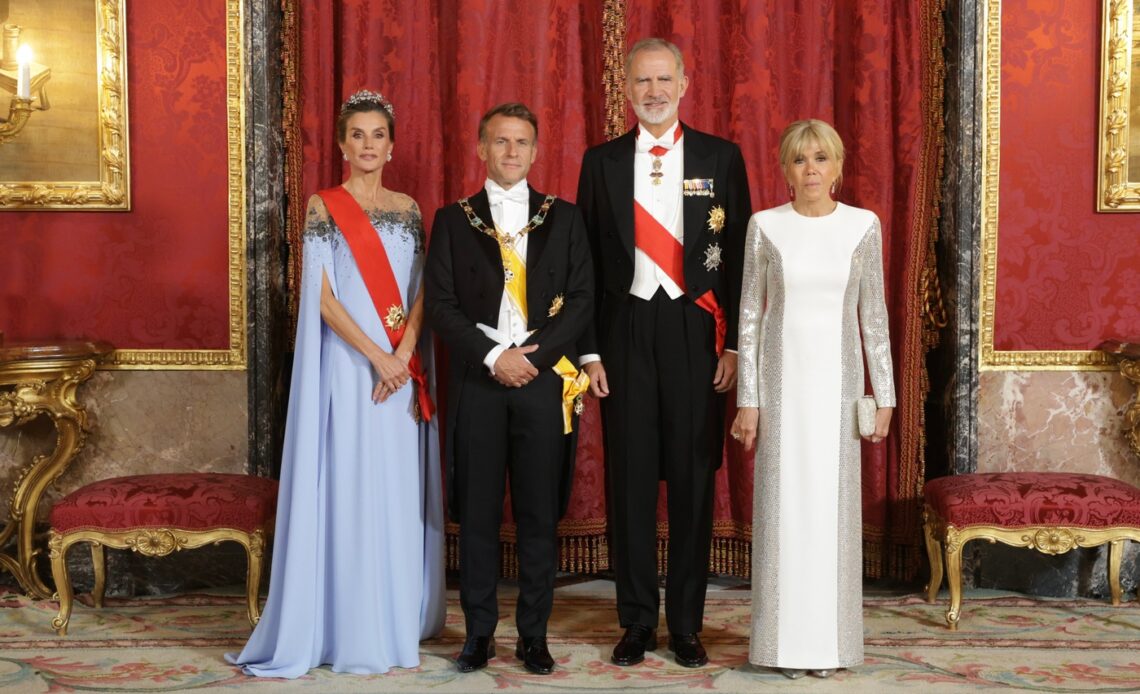
Princess Sofia wore the piece frequently throughout her tenure as Queen of Spain, before eventually passing the tradition down to the next generation. In the early years following her marriage to then-Prince Felipe, Queen Letizia frequently turned to the Floral Tiara for major white-tie events, making its recent reappearance a nostalgic nod to her earlier days within the royal family.
Broadening Bilateral Ties: Economic and Cultural Focus
Beyond the pageantry of the state banquet, the two-day official visit centered on substantive geopolitical and economic discussions between Madrid and Paris. President Emmanuel Macron and King Felipe VI utilized the platform to address shared European Union priorities, cross-border infrastructure projects, green energy transitions, and robust trade partnerships.
Spain and France share deeply entrenched historical, economic, and cultural bonds. During the banquet speeches, both heads of state emphasized the imperative of solidarity within the European framework, highlighting cooperative efforts in security, migration management, and technological innovation. Analysts noted that the warm reception extended to the Macrons underscores Madrid’s strategic intent to fortify its alliance with Paris amid evolving global economic pressures.
As the state visit concluded, the resounding success of the events—marked by cultural appreciation, sartorial elegance, and serious political dialogue—reaffirmed the enduring relevance of modern constitutional monarchies in facilitating international diplomacy.