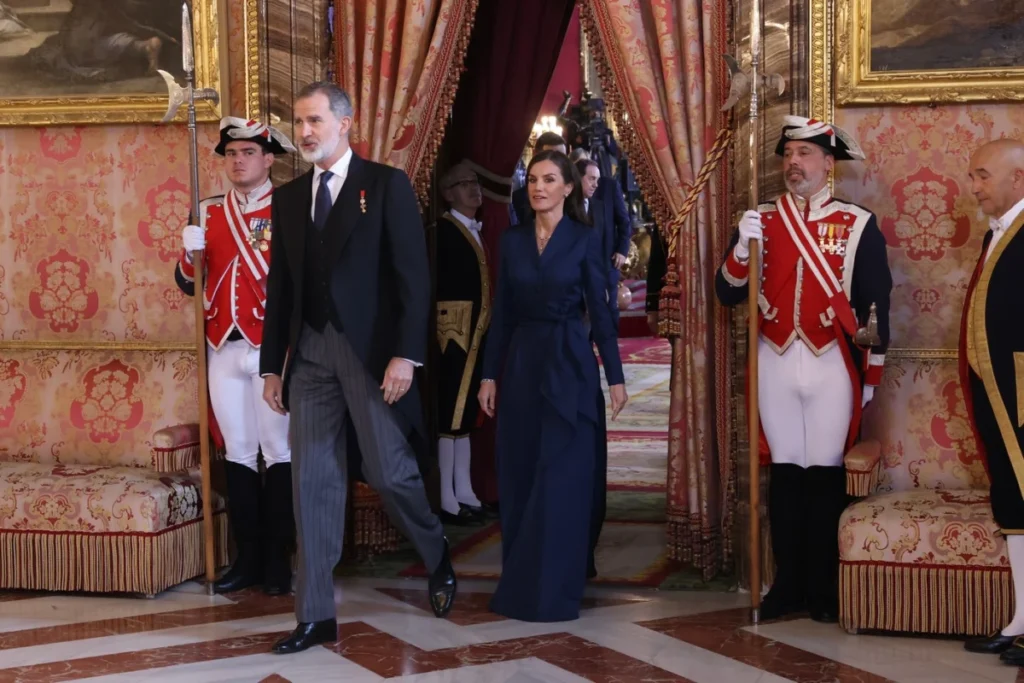

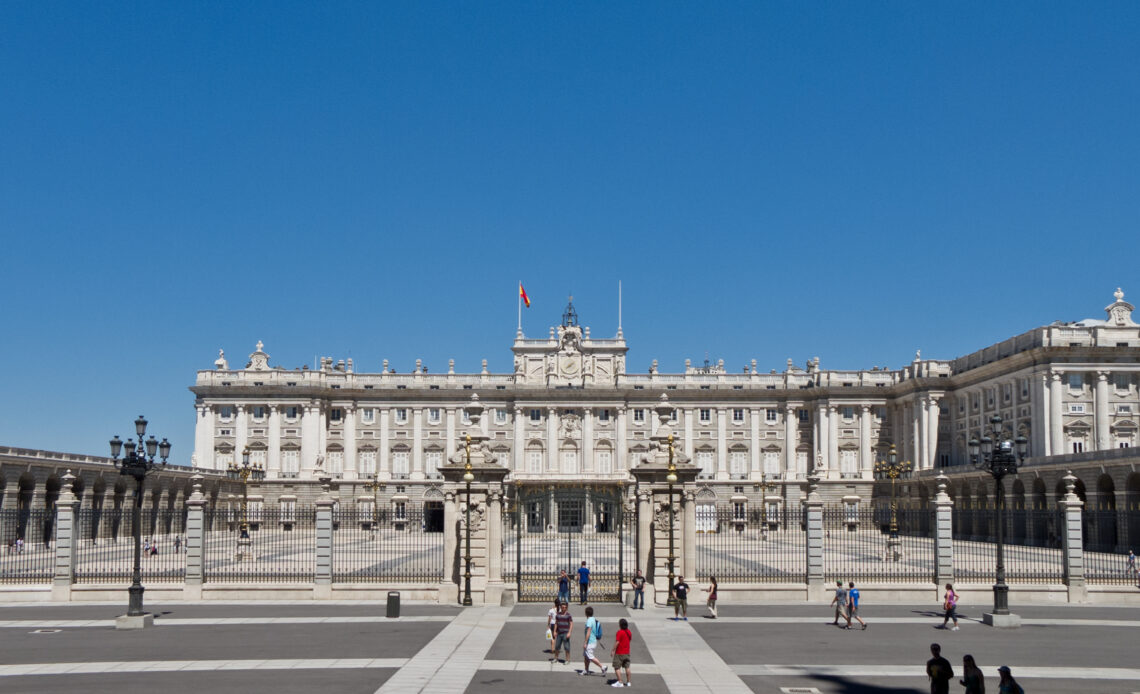
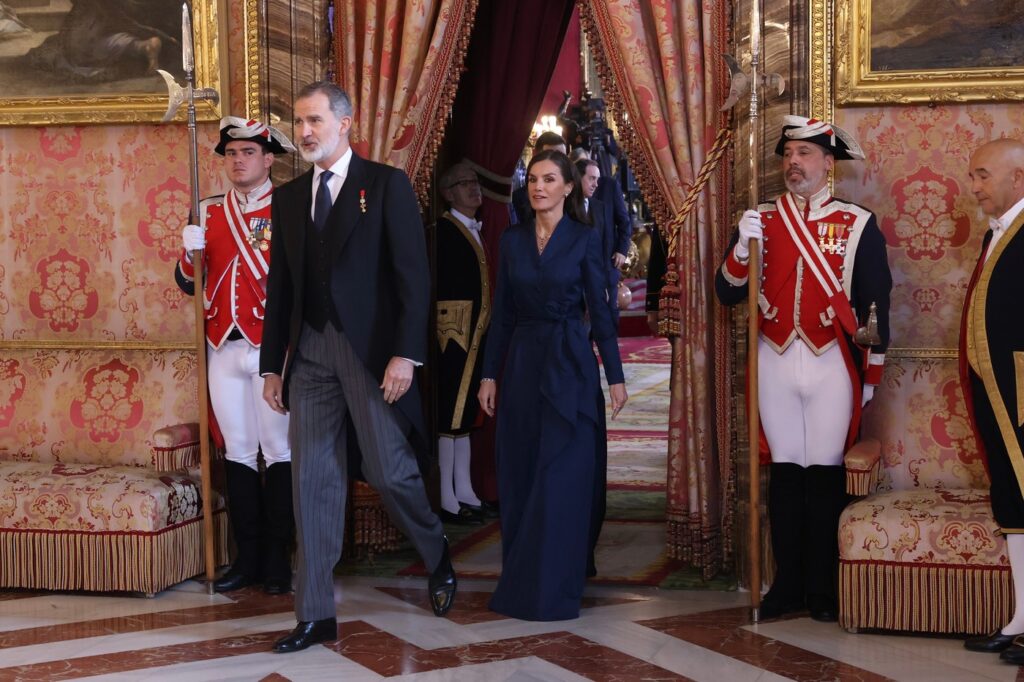
The Royal Palace of Madrid stood as a picture of elegance and diplomatic pageantry as King Felipe VI and Queen Letizia welcomed members of the international diplomatic corps for their annual grand reception. Amidst the sea of formal gowns, military uniforms, and high-level political discourse, it was a subtle yet historic sartorial choice by the Queen of Spain that captured the attention of royal watchers and fashion historians alike. Belying her reputation for favoring understated jewelry and modern minimalism, Queen Letizia chose to debut a magnificent sapphire and diamond necklace that had remained entirely hidden from public view for nearly twenty years.
The appearance of the heirloom piece marked a significant departure from the Queen’s usual wardrobe choices and provided a rare glimpse into the storied vault of the Spanish royal family. The necklace, featuring an intricate arrangement of deep-blue sapphires and brilliant-cut diamonds culminating in a grand drop pearl, carries deep sentimental and dynastic value. Its sudden resurgence at the diplomatic gathering not only underscored the rich heritage of the Spanish crown but also ignited widespread discussions regarding the preservation, rotation, and symbolic weight of royal heirlooms in the modern era.
A Rare Gemstone Resfacing: The Diplomatic Reception Debut
The annual diplomatic reception at the Royal Palace of Madrid is one of the most prominent fixtures on the Spanish royal calendar. Designed to honor the ambassadors, diplomats, and consular officials representing the global community in Spain—a body encompassing over 120 embassies and roughly 800 consulates—the event requires strict adherence to formal white-tie and long-gown protocol.
For the January 2024 iteration of this high-profile assembly, Queen Letizia opted for a sophisticated navy blue long-sleeved gown featuring a crossover bodice and a graceful, flowing skirt. The understated elegance of the dress served as the ideal canvas for her unexpected accessory. Woven discreetly into the neckline was the long-lost sapphire and diamond necklace, its vibrant blue stones catching the light with every movement.
The visual impact was immediate. Sapphires are exceptionally rare within the primary rotation of the Spanish royal jewelry collection, which has historically leaned heavily toward diamonds, rubies, and pearls. By choosing to wear the sapphire suite, Queen Letizia broke away from her contemporary styling norms, injecting a sense of historic continuity and visual splendor into the proceedings.
However, the necklace was not the only focal point of the evening concerning the Queen’s accessories. In a lighthearted and very human moment that quickly circulated among royal reporters, one of Queen Letizia’s diamond bracelets came unlatched and slipped to the floor while she was actively greeting guests. Demonstrating quiet composure, King Felipe VI immediately intervened, bending down to retrieve the piece and assisting his wife in securely refastening it to her wrist before the receiving line continued without interruption.
Chronology of a Vault Heirloom: From Wedding Gift to Twenty-Year Absence
To understand the true significance of Queen Letizia’s jewelry choice, one must trace the timeline of the sapphire necklace back through the recent history of the Spanish monarchy. The piece carries a rich lineage deeply tied to the marital milestones of the royal family.
Originally, the core components of the suite were gifted to Queen Sofia—then Princess Sofia of Greece and Denmark—by her parents, King Paul and Queen Frederica of the Hellenes, to mark her marriage to Juan Carlos I of Spain in May 1962. Over the years, Queen Sofia wore the sapphires selectively for major state functions, valuing them as a tangible link to her Hellenic heritage and her entry into the Spanish royal house.
Decades later, the necklace entered a new chapter of its existence when King Juan Carlos and Queen Sofia chose to present the historic suite to their daughter-in-law, Letizia Ortiz, as a wedding gift prior to her marriage to then-Prince Felipe. The high-profile introduction of the gift to the public occurred on the glittering eve of the royal wedding in May 2004, during a pre-wedding gala held in Madrid that drew royalty and heads of state from across the globe.
Following that celebratory weekend in the spring of 2004, the sapphire and diamond necklace vanished entirely from the public sphere. For nearly twenty years, the piece remained tucked away in the secure confines of the palace vaults. During this extended period, Queen Letizia established a distinct personal style characterized by sleeker, more contemporary jewelry designs, often favoring Spanish fashion labels and demi-fine pieces alongside select historical tiaras. Consequently, royal experts had largely assumed the sapphire suite had been permanently retired or relegated to private family archives, making its January 2024 reappearance a genuine stunner for observers of royal fashion.
Personal Symbolism and the Spanish Royal Collection
Beyond its historical pedigree, the sapphire necklace holds a profound personal connection for the Queen of Spain. Gemstone enthusiasts were quick to note a deliberate astrological and personal alignment in her choice of attire: sapphires are the traditional birthstone for the month of September, and Queen Letizia was born on September 15, 1972.
In the broader context of the Spanish royal collection, sapphires occupy a remarkably scarce position. While British, Dutch, and Swedish royal houses frequently display sprawling parures of blue stones, Spain’s collection is overwhelmingly defined by colorless diamonds and pearls. Queen Sofia possesses a notable ruby necklace that can be transformed into a bandeau-style tiara, but Queen Letizia has notably never worn it in public.
Instead, Queen Letizia’s interactions with high-level historic state jewelry are largely limited to specific crown treasures. Among these is the famed Cartier tiara created for Queen Ena for her wedding over a century ago. Known intimately within the royal household as “La Buena” ("The Good One"), this prized diamond and pearl diadem survived the tumultuous exile of the royal family following the abolition of the monarchy in 1931. Retained as a private family possession, it was restored to prominence when the monarchy was reinstated in 1975. Since that time, the tiara has been worn exclusively by Queens Sofia and Letizia, cementing its status as the ultimate symbol of the Spanish queen consort.
Broader Impact, Implications, and the Future of Royal Heirlooms
The decision to reintroduce the sapphire necklace after two decades carries wider implications regarding the curation and future distribution of Spain’s royal heritage. As monarchies across Europe adapt to modern expectations of transparency and financial prudence, the strategic rotation of existing royal archives—rather than the acquisition of new luxury items—has become the standard protocol for projecting institutional stability.
By unlocking historic pieces like the sapphire suite, Queen Letizia reinforces the continuity of the institution without engaging in unnecessary display. Observers note that such moves signal a deep respect for the predecessors who built the collection, particularly Queen Sofia, who amassed and preserved many of the family’s most treasured dynastic assets.
Furthermore, this careful stewardship of royal gems directly informs the future of the monarchy, specifically concerning the anticipated milestones of the next generation. Princess Leonor, the Princess of Asturias and heir to the Spanish throne, reached her 18th birthday in October 2023, stepping into an increasingly prominent public and constitutional role.
As Princess Leonor prepares for her inevitable future as reigning monarch, royal analysts have turned their attention to the upcoming tradition of her first public tiara appearance. While many of her European royal generational peers have already debuted diadems, Princess Leonor has yet to wear one publicly. The Spanish royal vault houses several delicate "starter" tiaras ideal for such an occasion. Among the leading candidates frequently cited by fashion historians are a Greek-design diamond diadem—loaned by Queen Sofia to Queen Letizia for her 2004 wedding—and an unusual pearl and diamond creation modeled after sea shells that has been favored by both her mother and grandmother.
The return of Queen Letizia’s sapphire necklace demonstrates a dynamic interplay between past and future within the Spanish court. As the Queen reinterprets forgotten heirlooms for modern diplomatic milestones, she simultaneously sets a precedent for how these cultural and historical artifacts will eventually be passed down, ensuring that the visual narrative of the Spanish crown remains as enduring as the gems themselves.