
In the annals of mid-century interior design, few figures possess the whimsical yet structural genius of French designer Jean Royère. His work, characterized by a distinct departure from the rigid, utilitarian minimalism prevalent in the post-war era, bridged the gap between industrial functionality and the fluid, unpredictable grace of the natural world. Central to this aesthetic evolution was his iconic Liane series, a collection of lighting fixtures that transformed cold tubular steel into organic, climbing silhouettes reminiscent of ivy. This design trajectory, which began with a journey to Stockholm in 1949, remains a cornerstone of modern decorative arts, reflecting a pivotal moment when the European design landscape shifted toward more expressive, nature-inspired environments.
The Stockholm Catalyst: An Aesthetic Awakening
The genesis of the Liane collection can be traced to a specific professional excursion undertaken by Royère in 1949. Upon returning from a tour of Scandinavia, Royère published a detailed account of his travels in the French magazine Le Decor d’Aujourd’hui. His report provided more than a mere travelogue; it served as a critique of contemporary interior philosophies. Royère was particularly struck by the design emporium Svenskt Tenn, then under the stewardship of Josef Frank.
At Svenskt Tenn, Royère encountered a philosophy of "jungle-like" integration, where the domestic sphere was not treated as a sterile museum of geometry but as a living organism. He described the experience of navigating the shop as an immersive encounter, noting that one had to "lift aside vines and branches to select a candy dish." This observation profoundly influenced his subsequent work. Royère noted that the Nordic penchant for incorporating climbing plants into interior architecture—ivy snaking along wall mirrors and Virginia creeper trailing from chandeliers—offered a blueprint for a new type of modernism. It was a vision that rejected the cold, clinical lines of the era in favor of a playful, naturalistic dialogue between furniture and the architecture it inhabited.

The Evolution of the Liane Series: From Sketch to Steel
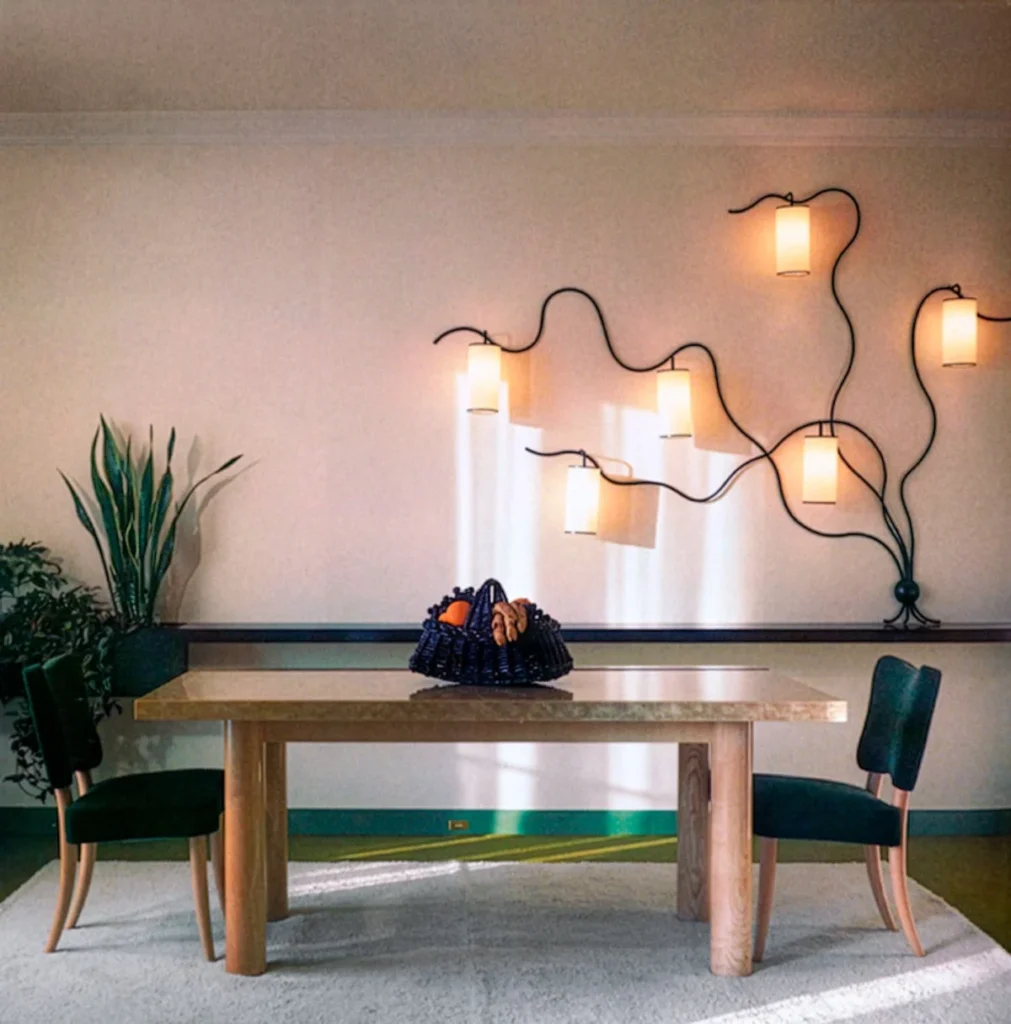
Following his Scandinavian inspiration, Royère began developing the Liane—a name derived from the French word for "vine"—in the early 1950s. The series was characterized by a fundamental technical challenge: how to render the rigid properties of tubular steel into the sinuous, erratic curves of a living plant.
The early iterations of the Liane, conceived in the mid-1950s, functioned as site-specific wall installations. These were not merely light fixtures; they were hand-forged sculptural interventions that seemed to sprout from a singular, weighted block at the base, climbing the wall with a deliberate, wiggly rhythm. As the design evolved, Royère expanded the series to include chandeliers, sconces, and floor lamps.
The technical specifications of these pieces were as deliberate as their aesthetic forms. The tubular steel was often finished with house paint in vibrant hues—coral, deep blue, or classic black—which granted the pieces a unique, matte texture that softened the industrial nature of the material. In rarer instances, the steel was treated with gold leaf to provide a sense of luxury. The light was diffused through cylindrical shades constructed from cellulose acetate, a cutting-edge material of the time, often finished with a color-matched paper trim to ensure visual cohesion.
Bauhaus Influence and the Humanist Departure
While the use of tubular steel inherently links Royère to the Bauhaus movement, which popularized the material for its efficiency and industrial purity in the 1920s and 30s, Royère’s application represented a distinct departure. Where the Bauhaus sought to strip away the decorative to reveal the functional, Royère utilized the functional to create the decorative.

Jonathan Wray, the current creative director at the Royère brand, notes that the designer’s approach was never purely expressive; it was always grounded in structural integrity. "The decorative elements are always structural," Wray asserts, highlighting that even in the most whimsical, tangled iterations of the Liane lamp, the curve serves the purpose of supporting the light source or balancing the weight of the fixture. This duality—the ability to mask complex engineering behind a seemingly spontaneous, hand-drawn aesthetic—is perhaps the most significant aspect of Royère’s contribution to design history.
Chronology of the Royère Revival
The preservation and curation of the Jean Royère archive have become a major enterprise in the 21st century, ensuring that his influence remains intact despite the influx of imitations.
- 1949: Royère visits Stockholm and documents the "jungle" aesthetic of Svenskt Tenn.
- Early 1950s: Initial development of the Liane series begins in Paris.
- 1955: Mid-decade refinement of the wall lights; the aesthetic moves from controlled wiggles to more organic, naturalistic lines.
- 1960s: Expansion of the Liane line into larger chandelier formats for high-end residential clients.
- 2018: The Royère brand is officially revived by Vladimir Markovic, the great-nephew of Royère’s long-term business partner, Micha Djordjevic, to protect the integrity of the original designs.
- Present Day: The brand maintains a strict policy against bespoke modifications of the Liane line, treating each piece as a reproduction of a masterwork rather than a mass-market commodity.
Market Analysis: The Struggle for Authenticity
In recent years, the market for mid-century modern lighting has seen an explosion in demand, leading to a proliferation of low-quality replicas of Royère’s work. These imitations often fail to capture the nuance of the original "hand-forged" feel, opting for machine-bent steel that lacks the organic, irregular rhythm of a true Liane fixture.
The modern-day Royère brand, managed by Markovic and his team, has adopted a stringent approach to this issue. The current catalog offers 35 original variations of the Liane, now manufactured using modern powder-coated steel and high-quality Japanese paper shades. By limiting the production to these 35 canonical forms and refusing to engage in custom or bespoke commissions, the brand maintains the status of the Liane as a work of art rather than a piece of interchangeable furniture.

"It is an expression of his hand," Wray explains. When viewing the original sketches, one can see the evolution of Royère’s line work—from the rigid geometry of his 1930s work to the mature, fluid curves of the 1950s. The result is a light fixture that acts as a wall drawing, a static object that carries the energy of motion.
Broader Implications for Interior Design
The resurgence of interest in Jean Royère’s Liane collection serves as a case study for the cyclical nature of design. In a digital age increasingly dominated by sleek, uniform, and often cold technological aesthetics, the human touch of the Liane—its imperfections, its deliberate wiggles, and its organic silhouette—resonates with contemporary consumers.
Furthermore, the emphasis on structural decoration provides a lesson for modern architects and designers. Royère’s work suggests that there is no inherent conflict between the functional requirement of an object and its ability to inspire wonder. By rejecting the stark austerity of early modernism, Royère created a framework that allowed for personality and nature to exist within the interior space.
As historical archives continue to be digitized and analyzed—such as the records housed at the Musée des Arts Décoratifs—the legacy of Royère remains secure. The Liane, once a radical departure from the norm, now stands as a timeless bridge between the industrial age and the organic future. For the collectors and design enthusiasts of today, these fixtures represent more than just illumination; they represent the successful marriage of the machine-made with the artistic spirit, a legacy that remains as relevant today as it was in the post-war ateliers of Paris.