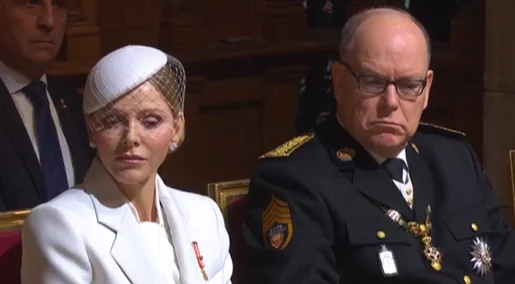

The Principality of Monaco’s sovereign couple traveled to northeastern France to participate in a high-level European peace conference, where Princess Charlene observed a rare and centuries-old Vatican protocol by wearing an all-white ensemble. Accompanied by Prince Albert II, the Princess joined international dignitaries, religious leaders, and heads of state in Metz for the gathering titled At the Roots of Europe: For Peace and Unity, which served as the culminating event of Pope Leo XIV’s four-day pastoral journey across France.
The royal delegation was officially received by French President Emmanuel Macron and First Lady Brigitte Macron at the Robert Schuman Conference Centre. The high-profile assembly also drew other notable European royals, including Grand Duke Guillaume of Luxembourg, highlighting the intersection of traditional European statecraft, modern geopolitics, and faith-based diplomacy. Central to the day’s proceedings was an address delivered by Pope Leo XIV, who tackled urgent transnational challenges such as migration, armed conflict, and the enduring quest for European unity.
Against the backdrop of these geopolitical discussions, Princess Charlene’s wardrobe choice drew significant attention from protocol experts and royal watchers alike. Clad in a sophisticated white Dior trousersuit accessorized with a matching Lady D-Joy handbag, the Princess invoked the privilège du blanc—or the "privilege of white"—an exclusive dispensation permitting specific Catholic royal women to wear white in the presence of the supreme pontiff, departing from the standard black attire traditionally mandated for female visitors.
Main Facts of the Papal Visit and Diplomatic Gathering
The conference in Metz marked a pivotal stop during Pope Leo XIV’s multi-day apostolic voyage through France, a journey designed to foster interreligious dialogue, address pressing humanitarian concerns, and engage with secular European leaders. The Robert Schuman Conference Centre, named after one of the founding fathers of the European Union, provided a symbolic venue for discussions centered on peace, solidarity, and the moral responsibilities of European nations in the face of modern crises.
Pope Leo XIV’s address to the assembled leaders focused heavily on the sociopolitical realities shaping contemporary Europe. The pontiff remarked that the continent was entering a new and complex stage in its long history, driven largely by the arrival of vulnerable populations fleeing war, persecution, and economic devastation across the Mediterranean and Middle Eastern corridors. Emphasizing the humanitarian imperative of integration and compassion, the Pope called upon European governments to reject isolationism and instead build frameworks rooted in shared ethical principles.
Prince Albert II and Princess Charlene maintained a visible and active presence throughout the proceedings, engaging in bilateral discussions with French state officials and regional representatives. The presence of Grand Duke Guillaume of Luxembourg further underscored the deep historical ties between European monarchies and the Holy See, reinforcing a shared commitment to diplomatic engagement and cultural preservation within the European Union.
Chronology of the Event and Associated Itinerary
The sequence of events surrounding the Metz conference formed part of a meticulously planned four-day pastoral itinerary that took Pope Leo XIV to several key regions in France.
Day One and Two commenced with formal arrival ceremonies in Paris, where the pontiff was greeted by civil authorities and representatives of the French episcopate. Initial engagements centered on secular-religious relations, the heritage of French Catholicism, and the church’s role in contemporary French society, famously characterized by its strict separation of church and state, or laïcité.
Day Three transitioned toward broader European themes, featuring theological symposia and closed-door meetings addressing environmental stewardship and economic justice. During this phase, preparations were finalized for the regional summit in Metz, a city chosen for its historical significance as a crossroads of Germanic and Romance cultures and a historic symbol of European reconciliation following decades of twentieth-century conflict.
Day Four, occurring on Monday, marked the culmination of the tour at the Robert Schuman Conference Centre. The morning began with the official reception of Prince Albert II, Princess Charlene, Grand Duke Guillaume, and other dignitaries by President Emmanuel Macron and Brigitte Macron. Following formal handshakes and diplomatic pleasantries, the principals entered the main auditorium for the keynote addresses, culminating in Pope Leo XIV’s speech on European unity and migration. The afternoon concluded with a private audience and departure ceremonies, marking the formal closure of the papal journey to France.
Supporting Data and Protocol Analysis: The Privilège du Blanc
The historical weight of Princess Charlene’s attire lies in the rigid and deeply codified etiquette governing audiences with the Bishop of Rome. Under traditional Vatican protocol, female visitors meeting the Pope are expected to wear formal black clothing, typically accompanied by a black mantilla—a traditional lace veil—covering the head. This custom serves as a sign of humility, solemnity, and respect for the office of the papacy.
However, an exclusive exception exists known as the privilège du blanc (in Italian, privilegio del bianco). This centuries-old concession is not granted automatically to all Catholic women, nor is it available to queens or princesses of non-Catholic nations. Instead, it is a discretionary privilege extended specifically to certain Catholic queens, princesses, and grand duchesses reigning in Catholic monarchies or representing historically Catholic royal houses that maintain formal concordats or close diplomatic traditions with the Holy See.
Currently, this elite designation is held by fewer than ten royal women worldwide. Alongside Princess Charlene of Monaco, those entitled to exercise the privilege include:
- Queen Letizia of Spain
- Queen Mathilde of Belgium
- Grand Duchess Maria Teresa of Luxembourg
- Princess Charlene’s fellow Monégasque royals under specific historical dispensations
- Select members of other historically recognized Catholic royal houses, such as the House of Savoy or the House of Bourbon-Two Sicilies, depending on dynastic recognition and specific papal permissions.
Brigitte Macron, as the spouse of the head of state of the French Republic—a secular state without an established official religion—did not hold this privilege and accordingly wore traditional black attire in alignment with standard diplomatic etiquette for non-privileged visitors.
Princess Charlene’s history with this protocol dates back to January 2013, when she first exercised the privilège du blanc during an official audience with Pope Benedict XVI at the Vatican, dressed in an immaculate white dress and matching lace mantilla. Her recent appearance in Metz demonstrates continuity with this rare tradition, even outside the physical confines of Vatican City. While the privilege formally applies to audiences held within the Vatican Apostolic Palace, popes have historically permitted entitled royal women to wear white during official papal visits conducted in other sovereign territories, reflecting the portability of traditional royal prerogatives during state engagements.
Official Responses and Institutional Implications
While neither the Palais Princier de Monaco nor the Holy See issued exhaustive commentary regarding the stylistic choices made during the conference, institutional observers have noted the profound symbolic value of such high-level gatherings. The juxtaposition of ancient ecclesiastical protocols, such as the privilège du blanc, with modern geopolitical debates on migration and European integration highlights the unique dual identity maintained by modern European principalities.
Political analysts suggest that the presence of sovereign heads of state and royal figures at a conference addressing migration and unity serves to amplify humanitarian appeals on the global stage. By lending their institutional weight to Pope Leo XIV’s message, leaders like Prince Albert II and Grand Duke Guillaume reinforce the moral dimensions of European policymaking, particularly concerning humanitarian crises along Europe’s southern and eastern borders.
Furthermore, the smooth execution of diplomatic protocol between the French Republic, the Principality of Monaco, the Grand Duchy of Luxembourg, and the Holy See underscores the enduring relevance of traditional diplomacy in navigating contemporary transnational challenges. The event in Metz successfully bridged centuries-old ceremonial traditions with urgent, forward-looking discussions on the future stability, security, and human rights standards of the European continent.