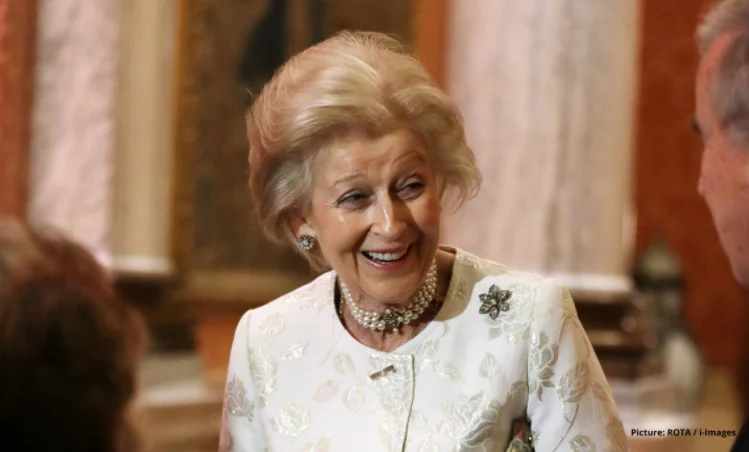

Princess Alexandra, a cherished member of the British Royal Family, has entered a new and significant chapter in her life, becoming a great-grandmother for the first time. Her granddaughter, Flora Vesterberg (née Ogilvy), and her husband, Timothy Vesterberg, joyfully announced the arrival of their first child, a baby girl, on July 11th, 2026. The announcement, made via Instagram, was carefully timed to allow the new parents and their precious daughter a few days to settle in and recover.
The arrival of this new addition to the extended Royal Family marks a milestone for the 89-year-old Princess Alexandra, the youngest child of Prince George, Duke of Kent, and Princess Marina of Greece and Denmark. The baby girl, who holds the 62nd position in the line of succession to the British throne, was born on July 8th, 2026.
Flora Vesterberg, 31, shared the heartwarming news alongside a tender photograph of her newborn daughter. The infant was dressed in a charming ensemble featuring bright white with delicate blue trim. This choice of colour holds historical significance, as blue has been traditionally associated with baby girls for centuries, reflecting a long-standing sartorial custom within royal and aristocratic circles.
Flora is the daughter of James Ogilvy, the only son of Princess Alexandra and her late husband, Sir Angus Ogilvy. This familial connection underscores the deep-rooted lineage and continuity within the Royal Family. Flora’s pregnancy was announced earlier this year, and she was last publicly seen attending the wedding celebrations of her cousin, Lady Marina Windsor, at Hovingham Hall, a picturesque estate in North Yorkshire, just weeks before the birth of her daughter.
The name chosen for the newest member of the extended Royal Family is Isabel Marina. Flora and Timothy Vesterberg thoughtfully explained the significance behind their daughter’s name, offering insight into their personal values and family heritage. Flora elaborated that the name "Isabel" derives from "of the sea," a place where she and her husband "always feel most at peace." This choice reflects a personal connection to nature and tranquility.
Furthermore, the inclusion of "Marina" in her daughter’s name is a direct and poignant tribute to Flora’s paternal great-grandmother, Princess Marina of Greece and Denmark. Flora acknowledged that she never had the opportunity to meet Princess Marina, who passed away in 1968. This naming convention serves as a beautiful way to honour and remember a significant ancestral figure, weaving a thread of continuity through generations.
Princess Marina of Greece and Denmark was a highly respected and beloved member of the Royal Family. She married Prince George, Duke of Kent, in 1934, and their union produced three children: Edward, the current Duke of Kent (born 1935); Prince Michael of Kent (born 1942); and Princess Alexandra (born 1936), who coincidentally was born on Christmas Day, a fortnight after the abdication of King Edward VIII. Princess Marina’s legacy is one of grace, duty, and public service, and her memory continues to resonate within the family.
The name "Isabel" itself carries a rich tapestry of history, particularly within royal circles. Meaning "God is my oath," it has seen a resurgence in popularity and has been adopted by several members of the Royal Family in recent years. Lord Frederick Windsor and his wife, Sophie Winkleman, for instance, named their second daughter Isabella. Historically, the name and its variants were less common for centuries, but during the Middle Ages, "Isabel" was a preeminent royal name, borne by several influential Queens of England.
Notable historical figures named Isabel include Queen Isabella, the wife of King John, and Queen Isabella of France, the second wife of Edward II. Known as the "She-Wolf of France," she played a pivotal role in the deposition of her unpopular husband. Another significant figure was Isabelle of Valois, who, at the tender age of six, was married to King Richard II. Following his deposition in 1399, she was kept in close confinement before returning to France, where she tragically died young. Her sister, Katherine of Valois, married Henry V. After Henry’s death, she married Owen Tudor, and their grandson, Henry VII, ascended to the throne, establishing the Tudor dynasty. It is through this lineage that not only Charles III but also Flora Vesterberg are directly descended, highlighting the intricate web of royal connections and shared ancestry.
A Timeline of Royal Generations
The birth of Isabel Marina Vesterberg represents a tangible link in a long and distinguished chain of royal lineage. To fully appreciate the significance of this event, a brief chronological overview of the relevant generations is illuminating:
- 1901: Princess Marina of Greece and Denmark is born.
- 1934: Princess Marina marries Prince George, Duke of Kent.
- 1935: Edward, Duke of Kent, is born.
- 1936: Princess Alexandra is born on Christmas Day.
- 1937: Prince Michael of Kent is born.
- 1963: Princess Alexandra marries The Honourable Sir Angus Ogilvy.
- 1968: Princess Marina of Greece and Denmark passes away.
- 1974: James Ogilvy is born, the only son of Princess Alexandra and Sir Angus Ogilvy.
- 1993: Flora Ogilvy (now Vesterberg) is born.
- 2001: Sir Angus Ogilvy passes away.
- 2022: Flora Ogilvy marries Timothy Vesterberg.
- July 8th, 2026: Isabel Marina Vesterberg is born.
- July 11th, 2026: The birth announcement is made public.
This timeline illustrates the progression of descendants and the enduring presence of the Royal Family across decades. The birth of Isabel Marina Vesterberg adds a fresh chapter to this ongoing narrative.
Supporting Data and Royal Connections
The inclusion of "Marina" in the baby’s name is a direct nod to Princess Marina, a figure of considerable importance in British royal history. Princess Marina was the paternal grandmother of James Ogilvy and thus the great-grandmother of Flora Vesterberg. Her life and marriage to Prince George, Duke of Kent, a son of King George V and Queen Mary, placed her firmly within the core of the British monarchy. Her popularity was significant, and her death at the age of 61 was widely mourned.
The name "Isabel" has a particularly strong resonance with the English monarchy. Beyond Queen Isabella, wife of King John, and Isabella of France, wife of Edward II, numerous European royal houses have featured prominent figures named Isabel or variations thereof. The historical significance of the name, particularly its association with queens and powerful female figures, adds a layer of gravitas to the Vesterbergs’ choice. The fact that this name has seen a modern resurgence, as seen with the naming of Lord Frederick Windsor’s daughter, further solidifies its continued relevance and appeal within contemporary royal circles.
Broader Impact and Implications
The birth of Isabel Marina Vesterberg, while a personal joy for her family, also has broader implications within the context of the British monarchy. As the 62nd in line to the throne, her existence underscores the continuity of the succession and the ever-expanding family tree of the reigning monarch. Each new birth within the extended Royal Family serves as a reminder of the institution’s enduring nature and its capacity for renewal.
The announcement, disseminated through social media, reflects the modern approach adopted by many royal and public figures in sharing significant life events. Instagram, in particular, has become a primary platform for personal updates, allowing for direct engagement with a global audience while maintaining a degree of curated intimacy. The Vesterbergs’ choice to share their daughter’s photograph and the story behind her name provides a glimpse into their family values and heritage, fostering a connection with the public.
The naming of the child, with its clear links to both contemporary and historical royal figures, also highlights the importance of tradition and lineage within the Royal Family. The deliberate choice to honour Princess Marina, a beloved ancestor, and to select a name with such a rich royal past, speaks to a conscious effort to maintain these connections and pass them down to future generations.
In conclusion, the arrival of Isabel Marina Vesterberg marks a joyous occasion for Princess Alexandra and her family. It is a moment that celebrates new life, honours ancestral heritage, and reinforces the ongoing narrative of the British Royal Family. The choice of names, rich with historical and personal significance, provides a compelling insight into the Vesterberg family’s values and their connection to the broader tapestry of royal history. As the newest and youngest member of the extended Royal Family, Isabel Marina’s birth heralds a new era of connection and continuity.