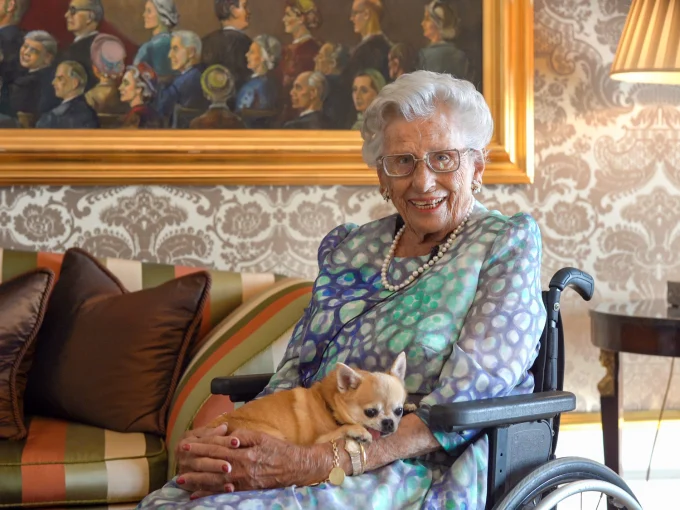

The Kingdom of Norway is in deep mourning following the passing of Princess Astrid, Mrs. Ferner, who has died at the age of 94. Her death, announced by King Haakon VIII, comes just two days after the solemn state funeral of her younger brother, King Harald V, and exactly a fortnight after his passing. Princess Astrid’s death marks the end of an extraordinary era for the House of Glücksburg, closing a chapter on a royal life that spanned nearly a century of monumental historical change, resilience, and dedicated public service.
The princess had experienced declining health earlier this year, prompting her to wind down her demanding schedule of public engagements following a period of hospitalization. Despite her frail condition, she made a deeply moving final public appearance on September 9 at Oslo Cathedral, attending the funeral service of her brother, King Harald. Images of the elderly princess mourning over his coffin captured a poignant moment of familial grief that resonated deeply across the nation. Her passing on September 11 leaves a profound void at the heart of the Norwegian monarchy, where she was long regarded as a pillar of stability, tradition, and unwavering loyalty.
Early Life, Royal Lineage, and World War II Exile
Born Astrid Maud Ingeborg on February 12, 1932, at the Royal Palace in Oslo, she was the second child and second daughter of Crown Prince Olav and Crown Princess Märtha. Her birth was a historic milestone for the Scandinavian nation, as she became only the second member of Norway’s modern royal family to be born on home soil since the restoration of the monarchy in 1905. Through her mother, she possessed close ties to British royalty, being a great-granddaughter of King Edward VII and Queen Alexandra, connections that helped cement the international standing of the young Norwegian royal house.
At the time of her birth, the rules of succession strictly barred female heirs from ascending the throne. Consequently, Princess Astrid was never in the direct line of succession, a reality that shifted significantly with the birth of her younger brother, Harald, in 1937.
Princess Astrid’s formative years were profoundly shaped by the turbulence of the Second World War. Following the sudden and violent Nazi invasion of neutral Norway in April 1940, the royal family faced immediate peril. To protect the heirs to the throne, Crown Princess Märtha fled into exile with young Astrid, her older sister Princess Ragnhild, and her younger brother Harald. After a harrowing journey through Sweden, the family found refuge in the United States, where they resided in Washington, D.C., under the protection of President Franklin D. Roosevelt and the U.S. government.
This period of exile fostered a lifelong resilience in the young princess. Following the liberation of Europe, the family returned triumphantly to Norway in 1945, when Astrid was 13 years old. She resumed her education in Oslo before traveling abroad to study economics and political history at Oxford University, equipping her with a sophisticated understanding of global affairs that would later inform her public duties.
Assuming the Role of First Lady and Overcoming Controversy
The tragic death of Crown Princess Märtha in 1954 at the age of 40 marked a profound turning point for the royal family and for Princess Astrid personally. Three years later, in 1957, her grandfather King Haakon VII passed away, and her father ascended the throne as King Olav V. Because her older sister Princess Ragnhild had already married businessman Erling Lorentzen and relocated to Brazil, Princess Astrid stepped forward to assume the demanding ceremonial duties of Norway’s first lady.
For over a decade, Princess Astrid served as her father’s constant companion, hosting foreign dignitaries, managing state functions, and representing the monarchy with poise and elegance. However, her position at the center of the royal establishment faced a major test when she made the personal decision to marry.
In January 1961, Princess Astrid married Johan Martin Ferner, a prominent Oslo businessman, sailor, and Olympic medalist. The union sparked significant public debate and constitutional discussion at the time because Ferner was a commoner and a divorcé. Defying conservative social norms of the era, Princess Astrid remained resolute in her choice. The wedding ceremony at Asker Church was a watershed moment for the Norwegian monarchy, signaling a gradual modernization of royal traditions. The couple went on to build a deeply devoted life together, raising five children: Cathrine, Benedikte, Alexander, Elisabeth, and Carl-Christian.
A Lifetime of Dedicated Public Service and Legacy
Even after relinquishing her role as first lady following her brother Harald’s marriage to commoner Sonja Haraldsen in 1968, Princess Astrid never slowed down her commitment to public service. Throughout her exceptionally long life, she maintained a rigorous calendar of patronages and engagements, focusing her efforts on causes close to her heart, including children with disabilities, dyslexia, cultural heritage, and sports.
She was a visible and reassuring presence at major national events, jubilees, and state visits. In recent years, as the broader European royal landscape navigated various controversies and familial tensions, Princess Astrid remained a steadfast symbol of continuity. Her profound devotion to King Harald V throughout his decades-long reign was widely recognized and admired by the Norwegian public. The bond between the siblings was exceptionally tight, forged in the fires of wartime exile and cemented by a shared dedication to the nation.
Broader Impact, Implications, and Official Responses
The passing of Princess Astrid closes a living bridge to Norway’s wartime history and the foundational years of its modern constitutional monarchy. As the last surviving child of King Olav V and Crown Princess Märtha, her death severs the final direct link to the generation of royals who guided Norway through the trauma of the Second World War and the subsequent decades of post-war rebuilding.
In the wake of her passing, expressions of grief and profound respect poured in from across the political and social spectrum in Norway. Government officials, civil society leaders, and foreign royal houses extended their condolences to the royal family and to her five children, grandchildren, and great-grandchildren.
Commentators and historians note that while the Norwegian monarchy now enters a new era under the next generation, the memory of Princess Astrid will endure. She is remembered not merely as a princess by birth, but as a woman who navigated personal controversy with grace, fulfilled her public duties with unwavering dedication, and served her country through times of immense triumph and profound personal sorrow. Her legacy remains permanently woven into the national identity of modern Norway.