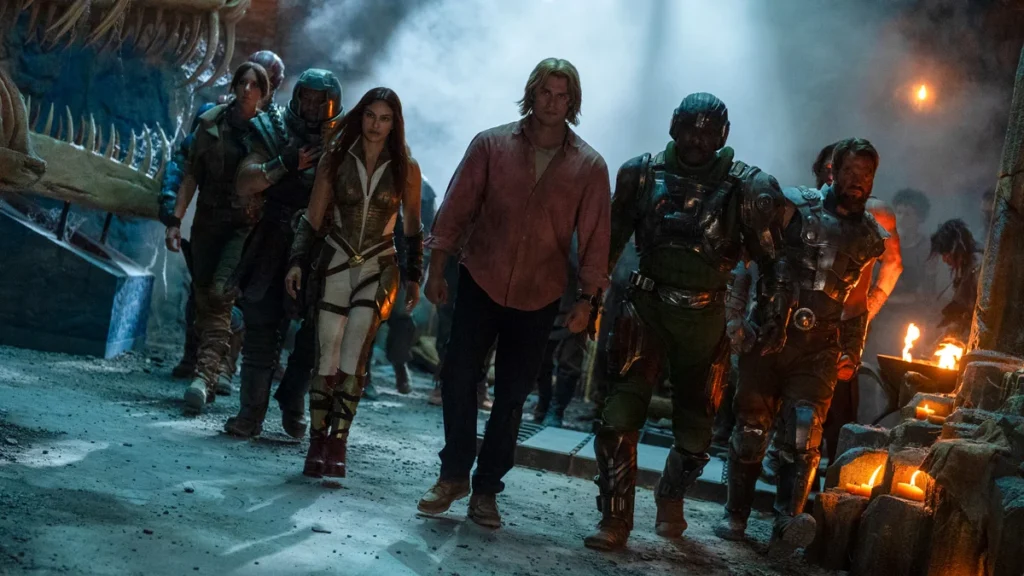

Amazon MGM Studios has officially launched its highly anticipated live-action adaptation of Masters of the Universe, marking a significant moment for fans of the iconic 1980s franchise. The film, directed by Travis Knight and featuring Nicholas Galitzine as Prince Adam/He-Man and Jared Leto as Skeletor, has premiered with a distinctive comedic and self-aware tone, intentionally leaning into the inherent absurdity of the source material rather than attempting a grim, serious interpretation. This creative decision, particularly evident in the faithful retention of He-Man’s famously scant costume, signals a deliberate strategy to entertain audiences through humor and homage, sometimes at the expense of its hero.
The Genesis of Eternia: A Legacy of Adaptation Challenges
The Masters of the Universe franchise originated in 1982 as a line of action figures from Mattel, quickly expanding into a hugely successful animated television series, He-Man and the Masters of the Universe (1983-1985), produced by Filmation. Known for its blend of sci-fi and fantasy elements, memorable characters, and a distinct moral lesson at the end of each episode, the series captured the imaginations of a generation. The core narrative revolves around Prince Adam of Eternia, who, by raising his Sword of Power and uttering the iconic phrase "By the Power of Grayskull, I have the Power!", transforms into the mighty He-Man, defender of Castle Grayskull against the evil forces of Skeletor.
Adapting such a unique property to live-action has long been a cinematic challenge. The 1987 film, starring Dolph Lundgren as He-Man and Frank Langella as Skeletor, attempted a more serious tone but struggled to balance the fantastical elements with its grounded narrative, ultimately becoming a cult classic rather than a mainstream success. For decades, various studios and filmmakers have grappled with how to bring He-Man back to the big screen, often getting mired in development hell. Projects at Warner Bros., Sony Pictures, and Netflix have been announced and subsequently stalled, each struggling with the core dilemma: how to make a character in a fur loincloth and metal harness, wielding a magical sword, palatable to modern, often cynical, audiences without sacrificing the spirit of the original.
The primary hurdle has consistently been the visual aesthetics and inherent campiness of the 1980s design. In a 21st-century cinematic landscape often dominated by gritty reboots and dark superhero narratives, the vibrant, often outlandish world of Eternia presented a paradox. Director Travis Knight and the screenwriters for this Amazon MGM Studios production appear to have found their solution by fully embracing this paradox, recognizing that a straightforward, humorless take on He-Man’s iconic look would likely invite ridicule. Instead, they opted for a meta-narrative that acknowledges and plays with the audience’s perception of the material.
A New Vision for Eternia: Plot and Tone
The film commences with an extended introduction establishing Prince Adam’s early life on Eternia, detailing the pressures he faced and the eventual invasion by the malevolent Skeletor, which plunges the kingdom into darkness. To ensure his safety, the young Adam is sent from Eternia to Earth, losing hold of the Sword of Power during his interdimensional journey. This foundational narrative sets the stage for Adam’s disconnected adulthood.
Years later, an adult Adam (Nicholas Galitzine) is depicted living a mundane life on Earth as a human resources consultant. His past as an exiled prince from another planet is a tale no one believes, least of all his hilariously deadpan roommate, Christian Vunipola, or his boss, Sasheer Zamata, who calls him out for his persistent obsession with locating the lost Sword of Power. This terrestrial phase of Adam’s life serves as a comedic interlude, contrasting his fantastical origins with the banality of modern existence, highlighting his perceived weakness before his heroic destiny is fully realized.

The narrative gains momentum when Adam eventually reclaims the Sword of Power, discovered ironically as merchandise in a comic book shop. This retrieval is quickly followed by an encounter with the literally named Beast Man, a giant creature sent to eliminate him. Timely intervention comes from his childhood friend, Teela (Camila Mendes), who helps Adam battle Beast Man and facilitates his return to a ravaged Eternia. Fifteen years under Skeletor’s tyrannical rule have transformed his homeland. With remnants of his father’s loyal soldiers still fighting, Adam finally unlocks his full powers, transforming into the muscle-bound He-Man and evening the odds against Skeletor’s forces.
Crafting the Camp: Performances and Creative Choices
The film’s success hinges on its ability to maintain a deadpan approach to its most outlandish elements, a strategy that largely resonates with audiences who do not hold the He-Man franchise as sacred. The inherent child-like imagination of the original series – a mash-up of robots, swords, magic, talking tigers, and a skull-faced villain – is embraced by director Travis Knight. This take even provides "vaguely rational explanations" for the delightfully silly names of characters like Mekaneck, Ram-Man, and Fisto, further cementing the film’s self-aware stance.
Nicholas Galitzine’s portrayal of Adam/He-Man has been particularly noted for his refreshing lack of ego. Having previously demonstrated a versatile range in roles such as an aloof gay prince in Red, White, and Royal Blue and a quirky journalist in The Sheep Detectives, Galitzine approaches He-Man’s goofiest qualities with enthusiasm, even after fully acquiring his powers. His performance is central to the film’s comedic success, making the audience laugh with the character’s predicament rather than at him in a derogatory way.
The supporting cast also delivers memorable performances that align with the film’s tone. Idris Elba takes on the role of Duncan, or Man-at-Arms, Adam’s former mentor. Elba’s character arc, depicting his struggles with past failures and subsequent journey to recovery, allows the seasoned actor to explore a more complex, albeit still humorously framed, role. Alison Brie, as Evil-Lyn, has received significant praise for her understanding and embodiment of the character. She reportedly "glories" in Evil-Lyn’s sadomasochistic relationship with Skeletor, ensuring the villains remain genuinely menacing despite the overall comedic tone. The film clearly establishes Evil-Lyn and Skeletor as irredeemably bad, reinforcing that, sometimes, a villain is simply a villain.
Jared Leto’s interpretation of Skeletor is visually impressive, largely due to the extensive effects work involved in bringing the skull-faced antagonist to life. While the heavy CGI makes it challenging to discern the full extent of Leto’s performance beneath the digital enhancements and over-the-top voice, the talking skull is a striking presence on screen. Critics have noted Leto’s engaging presence here, particularly in contrast to some of his recent roles, underscoring the effectiveness of the character’s design and delivery within this specific tonal framework.
Beyond the main cast, the film features delightful discoveries, such as stuntwoman Christiaan Bettridge as a snarky soldier who bullied Adam in their youth, a detail she reportedly takes pride in. Bettridge’s extensive stunt background, including doubling Gal Gadot in multiple films, is put to good use in the numerous battle sequences. These action scenes skillfully blend the wild, cartoony elements of the original series, such as laser blasters and fantastical creatures, with dynamic choreography, honoring the animated origins of Masters of the Universe.
Visuals, Sound, and Fan Service
The production prioritizes practical effects and real sets where possible, grounding the fantastical world of Eternia. However, some instances of CGI, particularly the giant talking tiger Cringer, Adam’s childhood friend, have been noted as less seamlessly integrated. While acknowledging that a realistic talking tiger isn’t the goal, the visual discrepancy between Cringer and the live-action elements is a minor point of critique. Despite this, Cringer’s portrayal as a reluctant, often comedic, royal figure remains a delightful addition.

Musically, the film embraces the "heavy metal album cover" aesthetic often associated with He-Man. Daniel Pemberton’s score joyfully incorporates this style, enhanced by electrifying guitar solos from Queen’s Brian May. The end credits feature a track by The Darkness, also titled "Masters of the Universe," designed to evoke the sound of 1983 heavy metal, complete with screaming vocals, a nostalgic nod to classic movie end credits songs.
The film is replete with numerous Easter eggs, catering to long-time fans. These include multiple post-credits sequences, a significant cameo, and a needle drop referencing Slackcircus’s viral video "Fabulous Secret Powers," a beloved internet meme that further underscores the film’s embrace of its own legacy and internet culture.
Broader Implications: A Blueprint for Nostalgic IP?
The strategic decision to not take He-Man seriously, but rather to embrace the inherent camp and humor of the Masters of the Universe franchise, represents a potentially significant trend in adapting nostalgic intellectual properties. For Amazon MGM Studios, this approach minimizes the risk of alienating an audience that might otherwise find the material dated or overly earnest. By positioning the film as a self-aware parody and homage, it sidesteps the pressures of a strictly faithful, high-stakes superhero narrative, instead aiming for broad appeal through comedy.
This approach aligns with a growing trend in Hollywood where properties with inherently quirky or fantastical elements are given a comedic or meta-textual twist to resonate with modern viewers. Films like The LEGO Movie or even certain superhero entries that lean into humor have demonstrated the viability of this strategy. For Masters of the Universe, a franchise that has struggled to find its cinematic footing for decades, this self-deprecating humor may be the key to unlocking its potential for a new generation while still entertaining its original fanbase.
The film’s release is not just a test for the Masters of the Universe property but also for the broader market of 1980s nostalgia. If successful, it could provide a blueprint for future adaptations of beloved, yet inherently outlandish, franchises, suggesting that embracing the "silly" over the "grounded" can be a more effective path to cinematic relevance. The ultimate impact on the franchise’s future, including potential sequels or spin-offs, will likely depend on critical reception and box office performance, but the initial strategy has undeniably carved out a unique space for He-Man in the contemporary cinematic landscape.
As Masters of the Universe opens in theaters on Friday, June 5th, its comedic, self-aware approach invites audiences to rediscover the power of Grayskull through a lens of fun and irreverence, proving that sometimes, the best way to honor a classic is to have a little fun with it.