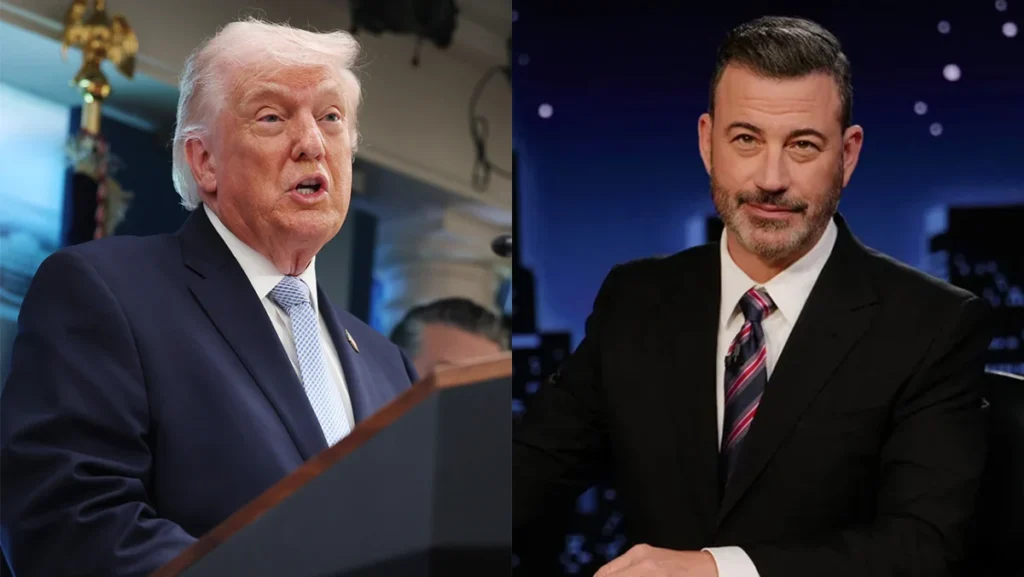

The ongoing public spat between late-night television host Jimmy Kimmel and former President Donald Trump intensified this week, with Trump explicitly calling for ABC to dismiss Kimmel from his program, Jimmy Kimmel Live! The latest salvo in this high-profile media-political battle saw Kimmel delivering a sharp retort on his show, directly challenging Trump’s critique of his show’s ratings by referencing the former president’s own approval figures. This exchange marks a significant escalation in a feud that has encompassed satirical jokes, demands for cancellation, and even a review by the Federal Communications Commission (FCC) into Disney’s broadcast licenses.
The latest chapter unfolded following a post by Donald Trump on his Truth Social platform on Thursday. In the missive, Trump stated, "When is ABC Fake News Network firing seriously unfunny Jimmy Kimmel, who incompetently presides over one of the Lowest Rated shows on Television? People are angry. It better be soon!!!" The former president’s comments underscored a consistent theme in his public communication: direct, often personal, attacks on media figures perceived as critical or disrespectful.
During the monologue for Thursday night’s episode of Jimmy Kimmel Live!, a screenshot of Trump’s Truth Social post was displayed to the audience. Kimmel, known for his quick wit and often politically charged humor, wasted no time in firing back. He quipped, "If incompetently presiding over not just one of, but the lowest rating in history is the reason I should be fired, we should both be out of a job." As he delivered this line, a photo of a headline indicating a slip in Trump’s approval ratings appeared on screen, reinforcing Kimmel’s counter-argument: "Because you’re not doing too good either." This direct comparison of their public popularity metrics highlighted the personal nature of the dispute, moving beyond mere criticism of a television program.
A Chronology of Rising Tensions
The roots of this current escalation trace back several weeks, illustrating a sustained period of friction between the two prominent figures.
The initial spark ignited around a satirical segment Kimmel hosted on his late-night show, mimicking the annual White House Correspondents’ Dinner (WHCD). On a Thursday preceding the actual WHCD, Kimmel aired "jokes" for his own mock event, a common practice for late-night hosts engaging in political satire. It was during this segment that Kimmel made a remark directed at former First Lady Melania Trump, stating, “Look at Melania, so beautiful. Mrs. Trump, you have a glow like an expectant widow.” This joke quickly drew significant criticism from Trump’s supporters and, notably, from the former First Lady herself.
Following the widespread controversy generated by the joke, both Donald and Melania Trump publicly called for Kimmel to be fired from Jimmy Kimmel Live! Melania Trump, in particular, issued a statement demanding his cancellation, citing the joke as disrespectful and inappropriate. The former president echoed these sentiments, using his platform to amplify the demand for Kimmel’s dismissal.
On the subsequent Monday episode of his show, Kimmel addressed the uproar but offered no apology for what he termed a "light roast" remark. Instead, he pushed back against the Trumps’ demands, stating, "You know how sometimes you wake up in the morning and the first lady puts out a statement demanding you be fired from your job? We’ve all been there, right?" His response signaled his intention not to back down, framing the calls for his firing as an overreaction to a comedic jab.
The controversy took an unexpected turn on Tuesday when the FCC launched an "early review" of Disney’s broadcast television licenses. Disney, the parent company of ABC, found itself indirectly drawn into the dispute due with the FCC’s action, which typically involves evaluating whether broadcasters meet public interest obligations. A Disney spokesperson quickly responded to the news, telling The Hollywood Reporter, "We are confident that record demonstrates our continued qualifications as licensees under the Communications Act and the First Amendment and are prepared to show that through the appropriate legal channels. Our focus remains, as always, on serving viewers in the local communities where our stations operate." This statement underscored Disney’s commitment to its legal and regulatory standing, while also invoking the First Amendment in defense of its programming.
Kimmel also continued to challenge Trump on Tuesday’s episode of Jimmy Kimmel Live!, specifically referencing a joke the former president made at an event tied to a state visit by England’s King Charles. In his speech, Trump had recalled his parents’ 63 years of marriage and then told his wife, "That’s a record we won’t be able to match, darling. It’s just not gonna work out that way." Kimmel seized on this, humorously turning the tables: "Wait a minute. Did he just make a joke about his death?" Kimmel joked during his monologue. "My God, you should be fired for that." This mirrored Trump’s own demands for Kimmel’s firing, highlighting what Kimmel perceived as hypocrisy.
The cumulative effect of these exchanges set the stage for Trump’s latest Truth Social post and Kimmel’s subsequent on-air rebuttal, marking a period of heightened tension and direct confrontation between the two figures.
Supporting Data and Contextual Analysis
Trump’s characterization of Jimmy Kimmel Live! as "one of the Lowest Rated shows on Television" warrants closer examination within the broader context of late-night programming. While traditional linear television viewership has generally declined across all networks and time slots due to the proliferation of streaming services and digital content, Jimmy Kimmel Live! consistently ranks among the top late-night talk shows. For example, in the 2023-2024 season, Kimmel’s show often competes closely with The Late Show with Stephen Colbert and The Tonight Show Starring Jimmy Fallon in key demographics and total viewership. While specific ratings fluctuate week-to-week, the assertion of it being "one of the lowest rated" is largely inaccurate when compared to its direct competitors and the overall landscape of network late-night television. Kimmel’s show, like others, leverages a significant digital presence, with clips and full episodes garnering millions of views online, further complicating a simple "ratings" assessment based solely on overnight linear viewership.
Conversely, Kimmel’s retort regarding Trump’s approval ratings is supported by publicly available polling data. Throughout his presidency and subsequent political career, Donald Trump’s approval ratings have shown considerable volatility but often remained within a specific range. For instance, reputable polls from organizations like Gallup, Reuters/Ipsos, and Quinnipiac University consistently show Trump’s approval ratings fluctuating, frequently hovering in the low to mid-40s, often lower than the historical average for former presidents at comparable points in their post-presidency. Kimmel’s use of this data point serves as a direct, fact-based counter to Trump’s criticism, suggesting that the former president’s own public standing is not without its challenges.
The broader context of this feud also touches upon the ongoing "cancel culture" debate and free speech principles. Kimmel notably highlighted Trump’s past statements against "censorship, blacklisting and cancel culture," playing a clip of the former president advocating for such positions. Kimmel then sarcastically remarked, "I hate to say this, and I hope it doesn’t get me in trouble, I’m starting to think Donald Trump might be a hypocrite." This comparison draws attention to the perceived inconsistency in Trump’s stance: on one hand, criticizing efforts to silence voices he disagrees with, and on the other, actively calling for the firing of a comedian who lampoons him. This dynamic mirrors a broader societal debate about the limits of satire, the responsibilities of public figures, and the application of free speech principles when criticism is directed at powerful individuals.
Official Responses and Broader Implications
The FCC’s "early review" of Disney’s broadcast licenses is a procedural action that, while not immediately indicative of wrongdoing, signals that a formal inquiry has been initiated. The FCC is responsible for regulating interstate and international communications by radio, television, wire, satellite, and cable. Broadcasters are required to operate in the public interest, and their licenses are subject to periodic review. Complaints regarding content, particularly those involving alleged indecency or violations of community standards, can sometimes trigger such reviews. Disney’s prompt response, reaffirming its commitment to the Communications Act and the First Amendment, underscores the network’s understanding of the legal and regulatory landscape and its readiness to defend its programming. Historically, the FCC has tread carefully when it comes to content regulation, especially in the context of political satire, due to strong First Amendment protections for free speech.
The ongoing feud also highlights the evolving role of late-night comedy in the modern political landscape. Shows like Jimmy Kimmel Live! have long served as platforms for political commentary and satire, often challenging authority and offering a comedic perspective on current events. In an era of increasing political polarization, these shows have become significant spaces where political figures are routinely lampooned, and political narratives are both reflected and shaped. The direct engagement between a former president and a late-night host underscores the blurring lines between traditional news, entertainment, and political discourse.
Furthermore, this series of exchanges serves as a stark reminder of the intense scrutiny and pressure faced by media organizations and personalities who engage with high-profile political figures. Donald Trump’s use of social media platforms like Truth Social allows him to directly address his supporters and critics, bypassing traditional media filters and amplifying his calls for action, such as the firing of a television host. This direct communication strategy has significant implications for how political figures interact with the media and how public discourse is shaped.
Kimmel himself alluded to the perceived disproportionate focus from Trump on the comedian, stating, "This guy is so mad, you would think I posted a picture of seashells or something. Isn’t there a war dragging on? Imagine if FDR had taken to the airwaves during the Battle of the Bulge to complain about a Little Orphan Annie comic strip he didn’t like? Trump has three wars going on right now; Iranians, Ukrainians and comedians." This observation by Kimmel attempts to frame Trump’s attention on the late-night host as a distraction from more pressing national and international issues, a common tactic in political rhetoric. Kimmel’s assertion that Trump uses such feuds as a "distraction for more pressing political topics" — including "the prices he didn’t lower on day one, and from the Trump-Epstein files that his attorney general refuses to release, and to distract us from the illegal war he started and can’t figure out how to get out of" — represents a significant political accusation from the comedian, positioning his show as a platform for political critique rather than just comedic entertainment.
In conclusion, the escalating feud between Jimmy Kimmel and Donald Trump is more than just a clash of personalities; it reflects deeper tensions at the intersection of media, politics, and free speech in contemporary American society. It underscores the power of satire, the complexities of broadcast regulation, and the ongoing debate surrounding accountability and discourse in the public square. As both figures continue to command significant public attention, their exchanges are likely to remain a focal point of discussion, prompting further reflection on the boundaries of comedy and the responsibilities of public figures in a highly polarized environment.