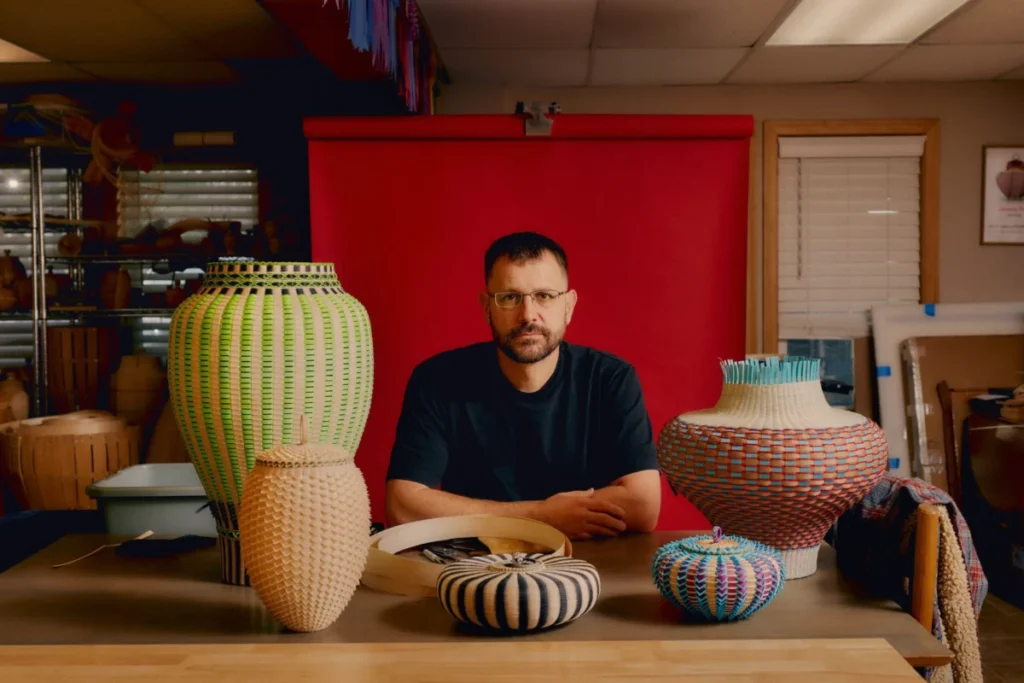

In the quiet, rural landscape of Eddington, Maine—a town with a population of just over 2,200 residents—Jeremy Frey sits in his studio, meticulously transforming the raw materials of the North American forest into world-class art. As he speaks via a digital link, his hands remain in constant motion, guided by the muscle memory of seven generations. With the precision of a surgeon and the vision of a geometric abstractionist, Frey uses tweezers and steady fingers to weave thin ribbons of jet-black dyed ash wood into intricate triangular points. These dark accents sit atop a layer of vibrant lime-green strips, creating an optical vibration that defies the traditional expectations of basketry.
Frey, a member of the Passamaquoddy Tribe and a 2025 MacArthur Fellow, is currently preparing for a landmark solo exhibition at the Karma gallery in New York City. The show represents a pivotal moment not only for Frey’s career but for the broader recognition of Indigenous craft as a high-stakes medium within the contemporary art world. One of the centerpieces of the exhibition, a vessel standing nearly 24 inches tall, requires more than a month of continuous labor to complete. For Frey, this is more than a vocation; it is a process of innovation that honors a deep ancestral lineage while aggressively pushing the boundaries of what a basket can be.

The Heritage of the Wabanaki Confederacy
To understand Frey’s work, one must first understand the cultural geography of the Wabanaki people. The Wabanaki Confederacy, or "People of the Dawnland," comprises five principal nations: the Passamaquoddy, Penobscot, Maliseet, Micmac, and Abenaki. For centuries, basket making was a fundamental aspect of survival and utility within these communities. Early Wabanaki baskets were robust, functional tools designed for harvesting potatoes, gathering seafood, or storing household goods.
The craft underwent a significant transformation during the 19th century. As European settlers moved into the region and the local economy shifted toward tourism, Wabanaki weavers began creating "fancy baskets." These were smaller, more ornamental pieces featuring intricate weaves and bright colors, designed to appeal to Victorian-era visitors at coastal resorts. While these baskets were often sold for minimal profit, they allowed the Wabanaki people to preserve their weaving techniques and maintain a connection to the land during periods of intense cultural suppression.
Jeremy Frey identifies as a seventh-generation practitioner of this craft. His journey into weaving was not a direct path, however. Growing up on the Passamaquoddy Indian Township Reservation, Frey initially expressed his creativity through drawing, painting, and hand-carving toys. It was only as a young adult, after returning to the reservation following several years away, that he took up the weaver’s tools. Under the tutelage of his mother and the legendary elder Sylvia Gabriel, Frey found that basketry "scratched the itch" for artistic expression in a way no other medium could.

Technical Mastery and Material Innovation
The physical demands of Frey’s work begin long before the weaving starts. The primary material for his vessels is the brown ash (Fraxinus nigra), also known as basket ash. This species is unique because its growth rings can be separated into thin, flexible strips when the wood is pounded. Frey’s uncle taught him the arduous process of harvesting: selecting the right tree, hauling it from the forest, slicing the log, and hand-pounding the timber until it yields ribbons of wood.
Frey’s innovation lies in his refusal to be limited by traditional forms. While he utilizes the fundamental elements of Wabanaki basketry—ash wood, sweetgrass, cedar, birch bark, spruce root, and porcupine quills—his execution is singular. He has developed a signature style characterized by ultra-fine "point weaves," complex double-walled structures, and a sophisticated use of color that moves his work into the realm of Op-Art.
Critics have compared his visual language to that of 20th-century masters like Victor Vasarely and Bridget Riley. Like their paintings, Frey’s baskets play with the viewer’s perception. The way he cuts his ribbing and applies finishes creates a sense of movement; the vessels seem to pulse or vibrate as the light hits the dyed ash and natural quills. By elevating the technical difficulty and aesthetic complexity of the work, Frey has successfully shifted the market’s perception of these objects from "handicraft" to "fine art."

Institutional Recognition and the Fine Art Market
The trajectory of Frey’s career serves as a case study for the rising valuation of Indigenous art in the global market. His pieces are no longer sold at local craft markets for "minuscule profit," as his ancestors’ works were. Today, his vessels are held in the permanent collections of some of the world’s most prestigious institutions, including the Smithsonian American Art Museum and The Metropolitan Museum of Art (The Met).
His upcoming show at Karma, a gallery known for representing significant contemporary voices, signifies a departure from the ethnographic framing often applied to Native American art. In this context, Frey’s baskets are presented as sculptures. The exhibition explores what Frey calls "the growth of the art form," featuring not only traditional woven vessels but also experiments in new materials.
One of the most ambitious developments in Frey’s recent practice is the translation of his woven forms into bronze. By casting his baskets in metal, Frey achieves a level of durability and scale that was previously impossible. "You could put it outside," he notes, "or really scale it up." These bronze sculptures retain the intricate texture of the original weave while transforming the object into a permanent, monumental statement.

The Environmental Crisis: The Emerald Ash Borer
Despite his professional success, Frey’s practice is shadowed by a looming ecological catastrophe. The emerald ash borer (EAB), an invasive wood-boring beetle from Asia, was first detected in Maine in 2018. The beetle’s larvae feed on the inner bark of ash trees, disrupting the tree’s ability to transport water and nutrients. In regions where the EAB has become established, the mortality rate for ash trees is nearly 100%.
For the Passamaquoddy and other Wabanaki nations, the threat is more than economic—it is existential. According to the legend of Glooskap, the cultural hero of the Wabanaki, civilization began when he shot an arrow into a brown ash tree, and the people emerged from the split bark. The loss of the ash tree would represent the loss of a spiritual relative.
"Every tree I take is immortalized," Frey says, reflecting on the urgency of his current work. "Otherwise it will die." As the EAB decimates the ash population across the Northeast, Frey has increased his harvesting efforts, salvaging as much usable wood as possible before the forests are lost. This environmental pressure has also driven him to experiment with weaving copper strips, a material that offers a visual parallel to the ash but ensures the survival of the weaving tradition in a post-ash future.

Analysis of Implications and Cultural Legacy
Jeremy Frey’s work sits at the intersection of several critical contemporary dialogues: the decolonization of art museums, the impact of climate change on cultural heritage, and the evolving definition of "craft" in a digital age.
By bringing his work to a New York City gallery, Frey is forcing a reevaluation of Indigenous aesthetics. His success proves that traditional methods can be used to produce avant-garde results. However, the potential loss of the ash tree poses a difficult question: Can a tradition survive if its primary material is eradicated? Frey’s move toward bronze and copper suggests that the intellectual property of the weave—the geometry, the rhythm, and the cultural narrative—is more resilient than the wood itself.
As the May issue of Architectural Digest highlights, Frey’s studio remains a site of intense production and profound reflection. Surrounded by ribbons won at craft markets over the decades, he continues to weave, knowing that each piece is a bridge between a storied past and an uncertain ecological future. His work does not merely exist to be looked at; it exists to testify to the endurance of the Passamaquoddy people and the transformative power of the human hand.

The solo show at Karma gallery is expected to draw significant attention from collectors and historians alike. It marks a moment where the "fancy basket" has finally shed its utilitarian and souvenir associations to stand as a pinnacle of contemporary sculpture. For Frey, the goal remains the same as it was when he first picked up a strip of ash: to innovate, to honor his ancestors, and to ensure that the story of his people continues to be told through the language of the weave.