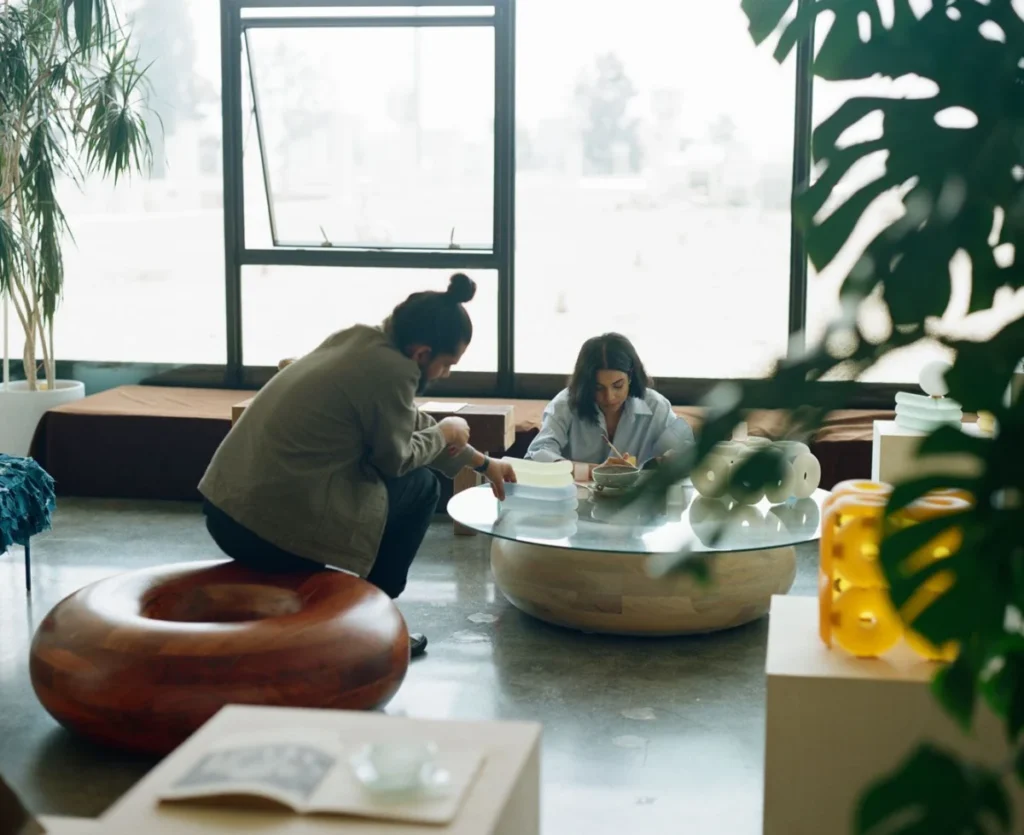

For Indian-origin, Los Angeles-based designers Utharaa Zacharias and Palaash Chaudhary, the creative process is an exercise in the deliberate. As the founders of the lighting and furniture design firm Soft-Geometry, the duo has built a reputation for work that prioritizes humor, slowness, and the intimate rituals of daily life. Their portfolio, characterized by objects that favor serenity over sharpness and the tactile imperfections of the handmade over the sterile precision of the hyperpolished, finds an unlikely home in the heart of Los Angeles. There is a profound, quiet poetry in the location of their residence: a 900-square-foot apartment nestled within a concrete shell, a space that initially appears entirely at odds with their soft, organic design language.

The Architectural Provenance of The Elysian
The apartment is located within The Elysian, a building that carries a formidable weight in Los Angeles architectural history. Originally designed in 1961 by William Pereira—one of the few architects ever to grace the cover of Time magazine—the structure served as the headquarters for the Metropolitan Water District of Los Angeles. Pereira, known for his futuristic and often monumental designs, including the Transamerica Pyramid in San Francisco and the Geisel Library in San Diego, engineered The Elysian as an "essential building."
Built with a robust steel-and-concrete framework designed to exceed the city’s seismic codes, the building features 12-foot ceilings and a structural honesty that reflects the mid-century obsession with permanence. Despite its pedigree, the tower stood vacant for nearly two decades, a concrete ghost on the edge of Echo Park, before it was converted into residential lofts in 2014. This transition from a rigid institutional headquarters to a living space provided the perfect "industrial canvas" for Zacharias and Chaudhary, though they did not initially know the building’s history.

“The building caught our eye our first week in LA, before we even knew its history,” the designers noted. While no units were available during their first search, a single unit became available six months later. Despite being passed over by other potential tenants due to its view of an industrial rooftop, Zacharias and Chaudhary saw the potential in the contrast between the building’s brutalist exterior and the warm, diffused light that filled the interior.
Spatial Strategy and the Blur of Work and Life
The loft’s 900-square-foot footprint serves a dual purpose as both a residence and a functioning design showroom. Upon moving in, the couple recognized that the architectural features—the scale, the light, and a specific floating wall—would dictate the flow of their lives. Chaudhary describes the floating wall located between the workspace and living area as a “natural divider between control and chaos.”

In a move that reflects their unconventional approach to design, the couple reconfigured the traditional floor plan. They converted the original bedroom into their primary workspace and repurposed the home office area into a "sleeping nook." This compression of space creates what Zacharias describes as a "room within a room," reminiscent of a ship’s berth. The nook is minimally decorated, featuring only their giant elephant ear plant, named Haathi, a single wedding photo, an alarm clock, and the first-ever prototype of their Flower Sconce.
This layout facilitates a lifestyle where work and personal life are inextricably linked. “When we moved into this home, we briefly tried separating our work and personal lives into different spaces, and it quickly became a lesson in who we are,” Chaudhary explains. The designers find value in waking up to see exactly where they left off the previous night, allowing the creative process to remain continuous and uninterrupted by the boundaries of a traditional 9-to-5 schedule.

The Interior Narrative: A Laboratory of Design
The living room functions less as a traditional social space and more as an evolving gallery for Soft-Geometry’s collections. It houses a curated selection of the studio’s practice, including the Elio Lamp, Donut Tables, and the Long-Haired Sconces. Many of these pieces are prototypes, such as the 2019 Fluff Bench, which was created for the Architectural Digest Design Show but never formally released to the public.
The designers’ commitment to the "handmade over the hyperpolished" is evident in their choice of furnishings. They have skillfully blended high-end prototypes with vintage finds and DIY projects. The kitchen island, for instance, is a vintage Neolt Architetto drafting table sourced via Craigslist. Their seating includes Breuer chairs found in San Francisco, a Vico Magistretti Selene chair, and Joe Colombo Universale chairs acquired through Etsy.

To further soften the industrial edge of the loft, the couple made tactical changes to the existing structure. In the kitchen, they applied removable steel covers to the cabinet fronts to hide a "greige" wood veneer that didn’t align with their aesthetic. Above the cabinets, the 12-foot ceilings provide ample space for a rotating display of Oaxaca paper craft posters, favorite books, and thriving greenery.
Materiality and the Technicality of Softness
A significant portion of the loft is dedicated to the technical experimentation that defines Soft-Geometry. Their workspace is centered around a vintage workbench where they develop their latest collections, such as the "Flowers in Our Hair" series launched in New York.

The manufacturing process for their Long-Haired Sconces highlights their innovative use of materials. Each unit is made by pressing a mixture of hemp, lime plaster, and water into cylindrical molds. To ensure the integrity of the casting while wet, the duo 3D-prints their own molds, designed to open in two halves. This blend of ancient materials (lime and hemp) with modern technology (3D printing) is a hallmark of their design philosophy.
Another example of their material exploration is the Summer-Winter Chairs from their 2018 collection. A specific pair in the loft was created for a show at the Rajiv Menon Gallery, utilizing layers of scrap fabric—organza for a white chair and denim linen for a blue one—to create a textured, "soft" seating surface. These pieces serve as a physical record of the studio’s evolution and their ongoing investigation into joinery and form.

Broader Impact and the Evolution of Live-Work Spaces
The story of Zacharias and Chaudhary’s loft is reflective of a larger trend within the global design community, particularly in high-density hubs like Los Angeles. As the boundary between professional and private life continues to dissolve, designers are increasingly looking toward adaptive reuse projects that offer high ceilings and open floor plans. The Elysian represents a successful model of how mid-century institutional architecture can be repurposed to support the creative economy.
Furthermore, the success of Soft-Geometry points to a growing market demand for "slow design." In an era of mass production and rapid consumption, their focus on handmade objects that carry childhood memories and cultural narratives resonates with a demographic looking for meaning in their domestic environments. Their use of sustainable materials like hemp and lime also aligns with the design industry’s necessary shift toward ecological responsibility.

Future Transitions: From Studio to Sanctuary
As Zacharias and Chaudhary prepare to welcome their first child, the loft is poised for another transformation. The couple expects the space to "soften" further as it adapts to the needs of a growing family. The "chaos" that Chaudhary previously mentioned is expected to increase, yet the fundamental elements of the space—the golden morning light and the diffused sunset reflected off the bronze glass of nearby downtown towers—remain constant.
For the founders of Soft-Geometry, the 900-square-foot loft is more than just an apartment; it is a living manifesto. It proves that even within the rigid, seismic-proof concrete of a Pereira-designed monolith, there is room for the handmade, the humorous, and the deeply personal. Their home stands as a testament to the power of design to bridge the gap between industrial history and the soft rituals of everyday life, creating a sanctuary that is as much about the process of making as it is about the art of living.