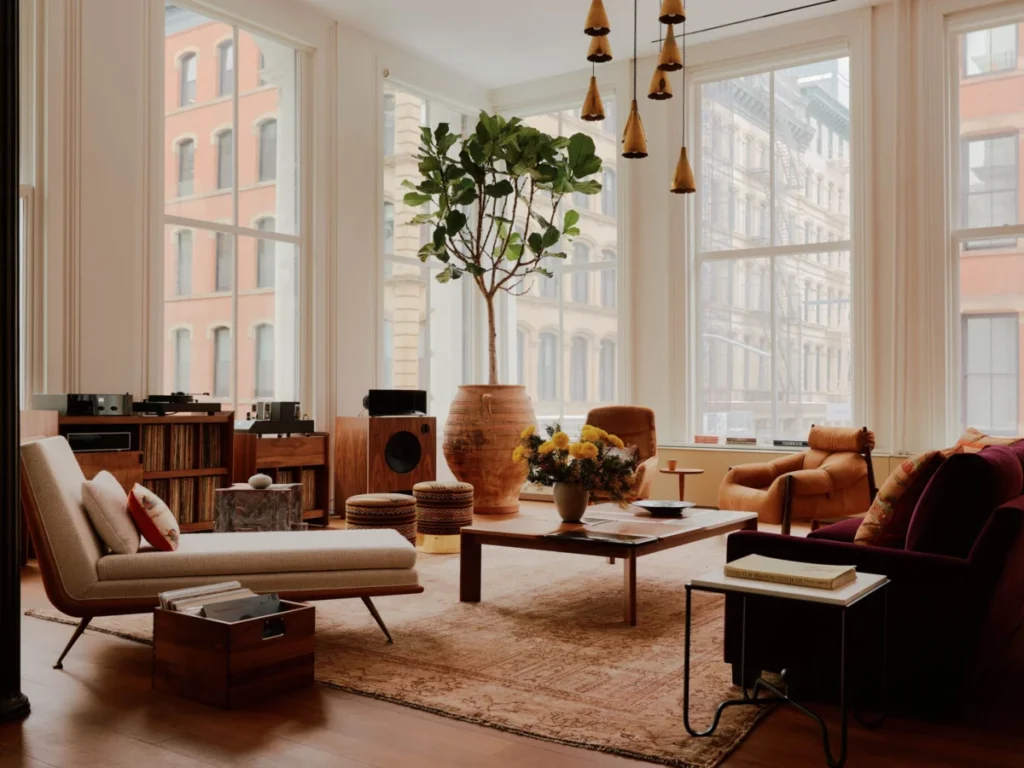

The conversion of industrial infrastructure into residential sanctuaries remains a cornerstone of Manhattan’s architectural identity, and few neighborhoods exemplify this evolution more vividly than SoHo. At the heart of this district stands a 3,700-square-foot loft located within a former silk warehouse. Originally constructed in 1872 and designed by the esteemed architect William H. Hume, the building represents the height of late-19th-century commercial design. While the space possessed the quintessential characteristics of a classic SoHo artist’s studio—soaring ceilings, massive windows, and an expansive, echoing floor plan—it presented a significant challenge for its new owners. An ambitious couple with four children sought to transform this voluminous, historically industrial space into a warm, functional, and intimate family home. To achieve this, they enlisted the expertise of designer Fawn Galli and the architectural firm Douglas C. Wright Architects.

Architectural Heritage and the Hume Legacy
The building’s pedigree is rooted in the post-Civil War industrial boom of New York City. William H. Hume, known for his work on significant structures such as the Spingler Building and the Hebrew Orphan Asylum, designed the warehouse with the structural integrity required for textile storage. By the late 20th century, these spaces were famously adopted by the city’s burgeoning artist community, who valued the "white box" aesthetic and the abundance of natural light.
However, the transition from an artist’s workspace to a high-functioning residence for a family of six requires more than just aesthetic updates. It necessitates a complete reimagining of spatial flow. The loft’s 3,700 square feet of open space could easily feel cold or cavernous. Galli’s primary objective was to introduce "tactility and purpose," ensuring that the vastness served the family’s daily needs without sacrificing the historic grandeur of the Hume design.

The Strategy of Five Zones: Redefining Open-Plan Living
Rather than partitioning the great room with permanent walls—a move that would have compromised the loft’s iconic light and airy feel—Galli implemented a strategy of "zoning." By utilizing custom rugs, distinct lighting fixtures, and strategic furniture groupings, the designer parceled the great room into five separate yet interconnected sections.
"I focused on having different spaces that people could be in within the open plan," Galli noted during the design process. This approach allows for simultaneous activities—a piano lesson in one corner, a dinner party in another, and a quiet reading session in the den—to occur without the occupants feeling isolated from one another.

1. The Texture-Rich Living Area
The living area serves as the loft’s primary social hub. It is anchored by a massive hemp rug from Doris Leslie Blau, providing a neutral, durable base for a series of high-contrast design choices. The seating is dominated by a custom forest-and-ochre velvet sectional, paired with a custom sofa upholstered in Pindler’s Hartell fabric in Truffle.
Artistry is integrated into the furniture itself, highlighted by an India Mahdavi rattan marquetry Fish coffee table and a classic Wegner Flag Halyard chair, constructed of steel, sheepskin, and rope. However, the true focal point is a kinetic ceiling sculpture by Tim Prentice. Composed of multicolored feathers, the piece moves with the building’s internal air currents. Galli describes the installation as "enchanting," designed to make the occupants feel "alive and engaged in their space."

2. The Culinary and Dining Zones
The kitchen and dining areas transition from industrial efficiency to Old World warmth. In the kitchen, Galli swapped existing cabinet fronts for deep green Boffi panels, a color choice that resonates with the pale sage millwork added by Douglas C. Wright Architects along the loft’s perimeter. Vintage stools, recovered in Amazonie Lie De Vin Velvet by Métaphores, provide seating at the counter.
Adjacent to the kitchen, the dining zone is designed for "long, indulgent meals." A 19th-century Oushak rug defines the space, which features a walnut Silver table by House of Finn Juhl. Surrounding the table are eight Rozy armchairs by Pierre Yovanovitch. Overhead, a floral Chinese silk Dimoremilano pendant provides a soft, warm glow, grounding the space with what Galli calls "gravitas."

3. The Music Sanctuary
A dedicated corner of the loft celebrates the family’s appreciation for music. This area is anchored by a glossy 1923 Steinway & Sons Model O piano. The audio experience is further enhanced by a Soundlux Audio and Ojas system, housed within a walnut Symbol console.
Lighting and textiles again play a crucial role here; a 1950s Paavo Tynell chandelier hangs above a midcentury T.H. Robsjohn-Gibbings chaise and a deep MP-81 armchair by Percival Lafer. The inclusion of a purple corduroy sofa adds a layer of bohemian comfort, encouraging guests to linger and listen.

4. The Den and Reading Nook
For more private family moments, a den nook offers a cozy retreat. This space features a custom sectional covered in Pierre Frey’s "Le Jardin du Palais Velours," a vibrant, "jungly" pattern that Galli describes as interesting without being overwhelming. The fabric’s night-scene imagery provides a dark, enveloping contrast to the sun-drenched great room.
5. The Primary Suite: A Private World
The primary bedroom represents a departure from the open-plan loft aesthetic, leaning instead into a traditional, "Old World" atmosphere. Galli constructed a new wall and upholstered it in a moody botanical Dedar tapestry. This serves as a backdrop for a custom brown-burgundy Holland & Sherry mohair velvet headboard.

Recognizing the modern necessity of a home office, Galli integrated a work-from-home setup featuring a vintage Jean Prouvé Compas Direction desk. To accommodate the professional needs of the owners, she designed a custom Zoom background screen, featuring fern-colored wool on one side and sea-blue silk on the other, allowing the space to transition instantly from a private sanctuary to a professional studio.
Chronology of Transformation
The transformation of the Greene Street loft followed a meticulous timeline that prioritized structural preservation alongside modern upgrades:

- Phase I: Architectural Integration (Months 1-4): Douglas C. Wright Architects focused on the perimeter millwork and the installation of the pale sage cabinetry. This phase included the careful restoration of the original 1872 window frames to ensure thermal efficiency without altering the facade’s historic character.
- Phase II: Spatial Zoning (Months 5-8): Fawn Galli began the process of "mapping" the five zones. This involved the procurement of oversized vintage rugs—some sourced from Turkish markets and others from French flea markets—to define the boundaries of the great room.
- Phase III: Custom Installations (Months 9-12): The final stage involved the installation of the bespoke elements, most notably the Tim Prentice feather sculpture and the upholstered walls in the primary suite. This phase also saw the integration of the high-end audio systems and the 1923 Steinway piano.
Materiality and the "Antithesis to Loft"
One of the most striking aspects of the project is Galli’s use of materials to combat the industrial coldness typically associated with warehouse living. By sourcing textiles with "soul"—such as worn vintage Turkish rugs and French flea market finds—she introduced a sense of history that predates the building’s residential conversion.
The color palette is equally deliberate. From the "Downpour Blue" by Benjamin Moore on the entryway ceiling to the "Winding Waterway" vanity in the powder room, the use of deep, saturated hues creates a sense of enclosure and comfort. Galli explains that her point of view is, in many ways, the "antithesis to loft." While the architecture celebrates the open, the interior design celebrates the intimate.

Broader Implications for Urban Residential Design
The Greene Street project reflects a broader trend in luxury urban real estate: the "familification" of industrial spaces. As more families choose to remain in Manhattan rather than migrate to the suburbs, the demand for large-scale apartments that can accommodate children while maintaining high-design standards has surged.
Furthermore, the project highlights the ongoing importance of adaptive reuse in historic districts like SoHo. By preserving the work of William H. Hume while introducing the contemporary visions of Fawn Galli and Douglas C. Wright, the renovation ensures that the 1872 silk warehouse remains a living, breathing part of the city’s fabric.

The successful conversion of this space suggests that the "open plan" is evolving. The future of the Manhattan loft lies not in the removal of all boundaries, but in the sophisticated use of art, light, and texture to create a "world within a world." As Galli concludes, the goal was to create a space where a family could feel both "enchanted and at home"—a feat accomplished through a masterful blend of 19th-century architecture and 21st-century artistry.