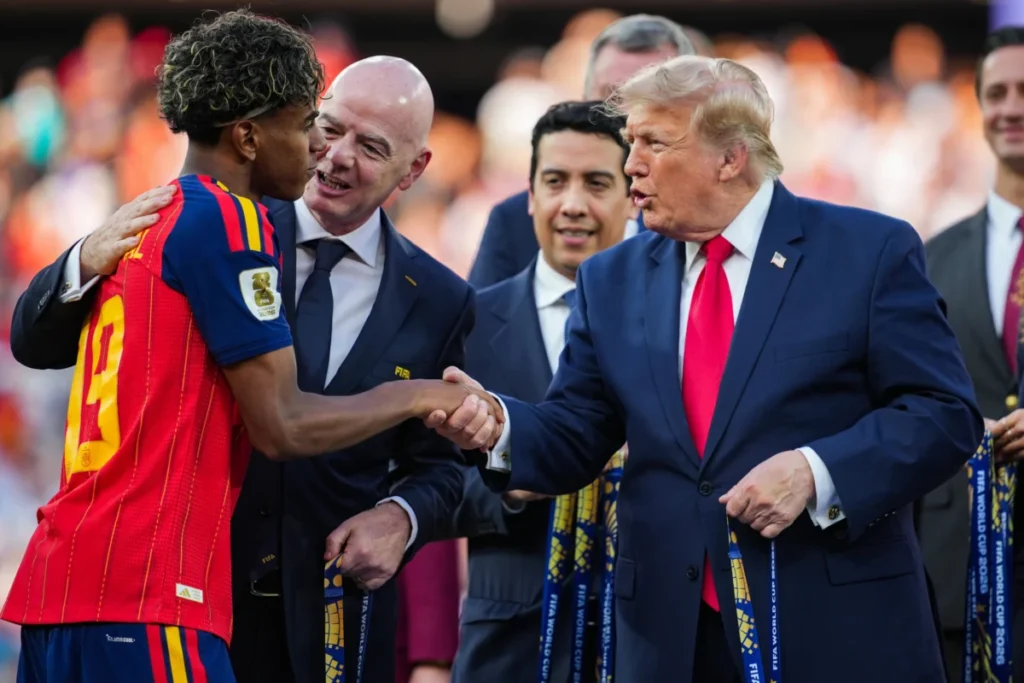

Former President Donald Trump faced a chorus of boos at the culmination of the 2026 FIFA World Cup final on Sunday, a moment that underscored the charged intersection of global sport and high-stakes politics. As Trump took the stage at MetLife Stadium, officially known as New York New Jersey Stadium for the duration of the tournament, alongside FIFA President Gianni Infantino to present the coveted trophy to tournament champion Spain, the audible dissent from the capacity crowd resonated throughout the arena. Spain had just secured a hard-fought 1-0 victory over Argentina in extra time, a triumphant conclusion to a month-long spectacle, but the celebratory atmosphere was briefly overshadowed by the public’s reaction to Trump’s presence.
The incident occurred as Trump and Infantino emerged onto the field, making their way toward the winners’ podium. The boos, distinct and widespread, immediately became a focal point for attendees and observers worldwide, drawing attention away from the immediate post-match jubilation. This public display of disapproval was widely interpreted as a direct response to a controversial intervention by Trump earlier in the tournament, where he admittedly played a role in overturning a red card suspension for a prominent U.S. national team player.
The Unprecedented Intervention: A Chronology of Controversy
The seeds of Sunday’s public reaction were sown weeks prior, specifically on July 6, when Donald Trump publicly confirmed his personal intervention in a critical disciplinary matter concerning U.S. Men’s National Team striker Folarin Balogun. Balogun, a key player for the American squad, had received a controversial red card during an earlier match, threatening his participation in subsequent knockout stages. Trump stated he had personally contacted FIFA President Gianni Infantino, advocating for the reversal of the red card decision.
This extraordinary appeal bore fruit. Following Trump’s call, FIFA took the highly unusual step of suspending the red card, thereby allowing Balogun to compete in the Round of 16 match against Belgium. The decision sent shockwaves through the international football community. Disciplinary rulings, particularly red card suspensions issued during live play and subsequently upheld by VAR (Video Assistant Referee) protocols, are rarely, if ever, overturned at such a high level of competition. According to reports, including one from The New York Times, this marked an unprecedented reversal by FIFA since 1962, highlighting the exceptional nature of the intervention.
The immediate reaction to FIFA’s decision was a mixture of anger and disappointment, particularly from the Belgian national team and its supporters. The integrity of the tournament’s disciplinary process was called into question, with many viewing the reversal as a politically motivated concession rather than a fair application of rules. Critics argued that such an intervention undermined the impartiality of FIFA and created a dangerous precedent where external political pressure could influence on-field decisions, potentially compromising the spirit of fair play that underpins global football. Despite Balogun’s reinstated eligibility, the U.S. team ultimately lost its Round of 16 match against Belgium by a decisive score of 4-1, exiting the tournament. This outcome, however, did little to quell the controversy surrounding the red card reversal.
The Grand Stage: The 2026 FIFA World Cup and MetLife Stadium
The 2026 FIFA World Cup holds immense significance as the largest iteration of the tournament to date, co-hosted by three North American nations: the United States, Canada, and Mexico. This expanded format features 48 teams competing across 16 host cities, a significant increase from the previous 32-team structure. The decision to award the final match to MetLife Stadium, rebranded as New York New Jersey Stadium for the event, underscored the venue’s prominence and the region’s capacity to host a global spectacle.
Located in East Rutherford, New Jersey, MetLife Stadium is a colossal multi-purpose venue known for its impressive capacity, which exceeds 82,500 for major events. Its selection as the final’s host city was a testament to the comprehensive bid put forth by the New York/New Jersey region, promising state-of-the-art facilities, robust infrastructure, and unparalleled logistical support for the culminating match of the tournament. The 2026 World Cup itself was anticipated to generate billions in economic activity and attract millions of international visitors, solidifying its status as a landmark event in sporting history. The final, therefore, was not merely a football match but a global celebration, a moment of immense national pride for the winning team, and a showcase for the host nations.
Donald Trump’s arrival at the stadium on Sunday was itself a spectacle, indicative of the high-profile nature of the event and his own political standing. He arrived via Marine One, the presidential helicopter, which conducted a flyover of the stadium approximately 45 minutes before kickoff, a customary gesture for a head of state or former head of state attending such a significant event. He watched the final match from a VIP section, an exclusive, glass-enclosed suite, alongside FIFA President Gianni Infantino. Also present in the vicinity of the VIP section were other prominent international figures, including King Felipe VI of Spain, whose nation was vying for the championship; Canadian Prime Minister Mark Carney; and Mexican President Claudia Sheinbaum, representing the other co-hosting nations. The presence of such a distinguished array of global leaders further highlighted the magnitude of the occasion.
Reactions and Broader Implications
The boos directed at Donald Trump during the trophy presentation were not an isolated incident but rather a moment that resonated within a broader context of public sentiment and the intricate relationship between politics and sport. While it is not uncommon for public figures to receive mixed reactions at large gatherings, the sustained and audible nature of the dissent at such a globally televised event was notable.
The intervention concerning Folarin Balogun’s red card had already generated significant debate among sports journalists, football pundits, and fans alike. Many commentators expressed concern that allowing political figures to influence on-field disciplinary actions could erode public trust in FIFA’s independence and the integrity of the game. The argument was made that such actions set a dangerous precedent, potentially opening the door for similar pressures in future tournaments, thereby compromising the fairness and objectivity that are fundamental to competitive sport. The reversal, being the first of its kind in over six decades, fueled theories of undue influence, especially given the U.S.’s role as a primary host nation for the tournament.
From a geopolitical perspective, the incident also touched upon the complexities of international relations and the blurred lines between national interests and global sporting ethics. While a host nation’s leader might naturally advocate for their country’s athletes, the direct intervention in a disciplinary ruling was seen by many as overstepping boundaries. The anger from Belgian supporters, whose team might have perceived a competitive disadvantage due to the reversal, was a tangible demonstration of the emotional and nationalistic fervor that defines the World Cup.
For FIFA, the incident presented a challenge to its governance structure and its commitment to impartiality. While Infantino’s presence alongside Trump at the trophy presentation suggested an amicable relationship, the decision to overturn the red card, purportedly at Trump’s behest, exposed the organization to accusations of susceptibility to political pressure. FIFA’s stated mission includes upholding the rules of the game and promoting fair play, principles that were widely seen as being tested by this particular intervention. The long-term implications for FIFA could include heightened scrutiny over its disciplinary processes and increased calls for transparency in decision-making, particularly concerning high-profile matches and players.
The public reaction at MetLife Stadium could also be viewed through the lens of political symbolism. Donald Trump has a history of eliciting strong reactions, both positive and negative, from various segments of the public. His appearance at a major global event, especially after a controversial action that directly impacted the tournament’s integrity, provided an opportunity for a large, diverse audience to express their sentiments. Such moments underscore how major sporting events, while ostensibly apolitical, often become stages for broader social and political commentary. The boos served as a potent, if informal, referendum on his actions and his presence on a global stage.
In conclusion, the 2026 FIFA World Cup final, a pinnacle of international sporting achievement, became a momentary crucible where the celebration of athletic prowess intersected with contentious political dynamics. Donald Trump’s appearance, following his unprecedented intervention in a tournament disciplinary matter, evoked a significant public reaction that reverberated far beyond the confines of MetLife Stadium. This incident not only added a layer of controversy to an otherwise triumphant sporting event but also reignited discussions about the delicate balance between national leadership, international sports governance, and the cherished ideals of fair play and impartiality in global competition. The boos served as a stark reminder that even on the world’s grandest sporting stages, political actions and their consequences remain firmly in the public eye.