
The architectural legacy of the late Ray Kappe, a foundational figure in Southern California modernism, continues to serve as a masterclass in the balance between structural rigor and organic warmth. In a 2006 interview, Kappe articulated his guiding philosophy, noting an interest in the "possibility of diversity within a common system," a principle that sought to harmonize varied spatial qualities and plan relationships under a unified architectural language. This ethos is vividly realized in the 1966 Rustic Canyon residence currently inhabited by filmmaker Alexandra Kerry, her husband Julien Dobbs-Higginson—co-founder with Kerry of the health-standard platform Madeworks—and their two daughters. The home stands as a testament to the enduring flexibility of Kappe’s designs, providing a luminous, volumetric stage where Continental antiques, New England heirlooms, and 20th-century design icons coexist in a seamless, contemporary dialogue.

The Architectural Pedigree of Rustic Canyon
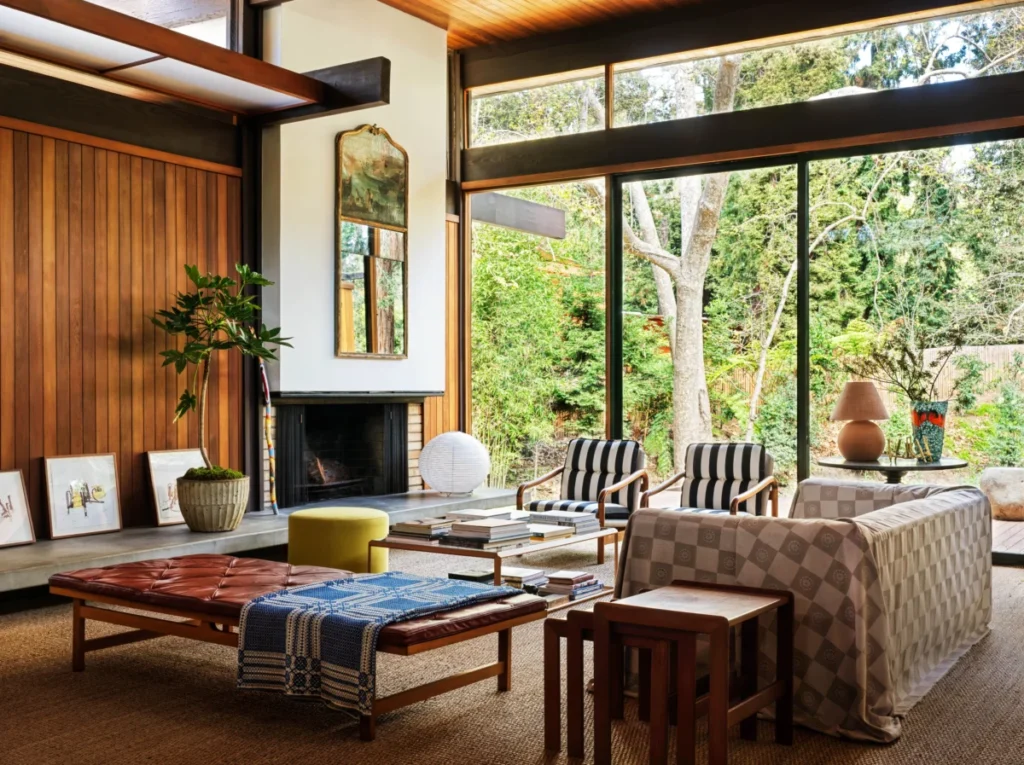
Ray Kappe’s work is synonymous with a specific brand of California modernism that prioritizes the preservation of the natural landscape and the orchestration of light. The 1966 house in Rustic Canyon bears the unmistakable hallmarks of Kappe’s most celebrated period, echoing the design language of his own landmark residence built nearby between 1965 and 1967. Characterized by cantilevered decks that seem to float amidst the canopy of redwood trees, clerestory windows that invite the shifting patterns of the sun, and interlocking wood volumes that create complex, multi-level interior vistas, the house is a masterwork of timber and glass.
Kappe, who passed away in 2019, was not only a prolific architect but also a radical educator, having founded the Southern California Institute of Architecture (SCI-Arc) in 1972. His approach to residential design often involved a "modular" or "systematized" logic that allowed for significant interior variation. In the Kerry/Dobbs-Higginson home, this translates into a series of open yet distinct "zones" that facilitate both communal family life and private reflection. The structure’s ability to remain relevant nearly six decades after its construction speaks to Kappe’s foresight in creating spaces that breathe and adapt.

A Synthesis of Global Backgrounds
The challenge of furnishing a Kappe house lies in honoring the architect’s minimalist intentions while reflecting the personal histories of its inhabitants. For Alexandra Kerry and Julien Dobbs-Higginson, the project was an exercise in cultural reconciliation. Dobbs-Higginson, who is of British and French descent and was born in Japan, describes himself as the "cliché of a foreigner finding domestic bliss in a great midcentury house in Los Angeles." His aesthetic leanings favor the restraint and intentionality of Japanese design—a preference that aligns naturally with Kappe’s geometric precision.
Conversely, Alexandra Kerry, daughter of former U.S. Secretary of State John Kerry and the late writer Julia Thorne, brings a "traditional New England sensibility" to the home. Raised among beautiful objects with deep historical roots, Kerry sought to integrate pieces inherited from her mother, who spent her formative years in Rome. "We wanted to honor Kappe’s vision," Kerry explains, "but we were a little stumped about blending the old and the new." The result is a home that functions as a curated map of their collective journeys, where a 19th-century Italian trumeau mirror might share a room with a 20th-century Scandinavian lounge chair.

The Design Intervention: Kate Driver’s Deferential Approach
To navigate the complexities of merging these disparate styles within a historic modernist framework, the couple enlisted Kate Driver, founder of the Los Angeles-based design firm West Haddon Hall. Driver’s approach was rooted in a profound respect for the existing architecture, which she describes as a "reason to believe in modern architecture." Her goal was to ensure that any decorative intervention felt like a natural evolution of the space rather than an imposition.
"I wanted to err on the side of not intervening too much," Driver notes. "I would never paint over the work of an Old Master." Drawing inspiration from the way the Kappes lived in their own home—a space filled with bold swaths of color, strategic hits of pattern, and stacks of books—Driver cultivated a mood that is at once sophisticated and lived-in. By treating the architecture as a "common system," she was able to introduce a "diversity" of appointments that feel comfortable and appropriate.

Chronology of a Curated Interior
The interior design follows a logic of "poetic orchestration," where each piece is selected for its form, history, and ability to modulate the home’s natural light.
The Living and Dining Areas
In the primary social spaces, Driver utilized a palette of natural textures and occasional vibrant accents. The living room features an antique trumeau mirror, a Thorne family heirloom, positioned above the fireplace—a move that introduces a sense of verticality and historical weight to the modernist room. This is balanced by vintage Scandinavian seating and an Akari lantern by Isamu Noguchi, which provides a soft, sculptural glow.

The dining area serves as a showcase for midcentury icons and neoclassical heirlooms. A custom credenza inspired by the work of Charlotte Perriand sits beneath a drawing by Claes Oldenburg. Bracketing this contemporary arrangement are Sheraton-style armchairs, another legacy from the Thorne family. Lighting is provided by a 1960s glass-and-steel Artemide lamp by Studio BBPR and an Ingo Maurer pendant, illustrating a "time-traveling" ethos that spans three centuries of design.
Private Sanctuaries and Functional Nooks
Throughout the home, smaller spaces are utilized to maximize the architectural "brio" Kappe intended. A built-in window nook is updated with seat cushions in a Liberty linen, creating a tactile connection to the greenery outside. Nearby, an Alvar Aalto table and a Ferm Living rattan storage basket offer functional beauty. In the entry hall, a Verner Panton chair for IKEA sits alongside a 1940s Italian console in the style of Paolo Buffa, underscored by the conceptual art of Jenny Holzer.

The Madeworks Mission: Nontoxic Living as a Design Standard
Beyond the aesthetic considerations, the renovation of the home was guided by a rigorous commitment to human health and environmental sustainability. This focus is a direct extension of Kerry and Dobbs-Higginson’s professional work with Madeworks, a platform dedicated to setting new standards for "clean" and healthy living.
"We’re very passionate about nontoxic living. Having children only amplified that concern," Kerry states. This philosophy influenced every material choice in the home, from the formulations of the wood finishes to the textiles and upholstery. By selecting products that meet high safety and ecological standards, the couple has transformed the house into a sanctuary that supports the well-being of its occupants. This mission dovetails with Kappe’s own interest in the relationship between the built environment and the natural world, suggesting that true modernism must account for the biological health of the inhabitant.

Landscape and Context: Communion with Nature
The integration of the interior and exterior is a defining feature of the property. The landscape design, executed by Joan Williamson, emphasizes the home’s location in the verdant enclave of Rustic Canyon. The backyard, featuring a creek and ancient redwood trees, serves as a living backdrop that is visible from almost every room.
Dobbs-Higginson notes that the setting—replete with the sounds of frogs and the occasional presence of local wildlife like bobcats—creates an atmosphere that feels entirely removed from the urban density of Los Angeles. The home’s cantilevered decks and large glass apertures facilitate a constant communion with this environment, fulfilling Kappe’s vision of a house that functions as a lens for experiencing nature.

Broader Implications and Design Legacy
The successful renovation of this 1966 Ray Kappe home offers a compelling case study for the preservation of midcentury modern architecture. It suggests that these homes need not be treated as static museums but can instead function as dynamic environments capable of absorbing various histories and lifestyles.
Analytical Summary:
- Architectural Resilience: Kappe’s "common system" allows for a high degree of interior personalization without compromising the integrity of the structure.
- The Shift Toward "Quiet Luxury": The blend of high-end antiques with modernist classics reflects a broader trend in interior design that values curation and personal history over rigid stylistic adherence.
- Sustainability as the New Standard: The involvement of Madeworks highlights a growing demand for "healthy" homes, where nontoxic materials are as important as aesthetic form.
- Cultural Synthesis: The home demonstrates how global design influences (Japanese, Italian, New England) can be synthesized through the neutral, light-filled language of California Modernism.
Ultimately, the Kerry/Dobbs-Higginson residence is a tribute to the enduring power of Ray Kappe’s work. By honoring the architect’s original vision while fearlessly introducing their own family’s history, the inhabitants have created a space that is both a tribute to the past and a blueprint for a healthier, more integrated way of living. As Kate Driver concludes, the home provides a rare architectural experience where "your blood pressure drops, and you exhale"—a testament to the profound impact of well-considered design.