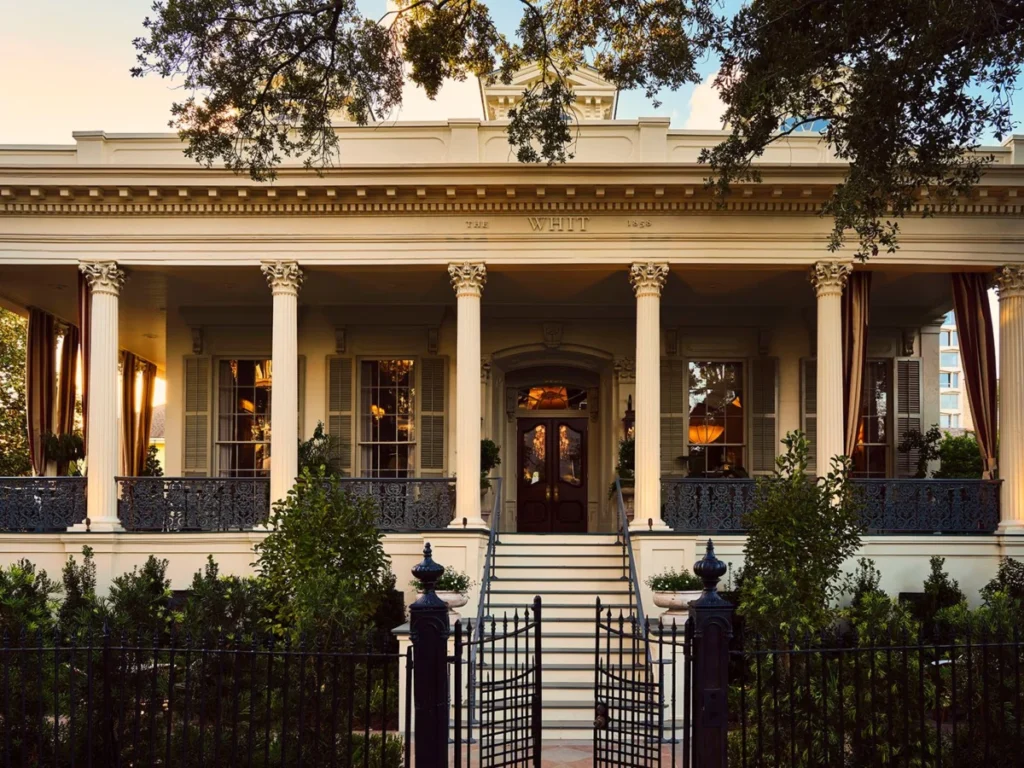

The Greek Revival mansion that sits at the corner of Prytania Street and Jackson Avenue in New Orleans’s Garden District has long been a centerpiece of local lore, but it is now undergoing its most significant transformation to date. Once known as the Magnolia Mansion, a property burdened by a reputation for supernatural activity and a chaotic recent history, the 1857 structure has officially been rebranded and redesigned as The Whit. This transition marks the end of an era defined by paranormal tourism and legal volatility, signaling a new chapter for one of the most architecturally significant corners in the city.
A Legacy of Turmoil and Transformation
The history of the property at 2127 Prytania Street is inextricably linked to the fortunes of 19th-century New Orleans. Originally constructed in 1857, the mansion served as a testament to the wealth of the cotton trade. However, the home’s narrative quickly took a tragic turn, as the original owner succumbed to yellow fever, an epidemic that ravaged the city during the era. Over the subsequent century, the residence changed hands multiple times, with local legends—often cited by the city’s thriving ghost-tour industry—attributing a series of untimely deaths and structural accidents to the house.

In the early 21st century, the property was converted into the Magnolia Mansion, a boutique bed-and-breakfast that leaned heavily into the building’s reputation for the macabre. The facility featured themed suites such as the "Vampire Lovers’ Lair" and the "Moulin Rouge," catering to a niche segment of tourists seeking a gothic, immersive experience. During this period, the mansion was frequently cited by national media outlets, including USA Today, as one of the premier locations in the United States for those interested in “sleeping with a ghost.”
However, the property’s later years were marked by significant legal and operational instability. The site became the focus of intense scrutiny following a high-profile FBI raid, which effectively signaled the collapse of the management group that had taken over the property—a team that included a former professional boxer and a well-known local political operative. This event served as a catalyst for the total closure and subsequent acquisition of the mansion, ending its tenure as a controversial tourist attraction.
Architectural Preservation and Design Philosophy
The task of repurposing such a storied, and historically sensitive, site fell to a team led by Gretchen Trauth, CEO of the investment firm that acquired the property. To navigate the complexities of rebranding a site with such a heavy “ghost-coded” reputation, the ownership team engaged designers Jensen Killen and Katie Logan Leblanc of the New Orleans-based firm Logan Killen. Their mission was to strip away the theatricality of the previous era and restore a sense of architectural integrity.

“The goal was a hotel where nobody can quite tell whether a designer has touched it,” says Leblanc. This approach, often referred to as “invisible design,” prioritizes the historical narrative of the structure over contemporary trends. The designers sought to create an atmosphere of “layered history,” ensuring that the furnishings, accessories, and art collections felt as though they had been curated over decades, rather than purchased for a commercial project.
Architect Seamus McGuire, of the local firm Cicada, played a critical role in this renovation. McGuire was tasked with ensuring that all modifications adhered to strict historical preservation codes while reconfiguring the interior to meet modern hospitality standards. A primary objective was to reclaim the glamour that had been obscured by the previous owners’ focus on gothic themes. This involved converting several bedrooms into communal lounges to encourage a more social, high-end guest experience.
The Reimagined Interior: A Curated Narrative
The rebranding of the property as "The Whit" pays homage to the American poet Walt Whitman, who spent three months residing in New Orleans in 1848, a decade before the house was constructed. This literary connection serves as the cornerstone of the hotel’s new identity, moving away from the sensationalism of the past toward a more intellectual, romantic aesthetic.

The renovation included the creation of a mahogany-paneled library, now a hallmark of the hotel. The room serves as a quiet repository for literature provided by the renowned local bookstore, Faulkner House Books. This space, designed to be dark and atmospheric, is meant to function as a sophisticated venue for evening cocktails or quiet study, moving away from the performative scares of the mansion’s previous iteration.
Other notable design choices include:
- The Breakfast Room: Featuring Pierre Frey’s Les Colonnes wallpaper, the room offers a cohesive, high-fashion aesthetic that contrasts sharply with the previous purple-velvet heavy decor.
- The Main Lounge: To address the challenge of animating such a large space, the designers implemented a dual-purpose strategy. By using specific paint tones—ethereal blue during the day and warmer hues at night—and incorporating a custom-tailored grid carpet, the room feels intimate even when unoccupied.
- The Art Collection: A salon-style gallery featuring works by Louisiana-based artists such as Robert Moreland and Mallory Page adds a layer of regional authenticity to the property.
Challenges of Historic Landmark Regulations
A central challenge during the renovation was the legal requirement to avoid the creation of a “fake history.” Landmark regulations in New Orleans are particularly stringent regarding the modification of historic buildings. Designers were prohibited from introducing elements that suggested a past the building did not possess.

“What we don’t want is to put a contemporary bar into a very historic property,” McGuire noted regarding the second-floor lounge. Instead of attempting to replicate a style that might contradict the original architecture, the team opted for an openly Art Deco aesthetic. This decision allowed the bar to stand out as a distinct, historically referenced addition rather than an attempt to blend into the 1857 construction, thereby satisfying regulatory bodies while maintaining a luxury standard.
Economic and Cultural Implications
The transformation of 2127 Prytania Street is representative of a broader trend in New Orleans’s hospitality sector, where legacy properties are being transitioned from tourist-centric "haunted" sites to more nuanced, boutique experiences. This shift has significant implications for the Garden District, which has long struggled to balance the preservation of its historic residential character with the demands of the tourism industry.
By removing the reliance on ghost-tour revenue, The Whit aims to capture a more sustainable demographic: travelers seeking luxury accommodations that emphasize local culture, art, and literary history. The 15 guest rooms, which include a mix of garden-facing units with glossy oxblood walls and high-ceilinged cabana rooms with bamboo accents, reflect this diversity in design, deliberately avoiding the uniform aesthetic found in chain hotels.

While local skeptics have noted that the “haunting” of the mansion was largely a commercial construct, the management of The Whit remains focused on the future. As for the paranormal reputation that defined the building for nearly two decades, the staff reports a quiet, professional atmosphere. In the words of the new ownership team, the ghosts of the past have been replaced by the enduring, tangible history of the house itself. Through careful preservation and a pivot toward high-end hospitality, The Whit has effectively repositioned itself as a legitimate landmark, ensuring that its future is defined by its architectural elegance rather than the ghost stories of its past.