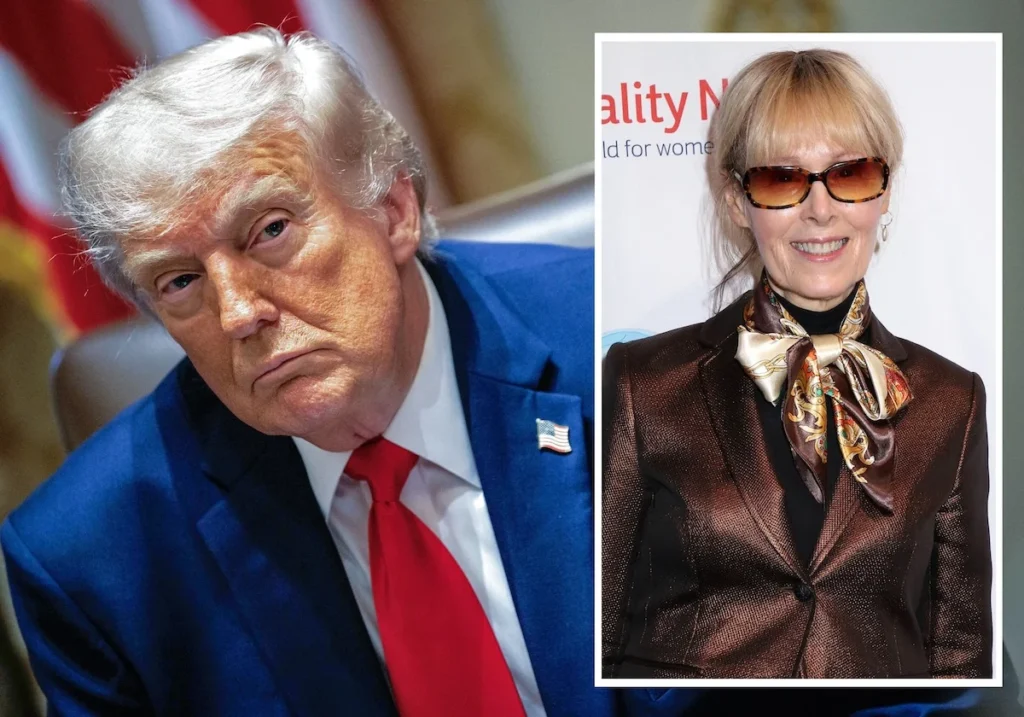

E. Jean Carroll, the former magazine columnist who successfully secured significant civil judgments against former President Donald Trump, is now reportedly the subject of a criminal investigation by the Justice Department. The inquiry centers on allegations that Carroll may have committed perjury during her courtroom testimony related to the high-profile lawsuits against Trump. This new development adds a complex and dramatic layer to an already protracted legal saga that has captured national attention, intertwining personal allegations with political implications.
The core of the investigation, first reported by CNN on Thursday, revolves around statements Carroll made during a 2022 deposition. During this testimony, Carroll reportedly asserted that no other individuals or entities were providing financial support for her protracted legal battle against Donald Trump. However, subsequent revelations contradicted this claim, indicating that billionaire LinkedIn co-founder Reid Hoffman allegedly contributed to covering some of Carroll’s legal fees and associated expenses through a non-profit organization. This discrepancy has reportedly become the focal point of the federal inquiry, drawing scrutiny from prosecutors who are now examining the veracity of her sworn statements.
The Allegation in Detail: A Question of Funding Transparency
The specific nature of the alleged perjury stems from Carroll’s testimony regarding the financial backing of her lawsuits. In a deposition taken in 2022, a crucial phase in the discovery process preceding the civil trials, Carroll was questioned about the source of her legal funding. She reportedly stated under oath that she was not receiving financial assistance from any third parties. This assertion is standard in many legal proceedings, as the transparency of funding can be relevant to assessing a litigant’s motives, potential biases, or the influence of external actors.
The subsequent revelation that Reid Hoffman, a prominent Democratic donor and co-founder of LinkedIn, had allegedly funneled financial support to Carroll’s legal efforts through a non-profit organization directly challenged her earlier testimony. Hoffman’s involvement became known later in the legal proceedings, reportedly stunning Trump’s legal team, who then sought to use this information to question Carroll’s credibility. The financial support reportedly covered a portion of Carroll’s legal fees and other related expenses incurred during the intense and costly litigation against a former president. The Justice Department’s investigation will now seek to determine whether Carroll’s initial denial of external funding constituted a knowing and intentional false statement under oath, a critical element for a perjury charge.
A Saga of Litigation: The Carroll-Trump Background
To fully understand the context of this new investigation, it is essential to revisit the contentious legal battles between E. Jean Carroll and Donald Trump. Carroll first publicly accused Trump of sexually assaulting her in a Bergdorf Goodman department store dressing room in the mid-1990s. She detailed these allegations in a 2019 article published in New York Magazine and subsequently in her memoir, What Do We Need Men For? A Modest Proposal.
Trump vehemently denied Carroll’s accusations, famously stating that she was "not my type" and dismissing her claims as a fabricated story designed to promote her book. These denials, which Carroll argued were defamatory, led her to file her first lawsuit against Trump in November 2019, alleging defamation. This initial case faced delays, including complex legal questions surrounding whether Trump could be sued for statements made while he was president, which involved debates over the Westfall Act and the scope of presidential immunity.
The legal landscape shifted significantly in November 2022 when New York passed the Adult Survivors Act (ASA), a law that created a one-year lookback window for adult victims of sexual assault to file civil lawsuits even if the statute of limitations had otherwise expired. Carroll seized this opportunity, filing a second lawsuit against Trump. This second suit included a battery claim under the ASA, directly accusing Trump of sexual assault, as well as a new defamation claim based on Trump’s subsequent public statements.
The first trial, combining the battery claim and a defamation claim from the second lawsuit, concluded in May 2023. A jury found Trump liable for sexually abusing and defaming Carroll, awarding her $5 million in damages. While the jury did not find him liable for "rape" as defined by New York law, they affirmed that he had sexually assaulted her.
The second trial, focusing solely on the remaining defamation claim from the 2019 lawsuit (which was consolidated with the new defamation claim from the second lawsuit), concluded in January 2024. This trial specifically addressed Trump’s defamatory statements made in 2019 after Carroll first went public. The jury found Trump liable for defamation and awarded Carroll a substantial $83.3 million in damages, comprising $18.3 million in compensatory damages and $65 million in punitive damages. These two verdicts represented a significant legal defeat for the former president.
Chronology of Key Events in the Carroll-Trump Legal Saga
- Mid-1990s: E. Jean Carroll alleges Donald Trump sexually assaulted her in a Bergdorf Goodman department store.
- June 2019: Carroll publishes an excerpt from her memoir in New York Magazine, detailing her sexual assault allegation against Trump. Trump publicly denies the allegations, making statements Carroll deems defamatory.
- November 2019: Carroll files her first defamation lawsuit against Trump in New York federal court.
- Late 2022: During a deposition related to her lawsuits, Carroll states under oath that she is not receiving outside financial backing for her legal fight.
- November 2022: New York’s Adult Survivors Act (ASA) takes effect, providing a new window for sexual assault victims to sue. Carroll files a second lawsuit against Trump, including a battery claim under the ASA and a new defamation claim.
- May 2023: A jury finds Trump liable for sexually abusing and defaming Carroll in the first civil trial, awarding her $5 million.
- Prior to/During Second Trial (late 2023/early 2024): The revelation emerges that Reid Hoffman, a Democratic donor, allegedly helped fund Carroll’s legal expenses through a non-profit organization, contradicting her 2022 deposition testimony.
- January 2024: A jury finds Trump liable for defamation in the second civil trial, awarding Carroll $83.3 million.
- February 2024 (approximate): Reports surface that the Justice Department has initiated a criminal investigation into Carroll for alleged perjury related to her 2022 deposition statements about funding.
- Ongoing: Donald Trump is aggressively appealing both civil verdicts against him.
The Funding Controversy Unveiled
The revelation of external funding became a contentious point during the civil proceedings. Trump’s attorney, Alina Habba, reportedly argued vigorously during the original proceedings that Carroll’s legal team had intentionally concealed the financial backing for months. This delay in disclosure, according to Trump’s defense, was a deliberate attempt to mislead the court and the jury, potentially impacting the perception of Carroll’s credibility and the motivations behind her lawsuit.
Carroll’s attorneys later acknowledged the existence of outside funding, confirming that financial assistance had indeed been provided. However, they maintained that Carroll herself had no direct communication with Reid Hoffman or anyone specifically connected to the non-profit organization that facilitated the funding. Their argument implied that while the funds were received by her legal team, Carroll was personally unaware of the specific source or the intricate details of the arrangement at the time of her deposition, or that the arrangement was structured in a way that she genuinely believed she was not directly "receiving" funds in a manner that would contradict her testimony. This distinction between direct personal knowledge and legal team’s knowledge is likely to be a key point in any potential defense against perjury charges.
Legal Nuances and Justice Department Involvement
Perjury, defined as the intentional act of swearing a false oath or of falsifying an affirmation to tell the truth, whether spoken or in writing, concerning matters material to a legal proceeding, is a serious federal felony. Conviction can carry significant penalties, including imprisonment. For a perjury charge to stick, prosecutors must prove not only that a statement made under oath was false, but also that the individual knew it was false at the time it was made and intended to deceive. The "materiality" of the false statement – meaning its relevance to the outcome or integrity of the legal proceeding – is also a crucial element. In this case, the source of litigation funding could be deemed material, as it could speak to a litigant’s credibility, potential conflicts of interest, or the perceived independence of the legal action.
The involvement of the Justice Department signals a significant escalation from a civil dispute to a potential criminal matter. Interestingly, the investigation has reportedly been referred to federal prosecutors in Chicago. This geographical referral is partly due to the fact that the non-profit organization connected to Reid Hoffman’s alleged funding is based in Chicago. This move also helps to mitigate potential conflicts of interest within the Justice Department in Washington D.C. or New York, given the high-profile nature of the individuals involved.
A notable aspect of the DOJ’s handling of the matter is the reported recusal of acting Attorney General Todd Blanche. Blanche previously served as one of Donald Trump’s personal attorneys during the appeal phase of the Carroll lawsuits. Such a recusal is standard practice in the legal profession to avoid any appearance of impropriety or conflict of interest, ensuring the impartiality of the investigation. While Blanche is a high-ranking official, his prior representation of Trump necessitates his removal from any oversight or decision-making regarding matters that could directly or indirectly impact his former client or their adversaries.
Reactions from Stakeholders
E. Jean Carroll’s legal team has reportedly adopted a policy of complete public silence regarding the criminal investigation. CNN noted that her attorneys have declined to comment on the situation altogether. This stance is typical for legal counsel when their client is the subject of a criminal inquiry, as public statements can inadvertently complicate legal strategy or provide information to prosecutors.
Donald Trump and his legal team, while not issuing formal statements specifically on the DOJ investigation into Carroll, have consistently used the funding revelations to challenge Carroll’s credibility. During the civil trials, they attempted to present the external funding as evidence of a coordinated effort against Trump, implying a political motivation behind the lawsuits. It is highly probable that Trump’s camp views this criminal investigation as a form of vindication, or at least as bolstering their narrative that Carroll’s claims and legal actions were not entirely straightforward or independent. They would likely leverage this development in their ongoing appeals, arguing that it further undermines the foundation of the jury verdicts.
The Justice Department, as a matter of policy, generally refrains from commenting on ongoing investigations. This standard practice is designed to protect the integrity of the investigative process, safeguard the rights of individuals involved, and avoid prejudicing potential legal proceedings. Therefore, official statements from the DOJ on the specifics of the Carroll investigation are unlikely until or unless charges are filed or the investigation is concluded.
Implications for E. Jean Carroll
For E. Jean Carroll, the criminal investigation presents a formidable new challenge. Should federal prosecutors find sufficient evidence to pursue a perjury charge, she could face severe legal consequences, including fines and imprisonment. Beyond the immediate legal jeopardy, an indictment or conviction for perjury would undoubtedly have a profound impact on her public image and could significantly undermine the credibility of her prior successful civil lawsuits against Donald Trump. Even if she is ultimately not charged or is acquitted, the existence of a federal criminal investigation itself casts a shadow over her past testimony and could be used by Trump’s legal team to sow doubt in the court of public opinion and potentially in the appellate courts. The psychological and financial toll of defending against a federal criminal charge would also be substantial.
Implications for Donald Trump and Ongoing Appeals
For Donald Trump, this development offers a potential strategic advantage in his vigorous appeals of the $5 million and $83.3 million verdicts. His legal team has already argued that Carroll’s alleged lack of transparency regarding funding was a critical issue. The existence of a federal perjury investigation could lend significant weight to these arguments, potentially persuading appellate judges to reconsider aspects of the civil judgments or even order new trials. Trump has consistently portrayed the lawsuits against him as politically motivated attacks, and a federal investigation into his accuser for alleged perjury could be framed by his supporters as evidence supporting that narrative.
The U.S. Supreme Court has repeatedly delayed deciding whether it will even hear one of Trump’s appeals related to the Carroll cases, specifically concerning the scope of presidential immunity for defamatory statements made while in office. This ongoing criminal investigation adds another layer of complexity to the appellate landscape, potentially influencing how higher courts view the entire legal saga.
Broader Context: Third-Party Litigation Funding
The controversy surrounding Carroll’s funding also highlights the growing and often debated practice of third-party litigation funding (TPLF). TPLF involves external entities, often private investment firms or wealthy individuals, providing capital to litigants in exchange for a share of any potential settlement or judgment. Proponents argue that TPLF levels the playing field, allowing individuals or smaller entities to pursue meritorious claims against well-resourced adversaries who might otherwise overwhelm them financially. It can enhance access to justice by removing the barrier of exorbitant legal costs.
However, critics raise concerns about transparency, potential conflicts of interest, and the influence of funders on legal strategy. There are worries that funders, driven by profit motives, might push for settlements or judgments that are not always in the best interest of the litigant, or that their involvement could taint the perception of a case’s impartiality. In high-profile cases, especially those with political undertones, the identity of funders and the terms of their involvement become particularly scrutinized, as they can raise questions about the true motivations behind the litigation. The E. Jean Carroll case underscores the increasing relevance of TPLF and the legal and ethical questions it presents, particularly regarding disclosure requirements in civil litigation and the potential for such funding to become material in criminal investigations related to testimony.
Conclusion
The reported Justice Department criminal investigation into E. Jean Carroll for alleged perjury marks a dramatic and unexpected turn in her long-running legal battle with Donald Trump. What began as an accusation of sexual assault and subsequent defamation claims has now broadened to include a federal inquiry into the accuser herself, centering on the transparency of her legal funding. This development will undoubtedly reverberate through the ongoing civil appeals, add further layers of complexity to the already intricate legal and political landscape surrounding Donald Trump, and draw renewed attention to the crucial importance of truthful testimony under oath in the American justice system. The saga, far from concluding with the civil verdicts, continues to unfold with new and significant legal implications for all parties involved.