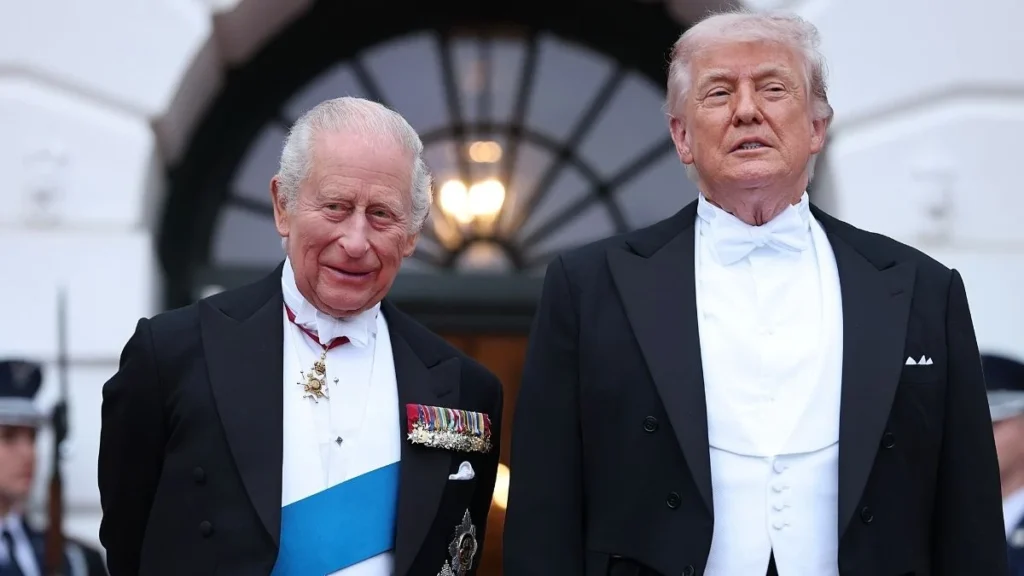

The diplomatic landscape of the "Special Relationship" between the United Kingdom and the United States has taken an unexpected personal turn following revelations regarding the private rapport between King Charles III and Donald Trump. As the British monarch and Queen Camilla conclude their high-profile state visit to the United States, scheduled to end on April 30, reports have emerged suggesting that the King views the former U.S. President through a lens of personal nostalgia. According to palace insiders, King Charles III finds that Donald Trump shares a distinct "spirit" with the late American comedian and television host Joan Rivers, a woman who was a close confidante of the King for several decades.
This comparison comes at a pivotal moment in transatlantic relations, as the royal couple engages in a series of ceremonial and political engagements designed to reinforce the historical ties between London and Washington. During a recent state dinner, the King and the former President demonstrated a level of camaraderie that surprised many observers, culminating in the presentation of a significant historical artifact: a golden bell from a World War II-era vessel. While the two men are known to hold diametrically opposed views on several global issues, most notably climate change and environmental policy, the personal chemistry between them appears to be rooted in a shared appreciation for charismatic, "larger-than-life" personalities.
The Joan Rivers Connection: A Study in Personality over Politics
The assertion that Donald Trump reminds King Charles III of Joan Rivers originated from sources close to the royal household, who spoke to journalist Rob Shuter. The insider clarified that the comparison is not based on political ideology or policy positions, but rather on an intangible "spirit" and a specific brand of presence. The source noted that the King finds the former President "very funny, wildly entertaining, and impossible to ignore."
Joan Rivers, who passed away in 2014, was a frequent guest of the King (then the Prince of Wales) at his Highgrove estate and attended his wedding to Queen Camilla in 2005. She was known for her sharp wit, her refusal to adhere to traditional social filters, and her ability to command any room she entered. Insiders suggest that King Charles III possesses a "soft spot" for individuals who are "sharp, unpredictable, and know how to command a room." Despite the King’s own reputation for formal adherence to protocol, he has historically been drawn to entertainers and public figures who offer a candid, if occasionally abrasive, departure from the guarded nature of court life.
The comparison highlights a psychological aspect of the British monarchy that is often overlooked: the value placed on "interesting" company. One source emphasized that while the King and Donald Trump "agree on almost nothing" regarding the technicalities of governance, the King values the former President’s ability to entertain. "Donald is interesting. Joan was interesting. That matters to Charles," the source added, suggesting that the King’s private preferences are often dictated by a person’s ability to provide a respite from the dry nature of diplomatic briefings.
Chronology of the State Visit and the Symbolic Golden Bell
The current state visit, which began in late April, has been marked by a blend of traditional pageantry and modern diplomatic maneuvering. The schedule was designed to cover a broad spectrum of cooperation, from military history to economic partnerships.
- April 22: Arrival of King Charles III and Queen Camilla in Washington D.C., met by senior State Department officials.
- April 24: A visit to Arlington National Cemetery to honor the shared military sacrifices of the two nations.
- April 26: The highly anticipated state dinner where the "Joan Rivers" comparison was reportedly discussed among circles of the attending delegation.
- April 28: Engagement with business leaders regarding transatlantic trade and the future of green technology.
- April 30: The scheduled conclusion of the visit and the return of the royal party to London.
The highlight of the state dinner was the exchange of gifts, a tradition that carries significant weight in royal diplomacy. King Charles III presented Donald Trump with a golden bell that once hung on the conning tower of a World War II-era ship. While presenting the gift, the King displayed the very humor that insiders say bridges the gap between him and the former President. Referring to the vessel as a "valiant namesake," the King quipped, "Should you ever need to get hold of us, just give us a ring!"
The gift is seen as a "symbol of friendship," connecting the current era of Anglo-American relations back to the "Greatest Generation" and the alliance that defined the mid-20th century. Analysts suggest that the choice of a maritime artifact is a subtle nod to the shared naval history of the two nations, providing a solid foundation of historical respect even when modern political opinions diverge.
The "Odd Couple" Dynamic: Analyzing the Divergent Views
The characterization of King Charles III and Donald Trump as an "odd couple" is supported by a wealth of public data regarding their respective priorities. For over five decades, the King has been a staunch advocate for environmental conservation, organic farming, and the fight against climate change. His "Terra Carta" initiative and his speeches at various COP summits have established him as a global leader in sustainability.
Conversely, Donald Trump’s administration was marked by a withdrawal from the Paris Agreement and a focus on deregulating the energy sector to promote fossil fuel production. The two famously discussed these issues during Trump’s 2019 state visit to the United Kingdom, where a scheduled 15-minute meeting turned into a 90-minute debate on the environment. At the time, Trump remarked that the then-Prince of Wales did most of the talking but acknowledged his passion.
Despite these ideological chasms, the personal rapport remains a point of fascination. Royal historians point out that the British sovereign often seeks out personalities that contrast with the "gray men" of the civil service. The King’s friendship with Joan Rivers was similarly unlikely; she was a brash, Brooklyn-born comedian, and he was the heir to a thousand-year-old throne. The common thread, it seems, is an appreciation for authenticity—even if that authenticity is controversial.
Broader Implications for UK-US Diplomacy
The revelation of this personal affinity has broader implications for the "Special Relationship." In the world of international relations, personal chemistry between heads of state (or ceremonial heads of state) can often grease the wheels of diplomacy during periods of political tension.
- Diplomatic Continuity: The King’s ability to find common ground with various U.S. political figures ensures that the monarchy remains a stable bridge between the two nations, regardless of which party holds the White House.
- Soft Power Influence: By engaging in a friendly, humorous manner, the King utilizes "soft power" to maintain influence. The gift of the golden bell serves as a tangible reminder of the UK’s historical importance to the U.S.
- Public Perception: While some critics in the UK may view the comparison to Joan Rivers as trivializing the monarchy, others see it as a humanizing element that shows the King’s ability to navigate complex social environments.
Official Responses and Public Reaction
While the Buckingham Palace press office has not officially commented on the "Joan Rivers" comparison—maintaining their standard policy of not commenting on "private conversations"—the atmosphere of the state visit has been described by officials as "warm and productive."
Representatives for the former President have frequently spoken of his high regard for the British Royal Family. Trump has often mentioned his admiration for the late Queen Elizabeth II, and his interactions with King Charles III appear to continue that trend of respect for the institution, albeit seasoned with his own brand of informal interaction.
In the United States, the reaction to the state visit has been largely positive, with media outlets focusing on the pageantry and the historical significance of the King’s first major visit to the U.S. since his coronation. The "golden bell" moment has been widely circulated as a successful example of "gift diplomacy," blending historical reverence with a touch of levity.
Conclusion: The Persistence of Personal Diplomacy
As the state visit draws to a close on April 30, the narrative surrounding the relationship between King Charles III and Donald Trump serves as a reminder that international relations are often as much about personal chemistry as they are about policy papers. The King’s comparison of Trump to Joan Rivers provides a rare glimpse into the private thoughts of a monarch who has spent his life observing the world’s most powerful people.
Whether they are discussing the conning tower of a WWII ship or sharing a laugh at a state dinner, the interaction between these two figures suggests that the "Special Relationship" remains resilient. In the complex theater of global politics, the ability to find an "interesting" partner in dialogue—even one with whom you "agree on almost nothing"—remains one of the most effective tools in the royal diplomatic arsenal. The golden bell, now a permanent fixture of the diplomatic record, stands as a testament to a visit that was as much about the spirit of the individuals as it was about the interests of the states they represent.