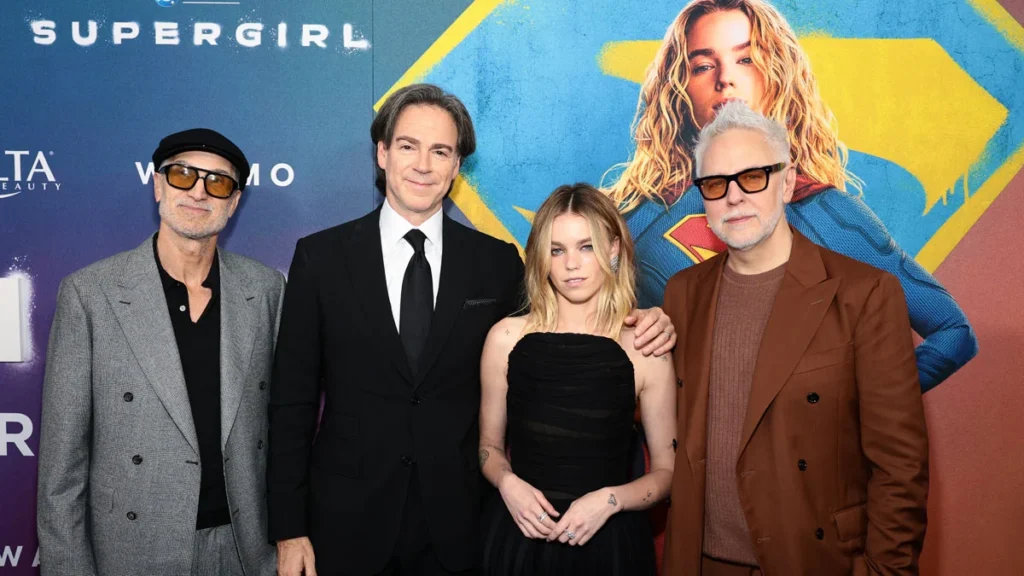

The departure of James Gunn and Peter Safran from the helm of DC Studios, announced this past Monday, marks a seismic shift for Warner Bros. Discovery. This development arrives less than two years after the studio’s ambitious reboot of the DC Universe (DCU) officially commenced, creating a state of uncertainty for a franchise that had only recently begun to find its footing. The exit of the duo, who were tasked with architecting a cohesive, interconnected narrative landscape for DC’s legendary stable of heroes, signals a potential pivot in strategy as the company navigates the complexities of a post-merger corporate environment under new leadership at Skydance.
The Rise and Stall of a Shared Universe
The DCU strategy, under Gunn and Safran, was designed to mirror the structural success of the Marvel Cinematic Universe (MCU), emphasizing interconnected storytelling that built toward major cinematic events. The roadmap was established with a mixture of television and film, beginning with the animated series Creature Commandos and the live-action Peacemaker. However, the cornerstone of this initiative was the 2025 release of Superman. Critically acclaimed and commercially robust, the film provided the essential "launchpad" for a new era, proving that audiences were still receptive to traditional superhero narratives if executed with clear vision and tonal consistency.
Following Superman, DC Studios experienced a period of mixed performance. The HBO series Lanterns, while drawing significant viewership and featuring high-profile talent such as Aaron Pierre and Kyle Chandler, received a polarized critical reception, underscoring the difficulty of maintaining consistent quality across varied platforms. Conversely, the October 2026 release of the R-rated thriller Clayface served as a successful counter-programming effort. With a modest production budget of $40 million and a global box office return exceeding $100 million, the film demonstrated that the studio could achieve profitability through smaller, character-driven projects.
However, the summer 2026 release of Supergirl proved to be a critical and commercial misfire. Many analysts pointed to the film’s tonal similarities to the Guardians of the Galaxy franchise as a potential point of fatigue. This raised broader concerns regarding whether the "house style" of the Gunn-Safran era was too narrow to accommodate the diverse range of characters within the DC pantheon. Had Supergirl performed at the level of Superman, it is highly probable that the leadership structure would have remained intact; its failure, however, appears to have accelerated the decision to re-evaluate the studio’s direction.
A Chronology of Instability
Warner Bros.’ struggle to define a consistent identity for its DC properties is a long-standing issue that predates the Gunn-Safran era. The history of DC cinema is a fractured timeline of attempts to emulate industry-leading models while simultaneously failing to commit to a singular vision:
- 2013–2017: The inception of the "Snyderverse" with Man of Steel, leading into Batman v. Superman: Dawn of Justice and the troubled production of 2017’s Justice League.
- 2017–2022: A period of divergence where the studio released standalone hits like Wonder Woman and Aquaman while simultaneously allowing the "Arrowverse" to dominate television and enabling Matt Reeves to develop his own isolated The Batman universe.
- 2022: The cancellation of the nearly completed Batgirl film, a move that sent shockwaves through the industry and signaled a lack of confidence in the existing development pipeline.
- 2023–2025: The "Gunn-Safran" reset, which promised a clean slate but ultimately struggled to reconcile new projects with legacy baggage, such as the lingering presence of characters from the 2023 Blue Beetle film.
This history reveals a recurring pattern: the inability to fully commit to a shared universe due to the competing demands of standalone projects, television spin-offs, and the sheer commercial draw of specific directors or characters.
The Future of the Slate
Despite their exit, Gunn and Safran’s influence will persist through at least two more projects. The most significant of these is 2027’s Man of Tomorrow, which is set to act as a direct sequel to Superman. The production is notable for its expansive cast, which includes the return of David Corenswet, the inclusion of Aaron Pierre as John Stewart, and the integration of Xolo Maridueña as Jaime Reyes.

Industry reports suggest that Man of Tomorrow may also integrate elements from the Peacemaker series, including a cliffhanger involving alternate dimensions. Furthermore, persistent rumors suggest the introduction of a new Wonder Woman. This approach indicates that, even as the architects leave, the "shared universe" machine continues to move forward, perhaps too far along in production to be significantly altered by the change in command.
Broader Economic and Industrial Implications
The decision to pause or potentially dismantle the grand vision for the DCU coincides with a broader cooling of the superhero genre. Market data from the past two years shows a decline in general audience interest in shared-universe projects that require significant "homework" to understand. Marvel Studios, the gold standard for such projects, has also faced recent hurdles, suggesting that the era of automatic box office dominance for comic book adaptations is waning.
The timing of this transition is particularly sensitive. On December 18, the industry will witness "Dunesday," a clash between the releases of Avengers: Doomsday and Dune: Part Three. Because Warner Bros. serves as the studio behind Dune, there is a growing consensus that the corporate leadership may prioritize the prestige and stability of established cinematic franchises over the high-risk, high-cost investment required to sustain a massive superhero universe.
Furthermore, the recent merger with Skydance introduces a new layer of shareholder accountability. Corporate stakeholders are increasingly wary of the bloated budgets and marketing costs associated with massive interconnected cinematic universes. In an era where a $200 million production can easily lose money, the "risk-adjusted return" of a smaller, more focused project—like Clayface—is becoming far more attractive to executives than the potential, but often elusive, billions generated by an Avengers-style team-up.
Official Stance and Future Outlook
In a statement released on social media, James Gunn confirmed that while his tenure as head of DC Studios is concluding, his commitment to the remaining projects remains steadfast. "We’ll see where it goes after that," Gunn noted, emphasizing that the characters established under his supervision will likely continue to play a role in the future of the studio.
The primary challenge for the next iteration of DC leadership will be to resolve the "curse of popularity." Because DC characters like Batman, Superman, and Wonder Woman have such enduring appeal, the studio has consistently found it impossible to prune its library, resulting in a cluttered landscape where multiple versions of the same character exist in different timelines and formats.
Whether the incoming management will choose to fully embrace the "multiverse" as a tool to justify this fragmentation, or attempt to force a more rigid, unified continuity, remains to be seen. What is clear is that the "Gunn-Safran" experiment serves as a case study in the difficulties of franchise building in an oversaturated market. As the industry looks toward 2027 and beyond, the DC Universe remains in a state of flux, suspended between its desire for a cohesive narrative and the economic reality that, in today’s landscape, flexibility is often more profitable than a rigid plan.