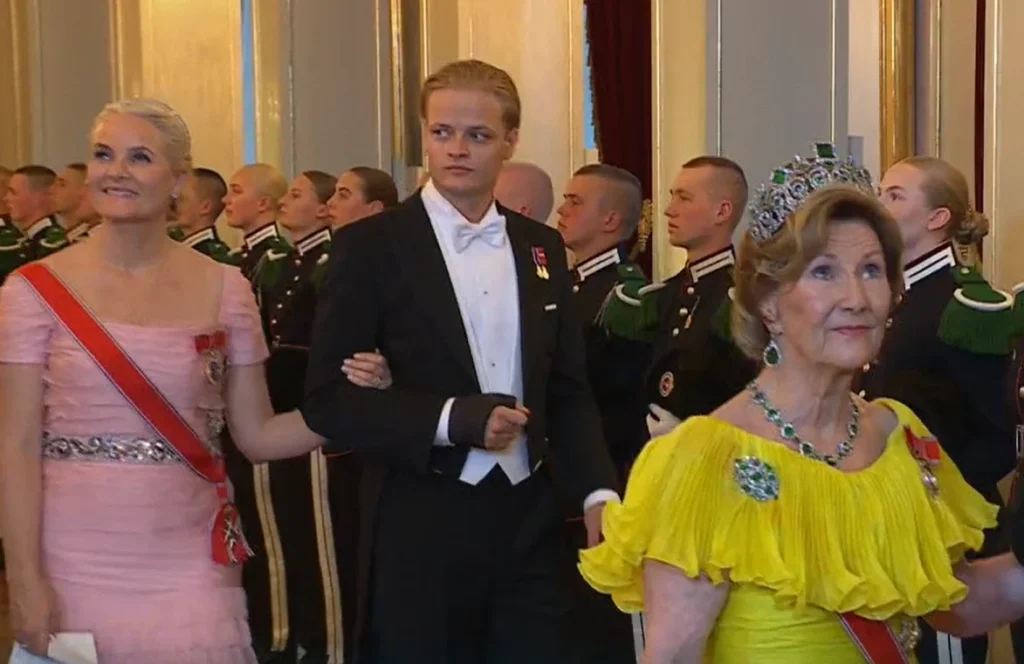

The son of Norway’s Crown Princess Mette-Marit has been handed a significant custodial sentence of four years in prison after being convicted of rape and a string of other serious offences. The verdict, delivered by Oslo District Court, concludes one of the most closely scrutinized legal proceedings in recent Norwegian history, casting a considerable shadow over the nation’s Royal Family. Marius Borg Højby, 29, was found guilty on two counts of rape, domestic abuse, and several additional charges involving multiple women. While the court acquitted him of two other rape allegations, his conviction on the remaining counts marks a serious legal outcome.
Højby, who participated in Monday’s hearing via video link from his place of detention, had consistently denied the rape charges levelled against him. The prosecution had sought a considerably harsher sentence of seven years and seven months, highlighting the gravity of the accusations. In contrast, the defence had argued for a much more lenient penalty, suggesting no more than 18 months in prison and seeking acquittal on the rape charges. The court’s final decision of a four-year custodial sentence also mandates Højby to pay substantial compensation totalling 640,000 Norwegian kroner to four of the women involved. Furthermore, he has been issued a two-year restraining order against one of his victims, underscoring the court’s assessment of the harm caused.
It is crucial to note that despite his familial connection to the Norwegian monarchy, Marius Borg Højby is not an official member of Norway’s Royal Family. He was four years old when his mother, Crown Princess Mette-Marit, married Crown Prince Haakon in 2001. Since that time, he has held no official royal duties or titles. The case, which encompassed allegations from six women, generated intense public interest and media scrutiny throughout Norway and internationally, due to its high-profile connections.
Details of the Convictions and Trial
The convictions for rape stem from two separate incidents. The court determined that in both instances, the victims were in a state where they were unable to resist the sexual assault. In one of the concluded cases, the judges found that the victim was asleep when the assault occurred. The other conviction related to an incident that took place at the Crown Prince’s Skaugum estate, a location intrinsically linked to the Royal Family. The acquittal on two further rape allegations means that while serious charges were proven, not all accusations resulted in conviction.
Beyond the rape charges, Højby was also convicted of domestic abuse against his former girlfriend, Nora Haukland. Haukland is a notable Norwegian influencer and the only complainant in the case who was publicly identified. Her involvement brought an additional layer of public awareness to the proceedings. The six-week trial involved extensive testimony and evidence, painting a detailed picture of the alleged offences.
A Difficult Period for the Norwegian Monarchy
The verdict comes at a particularly challenging time for the Norwegian monarchy. Just days prior to the court’s decision, the Royal Household released a statement revealing that Crown Princess Mette-Marit has been placed on a waiting list for a lung transplant. This announcement highlighted the worsening of her long-standing battle with chronic pulmonary fibrosis, a serious and progressive lung disease.
Højby’s legal team had repeatedly petitioned for his release from pre-trial detention, arguing that he should be allowed to spend time with his mother, particularly given her declining health. They contended that family contact was of paramount importance during this critical period. A lower court had initially granted a temporary release for Højby ahead of the verdict, acknowledging the family’s circumstances. However, this decision was subsequently overturned on appeal, meaning he remained in custody throughout the remainder of the trial and for the delivery of the sentence.
The legal team representing Højby has indicated their intention to consider an appeal against the verdict. Such an appeal would necessitate a further legal process, potentially prolonging the judicial saga and continuing the intense media attention surrounding the case.
Legal Proceedings and Sentencing
The Oslo District Court’s deliberation process was thorough, examining the evidence presented by both the prosecution and the defence. The court’s decision to convict on specific charges, while acquitting on others, reflects a careful consideration of the legal thresholds for guilt in each instance. The sentence of four years reflects the severity of the crimes for which Højby was found guilty, including rape and domestic abuse.
The compensation awarded to the victims is intended to address the harm and suffering they have endured. The sum of 640,000 Norwegian kroner is a significant financial penalty, and the restraining order provides a legal measure of protection for one of the complainants.
The trial’s duration and the public interest it garnered are indicative of the societal importance placed on addressing sexual offences and domestic violence. The fact that the case involved individuals connected to the Royal Family inevitably amplified its profile, leading to widespread coverage and public discussion.
Background and Context
Marius Borg Højby’s mother, Crown Princess Mette-Marit, is a prominent figure in Norwegian public life. Her marriage to Crown Prince Haakon in 2001 marked a significant moment for the Norwegian monarchy, bringing a modern and relatable element to the institution. Mette-Marit’s own journey, including her past, has been well-documented and has often been portrayed as a symbol of overcoming personal challenges. The Crown Princess has been open about her health struggles, making the current period particularly poignant for the family.
The Skaugum estate, where one of the incidents allegedly occurred, is the official residence of the Crown Prince and Crown Princess, further emphasizing the proximity of the alleged offences to the heart of the Norwegian monarchy. This detail likely contributed to the heightened public and media interest in the case.
Broader Societal Implications
The conviction of Marius Borg Højby has several broader implications. Firstly, it underscores the principle that individuals, regardless of their familial connections to prominent institutions, are subject to the law. The thoroughness of the legal process, from investigation to trial and sentencing, demonstrates the functioning of the Norwegian justice system.
Secondly, the case has contributed to ongoing public discourse on issues of sexual consent, accountability, and the impact of alleged crimes on victims. The courage of the complainants in coming forward, particularly in a case with such a high public profile, is a significant aspect of the proceedings.
Thirdly, the situation highlights the complexities faced by public figures and their families when personal matters intersect with legal proceedings. The Royal Family, while a symbol of national identity, is also comprised of individuals navigating personal lives that can, at times, attract intense scrutiny. The consistent efforts by the Royal Household to maintain a degree of privacy while acknowledging the gravity of the situation demonstrate a careful balancing act.
The dual challenges of a high-profile legal case involving a family member and the serious health concerns of the Crown Princess present a profound period of adversity for the Norwegian Royal Family. The resilience and public support for the monarchy will likely be tested as they navigate these complex and deeply personal issues. The outcome of any potential appeal by Højby will further shape the narrative and legal finality of this significant case. The detailed evidence presented, the lengthy trial, and the substantial sentence indicate a judicial process that took the allegations and their impact very seriously. The case serves as a stark reminder of the serious consequences of sexual offences and domestic abuse, irrespective of the background of the accused.