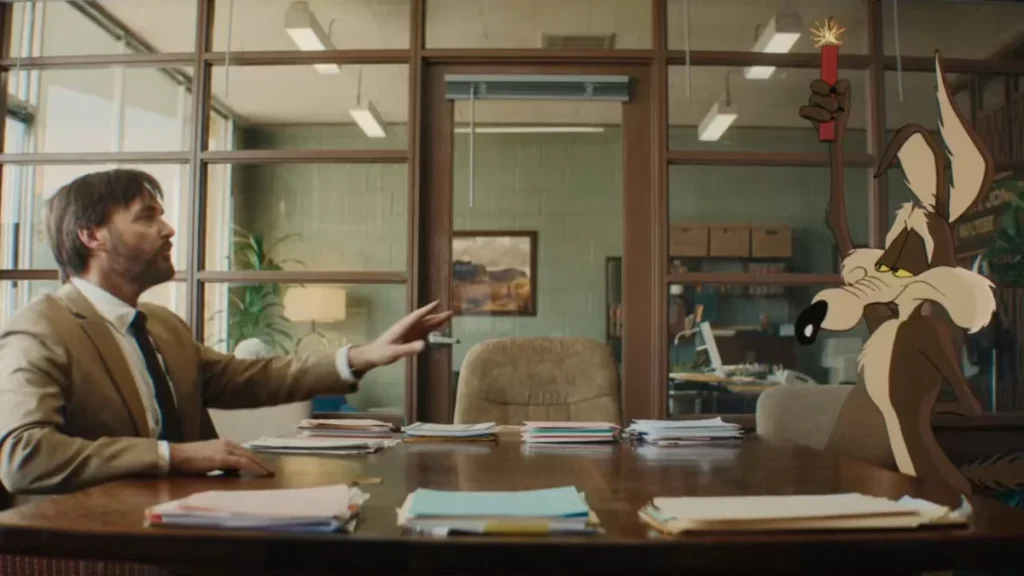

The long-gestating, highly publicized hybrid film Coyote vs. Acme has officially cleared its final hurdle in the race for industry recognition, having been confirmed as eligible for consideration in the Best Animated Feature category at the 2027 Academy Awards. Following a tumultuous journey from a near-cancellation at Warner Bros. Discovery to its eventual acquisition and release by Ketchup Entertainment, the project—which blends live-action performances from Will Forte and John Cena with the iconic animation of the Looney Tunes stable—is now positioned to compete against some of the most formidable titles in the animation landscape.
A Tumultuous Road to Release
The trajectory of Coyote vs. Acme is perhaps one of the most storied production sagas of the 2020s. Originally slated for release as a high-profile theatrical project under the Warner Bros. banner, the film became the center of a firestorm in late 2023. As part of a cost-cutting measure aimed at securing tax write-downs, Warner Bros. Discovery initially announced that the film would be shelved, effectively preventing it from being released in any capacity.
The decision triggered widespread backlash from the creative community, including animators, directors, and fans who argued that the studio was sacrificing artistic labor for short-term financial gain. The outcry prompted a reversal of sorts, with the studio opting to shop the project to third-party distributors rather than letting it sit in a digital vault indefinitely. Ketchup Entertainment ultimately secured the distribution rights, bringing the film to audiences and, subsequently, back into the orbit of the Academy of Motion Picture Arts and Sciences.
The Criteria for Animated Feature Eligibility
The Academy’s decision to grant eligibility to Coyote vs. Acme is rooted in the evolving definitions of animation in modern cinema. According to the Academy’s rules for the 99th Oscars, an animated feature is defined as a motion picture with a running time of more than 40 minutes in which the characters are created using a frame-by-frame technique, and a significant number of the major characters must be animated.
Coyote vs. Acme fits this definition, though it operates in the same hybrid space as previous contenders. By integrating Wile E. Coyote and other Looney Tunes characters into a world populated by live actors, the film joins a lineage of hybrid cinema that has increasingly found success with the Academy. The precedent set by 2022’s Marcel the Shell With Shoes On—which successfully navigated the nomination process despite its mix of stop-motion animation and live-action cinematography—provided the necessary framework for the Academy to approve the submission.
Competition and the 2027 Landscape
The field for the Best Animated Feature at the 2027 ceremony is exceptionally crowded, reflecting a banner year for both legacy studios and independent production houses. Coyote vs. Acme enters a field that includes several heavyweights:
- Wildwood: Produced by the acclaimed stop-motion studio Laika, this fantasy epic represents the studio’s ongoing commitment to handcrafted, tactile animation, a style that has historically performed well with the Academy’s voting body.
- Toy Story 5: Pixar’s latest entry in the franchise remains a commercial juggernaut, leveraging brand recognition and the technical advancements of the modern iteration of the studio’s proprietary software.
- Hoppers: Another major entry from Disney, continuing the studio’s trend of high-concept, character-driven narratives.
- Ray Gunn: Directed by animation legend Brad Bird, this project has been long-awaited by industry insiders, marking a return to a specific, stylized aesthetic that Bird has championed throughout his career.
For Coyote vs. Acme, the challenge lies in its hybrid nature. While the Academy is increasingly comfortable with mixed-media films, the category often favors works that lean heavily into purely animated storytelling. However, the film’s reliance on the Looney Tunes brand—a pillar of American cultural history—offers a distinct advantage in terms of audience nostalgia and recognition.
Financial and Industry Implications
The acquisition and subsequent release of Coyote vs. Acme by Ketchup Entertainment serves as a case study in the secondary market for "shelved" films. Industry analysts have noted that the film’s eligibility for the Oscars provides a significant boost to its longevity. A nomination, or even a strong showing during the voting phase, often translates into increased demand on physical media and streaming platforms.
This is particularly relevant given that the film is already set for a 4K Ultra HD release on December 1st. By securing a high-profile industry validation, the film transforms from a "saved" asset into a credible piece of cinematic art, potentially influencing future studio decisions regarding the treatment of completed, unreleased projects. The precedent suggests that there is a viable path forward for films that are initially discarded by major conglomerates, provided there is a willing independent distributor and sufficient critical interest.
The Role of Performance and Craft
The performances of Will Forte and John Cena have been cited by reviewers as essential to the film’s success. By providing a grounding, human element to the anarchic, physics-defying world of Wile E. Coyote, the live-action cast has allowed the animation team to push the boundaries of what is expected from a Looney Tunes project.
From a technical standpoint, the film’s production team focused on a seamless integration of CG elements with live-action plates. This required rigorous coordination between the directors and the animation supervisors to ensure that the comedic timing—a hallmark of the Looney Tunes style—remained intact when transitioned to a live-action environment. The result is a film that functions as a tribute to the legacy of animation while experimenting with the modern possibilities of hybrid filmmaking.
Historical Context of the Academy’s Animation Category
The Best Animated Feature category has undergone significant shifts since its inception in 2001. Initially dominated by large-scale studio productions, the category has opened up to accommodate diverse mediums, including international imports, independent stop-motion features, and now, hybrid films.
The inclusion of Coyote vs. Acme marks a shift in how the Academy views the "hybrid" genre. Historically, there was a reluctance to validate films that were not "fully" animated. However, as the lines between CGI, live-action, and digital performance capture continue to blur, the Academy has had to adapt its criteria to ensure the category remains relevant to the current state of visual storytelling. The eligibility of this film confirms that the focus of the award is shifting from the medium of production to the reliance on animated characters as the primary vehicle for the narrative.
Official Statements and Industry Reception
While Warner Bros. Discovery has remained largely quiet regarding the film’s resurgence, Ketchup Entertainment has leaned into the narrative of the film’s rescue. Representatives for the distributor have emphasized the artistic merit of the project, noting that the animation team’s work represents some of the most sophisticated character-based animation seen in recent years.
Critically, the film has been praised for its meta-commentary on the legal and creative processes of filmmaking, a theme that resonates deeply with the industry professionals who make up the Academy voting body. By positioning itself as a film about the struggle to create, Coyote vs. Acme has effectively aligned its internal themes with its external history, creating a compelling narrative for voters to consider.
Looking Ahead to the 99th Academy Awards
As the Academy begins the voting process, the campaign for Coyote vs. Acme will likely focus on its technical achievements and its role as a cultural touchstone. The film’s pre-order availability on Amazon signals a strategy to capture the home-video market during the critical awards-season window.
Regardless of the final outcome, the fact that Coyote vs. Acme has reached this stage is a victory for its creators. The film has survived the most challenging production cycle in recent memory, proving that even in an era of corporate consolidation, artistic work can find an audience. Whether it walks away with a golden statue or simply a nomination, its journey stands as a testament to the resilience of the animation community and the enduring appeal of the characters that define the genre.
For industry observers, the 2027 Oscars will be remembered as the year that a film rescued from a digital scrap heap challenged the dominance of the major studio giants. It is a reminder that in Hollywood, the final word on a film’s value is often written by the audience and the creators who refuse to let a project disappear. As the industry looks toward the upcoming awards ceremony, all eyes will be on whether the Academy decides to honor the unconventional path that brought Wile E. Coyote to the courtroom and, ultimately, to the Oscar race.