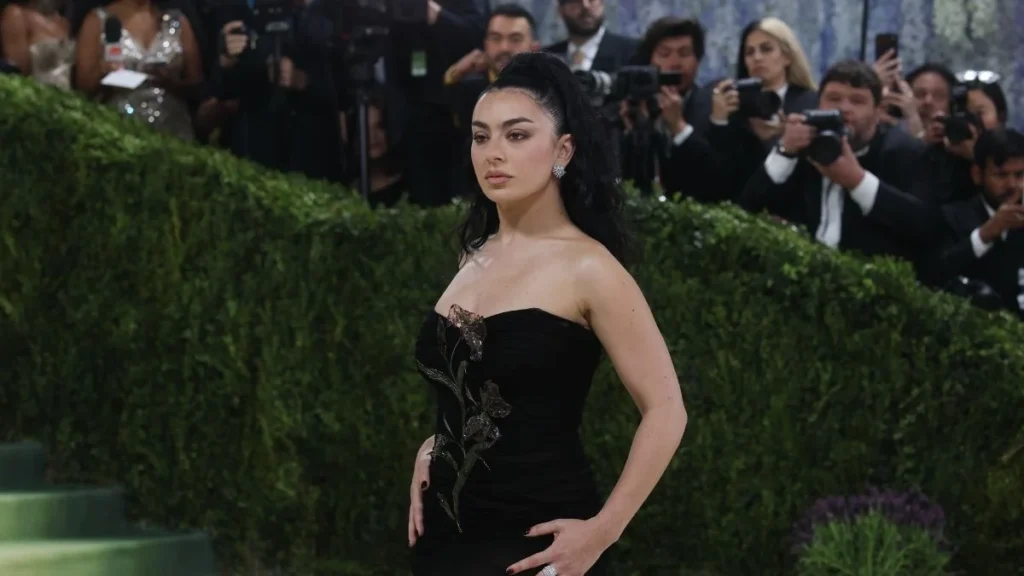

The British singer-songwriter Charli XCX has once again captured the attention of the global fashion and music industries with a series of photographs that emphasize her commitment to an edgy, boundary-pushing aesthetic. In the recently released images, the artist is seen wearing a minimalist white bikini top, characterized by a plunging neckline and delicate string construction. The visual presentation, which features the garment’s straps purposefully draped off her shoulders as she poses in a domestic, bedroom setting, serves as a continuation of her career-long exploration of the "indie sleaze" and "high-fashion grunge" movements. This latest visual output is not merely a social media moment but a calculated component of her broader artistic brand, which blends the raw energy of underground club culture with the polished sensibilities of luxury fashion.
The Intersection of Visual Identity and Musical Brand
Charli XCX, born Charlotte Emma Aitchison, has built a reputation as a pioneer who bridges the gap between mainstream pop and experimental hyperpop. Her latest visual presentation reinforces the "Brat" persona that has defined her 2024 output. The choice of a white, stringy bikini—minimalist yet provocative—aligns with the "messy" and "unfiltered" aesthetic that has become her hallmark. By opting for a relaxed pose on a bed rather than a highly structured studio environment, the artist leverages the "authentic" visual language that resonates with Gen Z and Millennial audiences.
Industry analysts note that these visual choices are rarely accidental. In the contemporary music landscape, the "look" of an era is as vital as the sonic production. For Charli XCX, the "Brat" era is defined by a specific shade of lime green and a fashion sense that oscillates between high-end couture and thrift-store chic. The bikini photos represent the "party girl" archetype that she has meticulously deconstructed and celebrated in her recent lyrics, moving away from the sanitized image often expected of female pop stars.
Chronology of an Avant-Garde Career
To understand the significance of Charli XCX’s current cultural standing, one must examine her evolution from a MySpace-era teenager to a dominant force in pop music.
- 2008–2012: The Underground Beginnings: Charli began her career performing at illegal warehouse raves in London. Her early work was heavily influenced by electronic music and the burgeoning synth-pop scene.
- 2013: True Romance: Her debut studio album received critical acclaim for its dark, atmospheric pop, establishing her as an "alternative" pop star.
- 2014: The Mainstream Breakthrough: With the release of "Fancy" (a collaboration with Iggy Azalea) and "Boom Clap," Charli achieved global commercial success. However, she famously pushed back against the constraints of the traditional pop machinery shortly thereafter.
- 2016: The Vroom Vroom Pivot: Collaborating with the late producer SOPHIE and the PC Music collective, Charli released the Vroom Vroom EP. This marked a radical shift toward hyperpop—a genre characterized by abrasive textures, pitched vocals, and a satirical take on pop tropes.
- 2017–2019: The Mixtape Era and Collaborative Growth: Releases like Number 1 Angel and Pop 2 solidified her status as a tastemaker, featuring a diverse range of global collaborators.
- 2020–2022: Pandemic Innovation and The Major Label Pivot: During the COVID-19 lockdowns, she recorded How I’m Feeling Now in six weeks, involving fans in the creative process. She followed this with Crash (2022), her most commercially successful album to date, which explored the "sell-out" pop star archetype.
- 2024: The Brat Phenomenon: Her sixth studio album, Brat, became a cultural touchstone, sparking the "Brat Summer" trend. The album’s focus on vulnerability, club culture, and feminine competition propelled her to new heights of critical and commercial relevance.
Supporting Data and Market Impact
The impact of Charli XCX’s brand can be measured through significant data points. As of mid-2024, Brat debuted at number two on the UK Albums Chart and number three on the US Billboard 200, marking her highest-ever chart positions in several territories. On streaming platforms, her monthly listeners on Spotify have surged past 35 million, driven by the viral success of singles like "Von Dutch," "360," and "Apple."
Social media engagement metrics further illustrate her influence. The "360" music video, which features a "who’s who" of internet "it girls," garnered millions of views within hours of release, signaling her ability to curate cultural moments. The fashion world has responded in kind; her presence at Paris and Milan Fashion Weeks often generates higher Earned Media Value (EMV) for brands than traditional models, as her "edgy" aesthetic attracts a younger, more engaged demographic.
Fashion Analysis: From Streetwear to High Couture
The "stringy bikini" aesthetic is part of a larger trend often referred to as "indie sleaze" or "subversive basics." Fashion critics have noted that Charli XCX’s style is a reaction against the "quiet luxury" trend of 2023. While many celebrities opted for minimalist, expensive, and understated looks, Charli has championed a more chaotic, expressive, and "sweaty" style.
Her wardrobe often includes pieces from designers such as Acne Studios, Marc Jacobs, and Vivienne Westwood, but she styles them in a way that feels lived-in. The "undone" nature of her recent bikini photos—where the garment appears to be slipping—is a deliberate stylistic choice. It subverts the traditional "glamour shot" by introducing an element of disarray, which serves to humanize the artist while maintaining her status as a fashion icon.
Reactions from the Industry and Public
The reception to Charli XCX’s latest visual and musical direction has been overwhelmingly positive among critics. Pitchfork and Rolling Stone have lauded her for her "uncompromising vision" and her ability to "reinvent pop in her own image." Fans, often referred to as "Angels," have embraced her candidness.
In the fashion sector, stylists have praised her for her authenticity. "Charli doesn’t just wear the clothes; she lives in them," noted one celebrity stylist in a recent industry roundtable. "The fact that she is comfortable posing in a stringy bikini that looks like it’s about to fall off is exactly why people love her. It’s a middle finger to the perfectly airbrushed, perfectly positioned influencer culture."
Conversely, some traditionalists argue that her provocative imagery leans too heavily on shock value. However, supporters point out that for Charli, the body is a canvas for self-expression, no different from her use of autotune or distorted synthesizers in her music.
Broader Implications for Pop Culture
The evolution of Charli XCX’s public persona suggests a significant shift in how female celebrities navigate the industry. We are moving away from an era where pop stars were expected to be "role models" in a traditional, sanitized sense. Instead, there is a growing demand for artists who are honest about their flaws, their party-heavy lifestyles, and their complex emotions.
Charli’s "Brat" era has essentially codified a new form of modern feminism that celebrates being "messy" and "complicated." This has implications beyond music, influencing social media trends (the "Brat Summer" lime-green takeover) and even political discourse, as seen when her branding was briefly adopted by internet subcultures to describe various public figures.
Furthermore, her success proves that "niche" or "experimental" sounds can achieve mainstream dominance without losing their edge. By staying true to her roots in the London club scene while embracing the visual language of high fashion, Charli XCX has created a blueprint for the modern multi-hyphenate artist.
Conclusion
The latest photographs of Charli XCX in a white stringy bikini are more than just a fleeting social media update; they are a testament to an artist who has mastered the art of visual storytelling. By blending vulnerability with a bold, unapologetic sexuality, she continues to challenge the norms of the music and fashion industries. As she moves forward in her career, her ability to oscillate between the underground and the mainstream ensures that she remains one of the most influential figures in contemporary culture. Her trajectory suggests that the future of pop lies not in perfection, but in the raw, the real, and the radically "edgy."