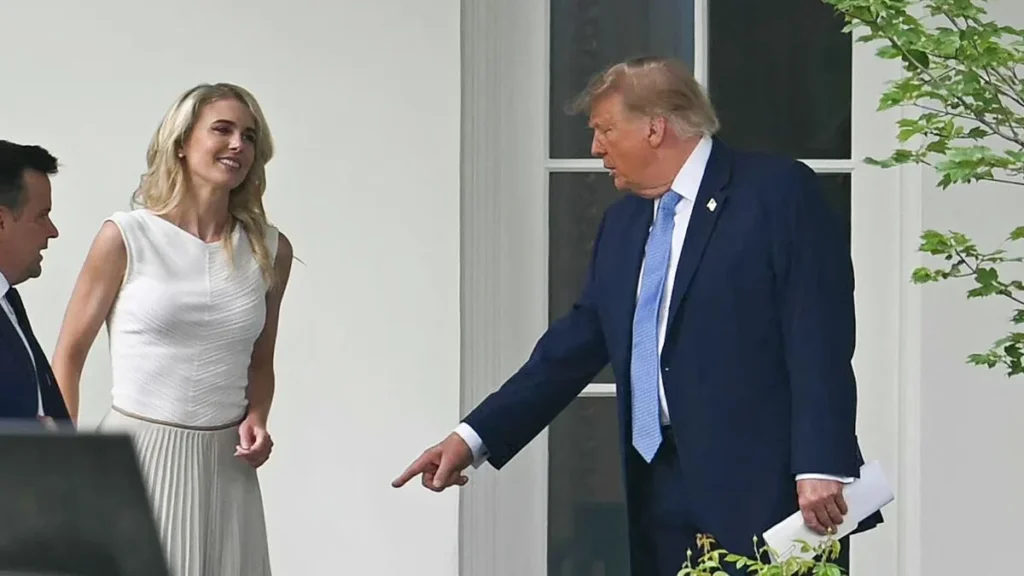

The intersection of modern political optics, social media scrutiny, and high-stakes White House dynamics was on full display following a routine presidential engagement that unexpectedly captured the public imagination. A series of photographs taken upon Donald Trump’s return to the White House quickly circulated across digital platforms, generating widespread speculation, intense online commentary, and renewed scrutiny regarding the inner workings of the presidential inner circle. The images, which feature a stern-looking Donald Trump pointing in the direction of aide Natalie Harp—who maintains a composed and smiling demeanor—have opened a window into the nuanced, fast-paced, and often heavily scrutinized environment of the modern executive branch.
While the photographs themselves do not explicitly capture the audio or immediate context of the interaction, their rapid dissemination on platforms such as X, formerly known as Twitter, highlights the insatiable public appetite for candid moments involving political figures. The incident underscores how split-second visual captures can be amplified, debated, and recontextualized by millions of observers within a matter of hours, transforming a mundane logistical return into a focal point of political discussion.
The Sequence of Events and the Backdrop of the Engagement
The sequence of events began earlier in the day when the president and members of his administration participated in a high-profile public event promoting the launch of America.gov, a newly unveiled, artificial intelligence-powered government portal. Designed to streamline public access to official information, the website aims to provide users with direct, simplified answers drawn exclusively from legitimate federal sources, marking a significant technological push by the administration to modernize civic engagement.
Following the conclusion of the event, Trump, Harp, and other members of the presidential entourage returned to the White House grounds. As they disembarked and navigated the complex logistics of the arrival, White House press photographers and media crews documented the scene. It was during this return that the widely circulated frames were captured.
The photographs depict an 80-year-old Trump extending his arm and pointing decisively toward Harp, who was dressed in an all-white ensemble. Harp, 35, maintained a smiling expression despite the pointed gesture from the president. Subsequent and alternate frames from the photo sequence revealed that Bill Pulte—a prominent Trump ally and the director of the Federal Housing Finance Agency—was standing nearby, suggesting to some analysts that the president’s attention and gesture may have been directed further into the distance rather than exclusively at Harp. Additional images showed Harp stepping out of an official vehicle and maintaining her position immediately behind the president as cameras continued to roll.
Digital Reaction and the Anatomy of a Viral Narrative
As soon as the images were uploaded to news wires and social media, users on X began dissecting every pixel of the encounter. Within hours, the photographs spawned numerous competing narratives and theories. Some prominent online accounts humorously questioned the nature of the dynamic, with one viral post jokingly asking whether the president was signaling instructions reminiscent of training commands. Other commentators focused on stylistic choices, jokingly speculating that the president’s stern expression might have been prompted by attire or footwear selections.
This rapid-fire digital speculation is emblematic of contemporary political discourse, where minor physical expressions are frequently elevated to symbols of broader organizational friction or loyalty tests. Despite the lack of definitive evidence regarding the audio exchange, the online discourse quickly pivoted from the initial photographs to a broader discussion about Natalie Harp’s unique role, professional background, and proximity to the commander-in-chief.
Profile of Natalie Harp: From Media Host to the President’s Inner Circle
Natalie Harp has cultivated a distinctive and highly visible profile within the architecture of the Trump administration. Formally holding the dual titles of special assistant to the president and executive assistant to the president, Harp commands an annual salary of $150,000. However, within the internal politics of the West Wing, her informal designation is far more descriptive: she is widely known among colleagues and journalists as the "human printer."
This moniker stems from her ubiquitous presence at the president’s side, carrying a specialized portable printer and a steady supply of paper and ink cartridges. Her primary logistical function involves sourcing, printing, and delivering curated news articles, social media screenshots, and real-time information directly to Trump throughout the day. In addition to this print-delivery system, Harp plays an active role in managing and facilitating the president’s digital footprint, specifically assisting with communications and posts on Truth Social.
Before entering the federal government, Harp built a career in conservative media. From 2020 to 2022, she worked as a television host at One America News (OAN), where she gained recognition for her staunchly pro-Trump commentary. Her loyalty to the former president was further solidified by a deeply personal narrative: Harp has frequently credited Trump’s signing of the 2018 Right to Try Act with helping to save her life during a harrowing battle with stage 2 bone cancer. While medical experts and oncologists have publicly debated the direct medical efficacy of the legislation in relation to her specific clinical treatments, Harp’s personal conviction and vocal gratitude formed the foundation of a steadfast personal and professional alliance with Trump.
Wider Scrutiny and Internal West Wing Dynamics
Harp’s rapid ascent, extraordinary physical proximity to the president, and unique operational responsibilities have not gone unnoticed by political opponents and administration observers alike. Her pervasive presence in nearly every public appearance and behind-the-scenes photograph has transformed her into a subject of intense interest among political analysts, journalists, and legislative figures.
Concerns regarding the concentration of access and information flow within the executive branch have occasionally bubbled to the surface. During an August campaign event, Senator Jon Ossoff drew public attention to the unusual nature of such specialized aide structures, highlighting questions about accountability and influence within the highest levels of government. Furthermore, prominent investigative journalists and authors—including Michael Wolff, Maggie Haberman, and Jonathan Swan—have previously reported that various individuals within Trump’s broader political and administrative orbit have occasionally raised private concerns regarding the extent of access afforded to certain aides operating outside traditional bureaucratic hierarchies.
In any modern presidential administration, the gatekeepers and closest aides invariably become subjects of fascination and friction. The dynamic between principals and their immediate support staff often reflects the high-pressure, fast-paced environment of the executive branch, where loyalty, availability, and discretion are valued above all else.
Implications for Presidential Optics and Media Consumption
The intense reaction to the photographs of Donald Trump and Natalie Harp serves as a case study in the power of visual media in modern politics. In an era dominated by instantaneous digital sharing, a single frame extracted from a routine afternoon can overshadow substantial policy rollouts—such as the launch of an AI-powered government portal designed to improve public service delivery.
While the administration continues to focus its messaging on technological modernization, administrative reform, and official governance, the viral lifespan of these photographs demonstrates the public’s enduring fascination with the interpersonal relationships unfolding behind the scenes. Whether viewed as an innocuous moment of logistical coordination, a fleeting expression of presidential frustration, or simply another day in the high-pressure environment of the West Wing, the incident highlights the constant microscope under which modern political figures and their staffs operate.