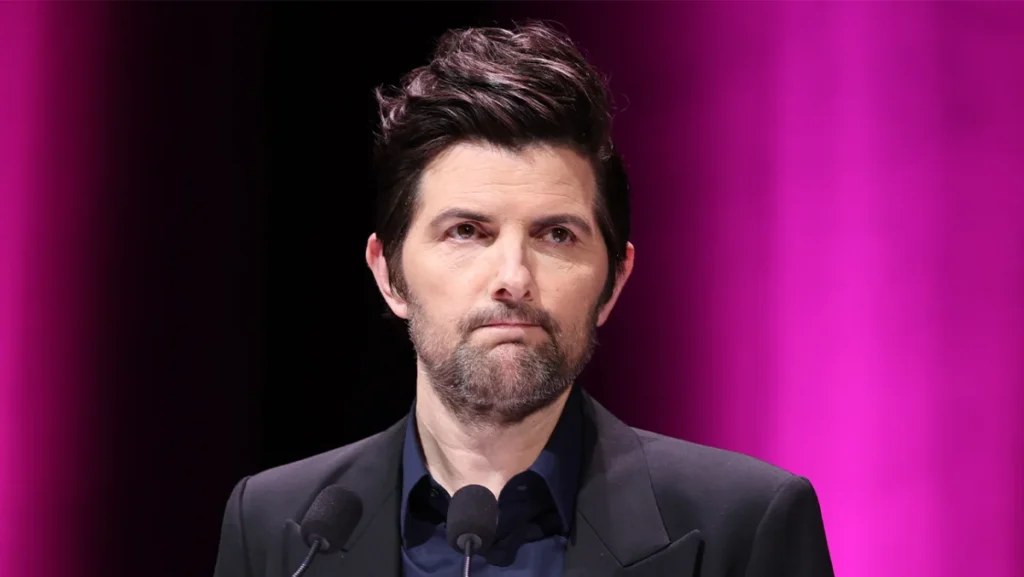

In a candid revelation that has sent ripples of amusement and insight across the entertainment industry, acclaimed actor Adam Scott recently shared a peculiar chapter from his early career: a determined, albeit unsuccessful, attempt to rejoin the iconic Hellraiser horror franchise years after his character had met a definitive end. Appearing on Late Night With Seth Meyers, the star of the critically lauded series Severance recounted his audacious bid to secure a role in 2002’s Hellraiser: Hellseeker, despite having played a character who was explicitly killed off in 1996’s Hellraiser: Bloodline. This anecdote not only offers a humorous glimpse into the often-unpredictable world of acting auditions but also provides a fascinating lens through which to examine the dynamics of long-running film franchises and the relentless pursuit of work by burgeoning talents.
The Audacious Bid: A Closer Look at Scott’s Hellraiser Gambit
Scott’s confession detailed a scenario familiar to many struggling actors: the receipt of an audition notice for a project that, upon closer inspection, presented a significant continuity challenge. "My agent sends an audition for Hellraiser 6," Scott recalled, expressing his immediate recognition of the franchise. "And I’m like, ‘Wait a second… I was in Hellraiser 4.’" The internal conflict was palpable: the actor knew his character, Jacques, a servant entangled in demonic summoning rituals, had been unequivocally dispatched in Bloodline. Yet, the pragmatic realities of a nascent career quickly superseded narrative consistency. "But I need a job," Scott admitted, encapsulating the driving force behind his decision. "So I’m like, ‘Screw it.’ And I go to the audition just thinking, ‘Maybe they won’t notice that I was in Hellraiser 4.’"
The audition itself was fraught with an added layer of comedic tension. Scott recounted recognizing a producer from Hellraiser: Bloodline in an adjacent office at the audition location. In a desperate attempt to avoid detection and maintain the illusion of being a fresh face, he employed a classic tactic of concealment. "I remember being in the waiting room, kind of looking around and seeing a door ajar to someone’s office and seeing a producer from Hellraiser 4 in the office," Scott explained. "And just like holding my papers up, just like, ‘OK, if he doesn’t see me, and they think I do a good job, maybe I’ll get in Hellraiser 6 as well.’" Despite his strategic paper-shielding and hopeful optimism, the attempt proved futile; Scott did not ultimately secure the role in Hellraiser: Hellseeker. This episode serves as a testament to the sheer determination required to forge an acting career, often involving navigating a labyrinth of roles, rejections, and occasional, deliberate oversight of established cinematic canon.
Adam Scott’s Early Career and the Lure of Hellraiser: Bloodline
To fully appreciate the context of Scott’s Hellraiser escapade, it is essential to revisit his career trajectory in the mid-1990s. Born Adam Paul Scott in Santa Cruz, California, his acting journey began with smaller roles in television series and independent films. The period leading up to Hellraiser: Bloodline in 1996 saw him making appearances in shows like Boy Meets World and ER, indicative of an actor diligently working to establish a foothold in Hollywood. Securing a role in a franchise film, even a direct-to-video installment, represented a significant opportunity for exposure and financial stability.
Hellraiser: Bloodline, released on March 8, 1996, marked the fourth entry in the Hellraiser series. Directed by Kevin Yagher (though credited to Alan Smithee due to production disputes) and later Joe Chappelle, the film ambitiously attempted to provide an origin story for the Lament Configuration puzzle box and the Cenobites, spanning several centuries. Scott’s character, Jacques, was a servant to Duc de L’Isle, an aristocratic occultist in 18th-century France. Jacques aids his master in summoning the demon Angelique, only to meet a gruesome fate himself. The film, like many horror sequels, received a mixed critical reception and struggled with its production, ultimately bypassing a wide theatrical release in favor of a limited one and subsequent home video distribution. For Scott, however, it was an acting job, a stepping stone. As he told Seth Meyers, "I didn’t know about Hellraiser, but I was like, ‘Oh, this is an acting job?’ And so I was so excited." This sentiment underscores the practical considerations that often outweigh artistic grandiosity for actors at the outset of their careers.
The Hellraiser Franchise: A Legacy of Pain and Pleasure
The Hellraiser franchise itself possesses a rich and complex history, born from the visionary mind of British author and filmmaker Clive Barker. The series originated with Barker’s 1986 novella, The Hellbound Heart, a dark exploration of sadomasochism, desire, and the blurring lines between pain and pleasure, heaven and hell. Barker himself adapted and directed the first film, Hellraiser, released in 1987. This seminal work introduced audiences to the iconic Cenobites, led by the unforgettable Pinhead (portrayed by Doug Bradley), interdimensional beings who perceive pain as the ultimate pleasure and seek to explore the limits of sensory experience. The film was a critical and commercial success, lauded for its unique mythology, unsettling atmosphere, and philosophical undertones, establishing it as a cornerstone of modern horror cinema.
Following the success of the original, Hellbound: Hellraiser II (1988) continued the narrative, delving deeper into the Cenobite mythology and the labyrinthine dimensions of Hell. However, as the franchise progressed into the 1990s and beyond, it largely moved away from Barker’s direct involvement and the theatrical big screen. Hellraiser III: Hell on Earth (1992) saw Pinhead entering the mortal world, marking a shift towards more conventional slasher tropes. By the time Bloodline arrived in 1996, the series was already navigating the challenges of maintaining narrative coherence and creative momentum across multiple sequels. The subsequent entries, including Hellraiser: Hellseeker (2002), Hellraiser: Deader (2005), Hellraiser: Hellworld (2005), Hellraiser: Revelations (2011), Hellraiser: Judgment (2018), and the most recent reboot in 2022, primarily found their audience in the direct-to-video market. This shift often came with reduced budgets, accelerated production schedules, and a frequent turnover of creative teams, which could contribute to inconsistencies in plot, character, and overall quality.
Hellraiser: Hellseeker (2002) and the Direct-to-Video Landscape
The film Scott auditioned for, Hellraiser: Hellseeker, represents a distinct era for the franchise: the direct-to-video boom of the early 2000s. Released on October 15, 2002, Hellseeker saw Doug Bradley return as Pinhead, a constant anchor for the series. The plot revolved around Trevor Gooden, a man who survives a car accident that kills his wife, only to find himself plagued by bizarre hallucinations and the machinations of the Cenobites. Directed by Rick Bota, Hellseeker was an attempt to inject new life into the series, often by employing twist endings and psychological horror elements.
The direct-to-video market of this period was a double-edged sword for horror franchises. On one hand, it allowed studios to continue capitalizing on established brand recognition with lower financial risk, extending the life of series that might no longer command theatrical releases. On the other hand, it often led to a perception of diminished quality, with films sometimes sacrificing narrative depth and production value for quantity. Within this context, casting directors might face pressures to find suitable talent quickly and affordably. The idea of an actor attempting to re-enter a franchise in a new role, even after a character’s demise, might not have been entirely unprecedented or shocking in this environment, given the often-flexible approach to continuity. While the specific role Scott sought is not detailed, it would have been a new character entirely, given Jacques’s definitive end.
The Unspoken Rule of Franchise Continuity (or Lack Thereof)
Scott’s story highlights a peculiar aspect of long-running cinematic universes, especially in the horror genre: the often-fluid nature of continuity. While some franchises meticulously guard their timelines and character arcs, others, particularly those with numerous sequels stretching over decades, demonstrate a remarkable willingness to bend or outright break established rules. Characters are resurrected, forgotten, or simply recast without extensive explanation. This phenomenon can be attributed to several factors: the desire to keep a franchise alive even when original cast members are unavailable or unwilling to return; the practicalities of a revolving door of writers and directors; and perhaps, a tacit understanding with the audience that horror, at its core, often prioritizes scares and spectacle over rigid narrative logic.
In the case of Hellraiser, while Pinhead remained a consistent presence (primarily due to Doug Bradley’s commitment for many films), other characters and plotlines were often introduced and discarded with varying degrees of consistency. For an actor like Adam Scott, who had a relatively minor, albeit memorable, role in an earlier installment, the leap to a new character in a later film might not have seemed entirely implausible, especially if enough time had passed and the production team had changed. His attempt to avoid eye contact with the Bloodline producer, however, reveals an awareness of the potential awkwardness and the implicit challenge to continuity his presence posed.
The Human Element: An Actor’s Persistence
Beyond the specific details of Hellraiser, Scott’s anecdote resonates deeply as a universal tale of an actor’s persistence and the often-humbling realities of the entertainment industry. His frank admission of "I need a job" strips away any pretense of artistic snobbery and lays bare the fundamental drive for employment that fuels many careers, particularly in their nascent stages. It speaks to the competitive landscape where thousands of hopefuls vie for a limited number of roles, often facing countless rejections.
Scott’s willingness to return to a franchise where his previous character had been killed off, and his attempt to subtly circumvent potential recognition, paints a picture of resilience and resourcefulness. It’s a reminder that behind the glamour of successful careers often lie years of grinding work, self-doubt, and the occasional desperate gambit. This candidness about his early struggles adds a layer of relatability to Scott’s public persona, making his journey all the more compelling to fans and aspiring artists alike.
From Jacques to Lumon Industries: Adam Scott’s Trajectory
The humor of Scott’s Hellraiser story is magnified by his subsequent career trajectory. The actor who once hoped a producer wouldn’t recognize him is now a celebrated figure in Hollywood, known for his versatile performances across comedy and drama. Following his early horror stint, Scott steadily built a robust filmography. He gained significant recognition for his comedic roles in cult favorites like Party Down (2009-2010, 2023) as Henry Pollard, and especially as Ben Wyatt in the beloved NBC sitcom Parks and Recreation (2010-2015). These roles showcased his understated humor and ability to play endearing, often-awkward characters.
More recently, Scott has garnered critical acclaim for his dramatic work, most notably as Mark Scout in the Apple TV+ psychological thriller Severance. His portrayal of a man undergoing a radical surgical procedure to separate his work memories from his personal life has earned him Emmy and Golden Globe nominations, establishing him as a leading man capable of profound emotional depth. The contrast between the young actor desperately auditioning for a Hellraiser sequel and the accomplished star of a prestige drama highlights a remarkable journey of growth, talent, and perseverance. It underscores that every actor, no matter how successful, likely has a treasure trove of similar, often amusing, anecdotes from their path to stardom.
The Enduring Appeal of Horror and Actor Anecdotes
Adam Scott’s Hellraiser story is more than just a humorous anecdote; it’s a window into the enduring appeal of horror franchises and the human element behind celebrity. Stories like these resonate because they demystify the acting profession, revealing the struggles and everyday decisions that shape a career. They offer a glimpse behind the curtain, connecting audiences to the actors they admire on a more personal, relatable level.
The Hellraiser franchise, despite its varied quality across numerous sequels, maintains a dedicated fanbase. Its unique blend of philosophical horror, visceral imagery, and iconic villainy ensures its continued relevance, as evidenced by the 2022 Hulu reboot, which reimagined the Cenobites for a new generation. The fact that an actor like Adam Scott, now a household name, has such a distinct memory from his early days with the series only adds to its legend. It reinforces the idea that even minor roles in cult franchises can leave a lasting impression, not just on audiences, but on the careers of the actors involved. Scott’s candidness about his experience serves as a delightful reminder that every journey to success is paved with unexpected detours, humorous missteps, and a whole lot of hustle.