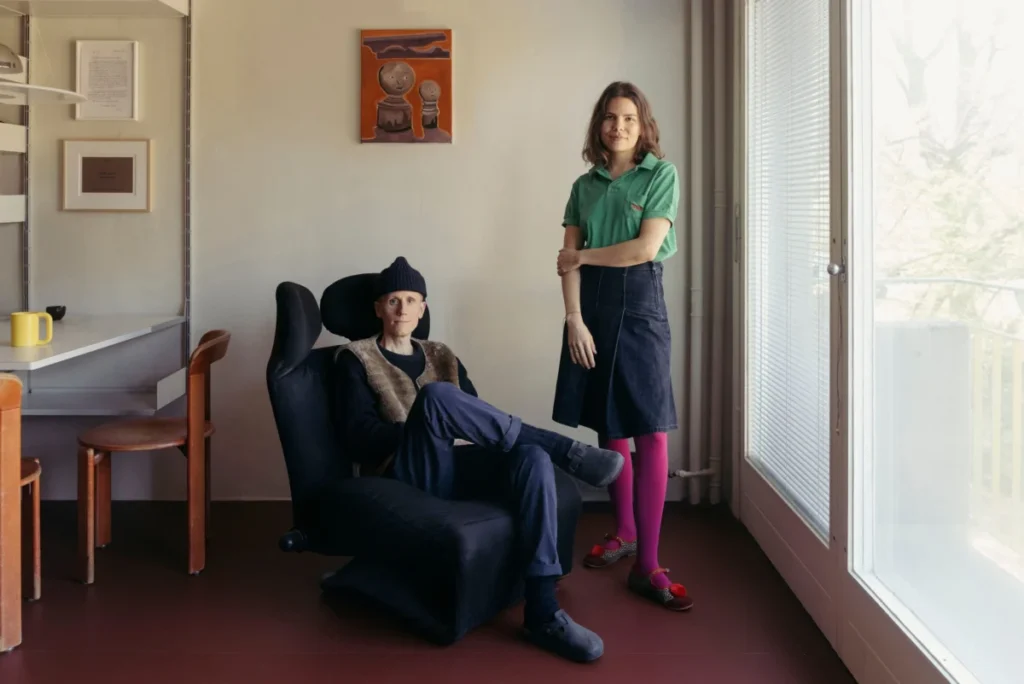

In the heart of Berlin’s Hansaviertel, a district renowned for its mid-century modernist architecture, a 355-square-foot studio apartment has become a case study in radical downsizing and historic preservation. The project, led by creatives Leonie Herweg and Simon Freund, transcends a simple residential renovation; it represents a broader effort to revitalize a neighborhood that was once a revolutionary model for urban living. After years of living abroad in Switzerland and Egypt, the couple returned to Germany to transform a neglected unit in the iconic "Giraffe-Hochhaus" into a functional, doorless "hotel suite" that honors its 1957 origins while embracing contemporary minimalism.

The acquisition of the apartment was as much a family legacy as it was a real estate investment. The studio was purchased from Herweg’s great-uncle, Klaus, who had moved into the building at the age of 80 to "experience life" in the city’s creative epicenter. Following his tenure, the space required an exhaustive overhaul to strip away decades of non-original additions. What emerged was a meticulously curated residence that serves as the home base for the couple’s expanding community footprint, which now includes a local art gallery, Grotto, and a neighborhood hub, Café Tiergarten.
Historical Context: The Interbau 1957 Legacy
To understand the significance of the renovation, one must look to the history of the Hansaviertel. The neighborhood was the site of the 1957 International Building Exhibition (Interbau), a Cold War-era urban planning competition designed to showcase West Berlin’s architectural superiority and democratic ideals. At a time when East Berlin was constructing the monumental Stalinallee, West Berlin invited 53 world-renowned architects—including Le Corbusier, Walter Gropius, and Oscar Niemeyer—to design a "city of tomorrow" that was airy, green, and functional.

The "Giraffe-Hochhaus," where Herweg and Freund’s studio is located, was designed by architects Klaus Müller-Rehm and Gerhard Siegmann. Standing 17 stories tall, the building earned its nickname from its slender, elongated proportions. It was a pioneer in high-density studio living, featuring 160 units designed specifically for single occupants or young couples.
A fascinating architectural quirk of the building is its gendered layout, a reflection of 1950s social norms. The west-facing side of the building, often called the "men’s side," features apartments with small kitchenettes. The east-facing "women’s side" offers views of the Tiergarten and includes separate kitchens. The original planning logic suggested that women, viewed as more "industrious" at the time, would benefit from waking with the sun and having more substantial culinary spaces. Herweg and Freund reside on the west side, a detail that influenced their decision to install a custom, compact stainless-steel kitchen.

The Renovation Process: A Year of Dust and Deconstruction
When the couple took possession of the 33-square-meter (355-square-foot) space, it was cluttered with layers of history that obscured the original modernist intent. The renovation was "extreme" by studio standards, involving the removal of seven layers of wallpaper, salmon-colored vinyl flooring from previous decades, and a bulky 1990s kitchen.
For over a year, the couple lived in what they described as a "construction site," navigating unfinished floors and dust. This period of discomfort allowed them to understand the spatial flow of the studio before making permanent changes. One of the most radical decisions was the removal of the bathroom door. By replacing the solid barrier with a chainmail curtain, they created a sense of visual continuity that makes the small footprint feel like a cohesive suite rather than a series of cramped boxes.

Technical specifications were chosen with historical reverence. For the flooring, they selected a dark red linoleum—the same material used in the Bauhaus library in Dessau. Linoleum, a sustainable material made from linseed oil and wood flour, was a staple of early 20th-century modernism, valued for its durability and muted aesthetic. The kitchen was replaced with a custom-made stainless-steel unit, paired with a 1970s mobile electric stove that belonged to Herweg’s great-grandparents, bridging the gap between three generations of family history.
Strategic Minimalism and Interior Design
Living in 355 square feet requires what Herweg calls "ruthless" downsizing. Upon moving from a larger residence in Switzerland, she sold or donated the majority of her belongings, a process she claims has resulted in zero regrets. The couple’s philosophy is that a small space allows for "little extravagances" that would be budget-prohibitive in a larger home, such as high-end Vitsœ shelving systems and custom-designed textiles.

Key design elements include:
- The Vitsœ Shelving System: Designed by Dieter Rams, this modular system provides storage without the visual weight of heavy cabinetry. A dining table is integrated directly into the shelving, maximizing floor space.
- Bruno Rey Seating: The couple sourced iconic 1970s chairs by Swiss designer Bruno Rey from a barn in the Bernese Oberland, adding a touch of organic geometry to the room.
- Artistic Integration: Despite the limited wall space, the studio functions as a mini-gallery, featuring works by Sunah Choi, Danh Vo, Katrin Plavcak, and Isabella Ducrot.
- Textiles as Architecture: A special curtain by Studio Azur in Marseille and a portrait of a dog by Paul Levack above the bathroom entrance serve as soft dividers that define different "zones" of the studio.
Community Revitalization: Beyond the Four Walls
The renovation of the studio was the catalyst for a larger mission to awaken the Hansaviertel from its "slumber." Despite its architectural pedigree, the neighborhood had many empty storefronts and a dwindling sense of community. Herweg and Freund viewed this not as a drawback, but as an opportunity to shape their environment.

They opened Grotto, an art gallery, and Café Tiergarten, which has quickly become a focal point for the neighborhood. These ventures act as an extension of their living room, providing the space for social interaction and large-scale art that their studio cannot accommodate. Herweg notes that in more established neighborhoods like Graefekiez, such an undertaking would be unnecessary due to the existing density of businesses. In Hansaviertel, however, their presence serves a vital civic function.
The couple applies the "broken windows theory" to their community work—the sociological idea that maintaining and monitoring urban environments in a well-ordered condition may stop further vandalism and escalation into more serious crime. By treating the buildings and the neighborhood with respect and care, they have noticed a ripple effect, encouraging other residents to engage more deeply with their surroundings.

Broader Implications for Urban Planning
The experience of Herweg and Freund offers valuable insights into the future of urban housing. As major cities like Berlin face severe housing shortages and rising rents, the "Hansaviertel model" of high-quality, small-footprint living in green, central locations is gaining renewed relevance.
- Sustainable Preservation: Rather than demolishing aging post-war structures, the couple demonstrated that these buildings can be adapted for modern life through thoughtful renovation.
- The Rise of Micro-Living: The project proves that 33 square meters is sufficient for a couple if the design is intentional and if the surrounding neighborhood provides "third spaces" like cafes and parks.
- Social Connectivity: The Hansaviertel was designed to be a "modern-day Disneyland" of essential services—a kiosk, a supermarket, a florist, and a pharmacy all within walking distance. This "15-minute city" concept, pioneered in the 1950s, remains a gold standard for reducing urban isolation.
Conclusion
The transformation of the studio in the Giraffe-Hochhaus is a testament to the enduring power of modernist design. By stripping away the superficial and focusing on high-quality materials and spatial flow, Leonie Herweg and Simon Freund have created a home that feels expansive despite its physical constraints. Their work serves as a reminder that the "city of the future" envisioned in 1957 is still a viable, vibrant path forward for 21st-century urbanites. Through their residence, their gallery, and their café, they are not just living in a historic district; they are actively ensuring its legacy continues for the next generation of Berliners.