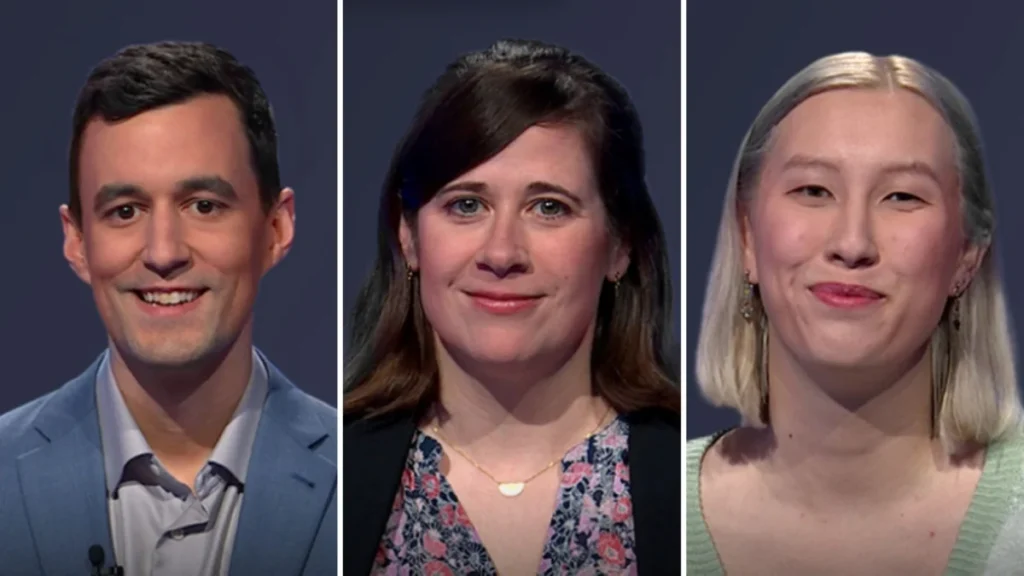

Shannon Crisenbury, a data annotator from St. Clair, Michigan, emerged victorious in the May 6 episode of Jeopardy!, securing her first win and $38,400. Her triumph, however, did little to break the recent trend of single-day champions, a pattern that has captivated and, at times, frustrated viewers since Jamie Ding’s remarkable 31-game winning streak concluded earlier this year. The question on many fans’ minds remains: will the next contestant be able to end this cycle of new champions each day?
The prevailing narrative in the Jeopardy! fandom since Jamie Ding’s historic run is an anticipation for a contestant to achieve multiple victories. Ding’s unparalleled success set a new benchmark, leading many to expect that subsequent strong players would also be able to string together wins. Following Ding’s defeat by Greg Shahade, who himself went on to win three games before being dethroned, the show has seen a consistent turnover of champions, with each new victor only managing a single win. Crisenbury’s win on May 6 continued this pattern, prompting renewed speculation about the show’s competitive landscape and the elusive nature of sustained winning streaks in the modern era of the game.
A Comeback Victory Driven by Strategic Wagers
Ken Jennings, the esteemed host of Jeopardy!, opened the May 6 episode by acknowledging the continued trend: "For the fourth straight game, we have a new champion." He then detailed Crisenbury’s remarkable journey to victory, highlighting her strategic brilliance, particularly during the Double Jeopardy round. Jennings recounted how Crisenbury, who began the Double Jeopardy segment in a distant third place, managed to find both Daily Doubles. Her bold wagers on these crucial clues allowed her to not only catch up but also take a narrow lead heading into Final Jeopardy. Her correct response to the final clue, "Who is Celine Dion?", not only secured her win but also earned a playful nod from Jennings, who quipped that her "heart, and her Jeopardy! journey, would go on."
The game began with Tristan Williams, a data scientist from Lincoln, Nebraska, establishing an early lead. By clue 11, Williams held a $5,200 advantage and landed on a Daily Double in the "Big Business" category. He wagered $4,000 on the clue: "Though this company has made billions of Galaxies, its name is Korean for just ‘3 stars.’" Williams incorrectly responded "Mitsubishi," when the correct answer was Samsung. This misstep significantly reduced his score to $1,200, though he remained in first place, with Crisenbury at $600 and Lauren Black, a sales assistant from San Jose, California, in the negative.
Despite the early stumble, Williams continued to lead through the first 15 clues, holding $2,000 to Crisenbury’s $2,600, who was steadily closing the gap. By clue 18, the two were tied, and though they exchanged the lead multiple times, Williams finished the first round with a $3,400 lead over Crisenbury’s $2,600. Black remained in third place with a score of -$800, effectively disqualifying her from advancing further in the game.
Double Jeopardy: A Turning Point for Crisenbury
The Double Jeopardy round proved to be the pivotal stage for Shannon Crisenbury’s comeback. Tristan Williams, with $5,000, found the first Daily Double on clue five in the "1840s America" category. The clue read: "In Nov. 1842 Father Edward Sorin & friends took possession of 500 acres of snow in Indiana, the start of this school." Williams correctly answered "What is Notre Dame?" and added $4,000 to his score, bringing his total to $9,000.
Williams then encountered the second Daily Double on the very next clue, this time in "It’s Simple Physics." He wagered $5,000 on the clue: "This type of attraction isn’t limited to iron, from which its name is derived; it also applies to nickel & cobalt." His response, "What is magnetic attraction?", was incorrect. The correct answer was ferromagnetism, causing Williams to drop back down to $4,000, though he still maintained a significant lead.
While Crisenbury mounted a strong challenge, accumulating $7,400 by the end of the Double Jeopardy round, she was still trailing Williams, who had a commanding $20,400. Lauren Black’s score remained at -$800, solidifying her exit from contention before Final Jeopardy.
Final Jeopardy: A High-Stakes Answer Secures the Win
The category for Final Jeopardy was "Geographic History." The clue presented was: "About 10,000 sq. miles, this region was the subject of a 19th c. war, declared independence in 1917, reorganized in 1921 & is under dispute to this day."
Shannon Crisenbury correctly identified the region as Crimea. Demonstrating her confidence and commitment to winning, she wagered her entire $7,400. This bold move doubled her score to $14,800, securing her position as the day’s champion.
Tristan Williams, despite his substantial lead, faltered on the final clue. He wrote down "What is ?" and wagered only $400. Even with this minimal wager, his remaining score of $20,000 was insufficient to overtake Crisenbury’s final tally of $14,800 after her correct response and wager. The irony was that Williams’ incorrect response to the physics Daily Double and his low wager in Final Jeopardy, despite a dominant performance throughout much of the game, ultimately cost him the win.
Crisenbury’s victory, while a personal triumph, unfortunately extended the streak of single-day champions. Tristan Williams is set to return for the May 7 episode, and the question now is whether he can be the one to break the current cycle and begin his own winning streak.
The "Curse" of the Single-Day Champion: A Growing Trend?
The phenomenon of single-day champions has become a notable aspect of recent Jeopardy! seasons. While multi-game winners are a staple of the show’s history, the current trend suggests a heightened level of competition or perhaps a shift in contestant preparation and strategy. The extended dominance of Jamie Ding earlier in the year likely reset expectations, but the subsequent lack of multi-game winners has created a new, albeit less celebrated, kind of streak.
This trend can be analyzed through several lenses. Firstly, the increased accessibility of Jeopardy! through streaming platforms and the show’s enduring popularity mean that a wider pool of highly knowledgeable individuals are auditioning and participating. This could lead to a more evenly distributed talent pool, where exceptional contestants face equally strong opposition on a daily basis. Secondly, the pressure of the game, combined with the unique environment of the television studio, can be a significant factor. Even the most prepared contestants can falter under the bright lights and the ticking clock.
The psychological aspect cannot be overstated. Knowing that a strong opponent is waiting in the wings, or that the previous day’s champion was a formidable player, can add immense pressure. For a contestant to achieve a multi-game streak, they need not only an exceptional knowledge base but also resilience, adaptability, and a degree of luck in the categories and opponents they face.
Looking Ahead: Can the Streak Be Broken?
The May 6 episode of Jeopardy! underscored the unpredictable nature of the game. Shannon Crisenbury’s strategic play and a well-timed correct answer in Final Jeopardy allowed her to achieve her dream of winning. However, her victory also highlights the current challenge faced by contestants looking to replicate past streaks of multiple wins.
As Tristan Williams prepares for his next appearance, the audience will be watching closely. His strong performance, despite the final outcome, indicates he is a capable competitor. Whether he can overcome the recent pattern and become the next multi-day champion remains to be seen. The "curse" of the single-day champion continues, adding an intriguing layer of suspense to each new episode of Jeopardy!. Fans will undoubtedly be tuning in to see if the next champion can finally break this prevailing trend.
Jeopardy! airs on weekdays, with episodes available for streaming the next day on Hulu and Peacock.