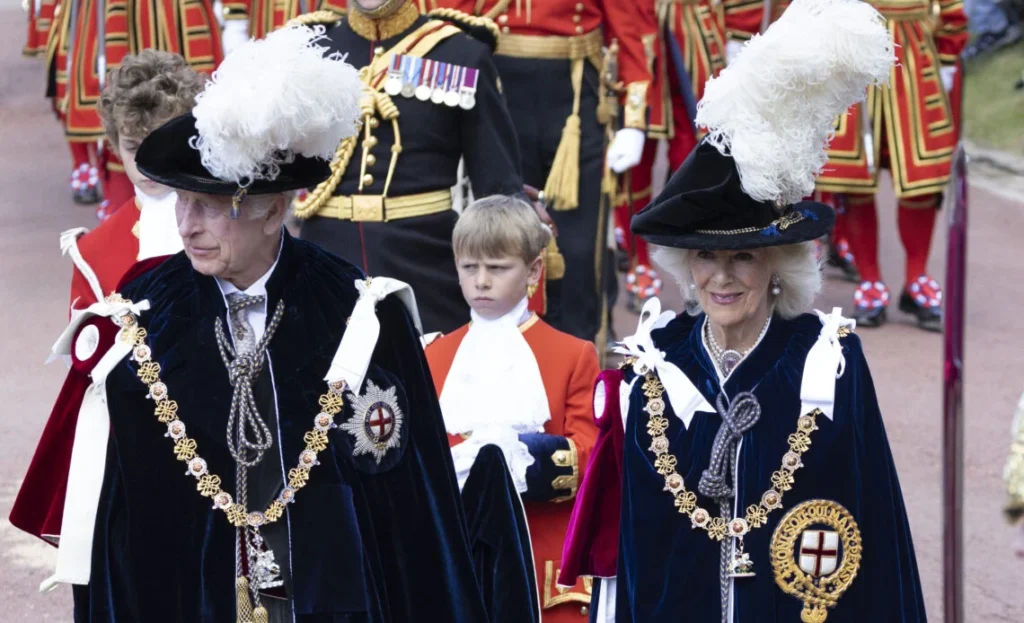

King Charles III has officially announced the appointment of three new distinguished members to the Most Noble Order of the Garter, the United Kingdom’s oldest and most prestigious chivalric order. This significant royal honour, bestowed annually, typically follows tradition with announcements made on St. George’s Day, April 23rd. The inclusion of these new knights marks a continuation of the Order’s long-standing legacy, which dates back to the 14th century, and occurs several months after the notable removal of Prince Andrew, Duke of York, from its ranks.
The newly appointed Companions of the Order are:
- The Lord Hennessy of Nympsfield: A highly respected historian and academic, renowned for his extensive work on 20th and 21st-century British political history. His scholarly contributions have significantly shaped public understanding of modern British governance.
- Baron Burnett of Maldon: Formerly known as Ian Burnett, he served as the Lord Chief Justice of England and Wales from 2017 to 2023, holding the highest judicial office in the country. His tenure was marked by significant legal reforms and a commitment to upholding the rule of law.
- The Lord O’Donnell: A distinguished public servant, he previously held the position of Cabinet Secretary and Head of the Home Civil Service, overseeing the administrative machinery of government during a period of considerable national and international change.
These new appointees are expected to participate in the formal installation ceremony, the Garter Day Parade, which will take place at Windsor Castle in June. This event is a cornerstone of the Order’s calendar, where new members are formally invested with their regalia.
A Legacy Steeped in History and Tradition
The Most Noble Order of the Garter was founded by King Edward III in 1348, though some historical accounts suggest its origins may extend as far back as 1344. Legend attributes its inception to a moment of chivalric inspiration, possibly influenced by King Arthur’s legendary Round Table, as well as contemporary European chivalric orders. The Order’s motto, "Honi soit qui mal y pense," translating to "Shame on him who thinks evil of it," underscores its commitment to honour and integrity.
St. George, the patron saint of England, was chosen as the Order’s patron, and it is fitting that new appointments are traditionally announced on his feast day. The spiritual home of the Order has always been St. George’s Chapel at Windsor Castle, where the founder, King Edward III, and the original 25 Founder Knights, including his son Edward, the Black Prince, took their stalls. This sacred space continues to be the venue for the Order’s most significant ceremonies.
Buckingham Palace outlines the selection criteria for membership, emphasizing that individuals are "chosen personally by the Sovereign to honour those who have held public office, who have contributed in a particular way to national life or who have served the Sovereign personally." This ensures that the Order recognizes individuals who have demonstrated exceptional service and dedication to the nation and the Crown.
The Order’s Structure and Royal Connections
The Order of the Garter comprises a maximum of 24 Companions, alongside the Sovereign and the Prince of Wales. The Sovereign holds the ultimate authority, and upon ascending to the throne, automatically becomes the Sovereign of the Order. King Charles III, who was appointed a Royal Knight Companion in 1958 as Prince of Wales, assumed this role upon his accession on September 8, 2022.
The Order also includes provisions for "Royal Knights and Ladies of the Garter" and "Stranger Knights and Ladies." The former, established by King George III, allows the Sovereign to appoint members of the Royal Family without affecting the limit of 24 Companions. The latter category recognizes foreign monarchs and heads of state, fostering international diplomatic ties. Notable foreign recipients include Emperor Alexander I of Russia, King Felipe VI of Spain, and King Willem-Alexander of the Netherlands, as well as the current Emperor of Japan.
Current royal members of the Order include Queen Camilla, the Duke of Edinburgh, the Duke of Kent, and the Duke and Duchess of Gloucester. These individuals, alongside the newly appointed Companions, represent a blend of historical lineage and contemporary service.
A Shift in Membership: The Removal of Prince Andrew
The recent appointments follow a significant event in December 2023, when King Charles III removed his younger brother, Prince Andrew, Duke of York, from the Order of the Garter. This marked the end of an honour Prince Andrew had held since 2006. Following his removal, his ceremonial banner was taken down from St. George’s Chapel, and his name was expunged from the Order’s register. This action was widely understood to be a consequence of the Duke’s association with Jeffrey Epstein and the subsequent civil lawsuit filed against him. The removal underscored the Order’s commitment to upholding its esteemed reputation and ensuring its members embody the highest standards of conduct.
The Order of the Garter, as the highest order of chivalry in the UK, carries with it immense prestige. Its historical significance is undeniable, and the carefully considered appointments reflect the Sovereign’s judgment of individuals who have made substantial contributions to British life. The inclusion of Lord Hennessy, Baron Burnett, and Lord O’Donnell signifies a recognition of intellectual, judicial, and public service excellence, aligning with the Order’s long-standing tradition of honouring those who have served the nation with distinction.
Broader Implications and Royal Prerogative
The appointments serve as a reminder of the enduring relevance of the Order of the Garter in contemporary Britain. While the world has evolved dramatically since its 14th-century inception, the core principles of chivalry, honour, and service remain central to its identity. The Sovereign’s personal choice in selecting members highlights the monarch’s role as a figurehead who can recognize and celebrate individuals who embody the nation’s highest ideals.
The transition in membership, marked by both new inclusions and past exclusions, reflects the evolving societal expectations and the scrutiny applied to individuals holding positions of honour. The Order of the Garter, therefore, not only serves as a historical institution but also as a living testament to the values the monarchy seeks to uphold. The formal installation at Windsor Castle will undoubtedly be a moment of considerable pomp and ceremony, reaffirming the Order’s place in the fabric of British tradition and its continued role in acknowledging exceptional service. The strategic appointments by King Charles III demonstrate his commitment to upholding the Order’s esteemed legacy while ensuring it remains a relevant and respected institution in the 21st century.