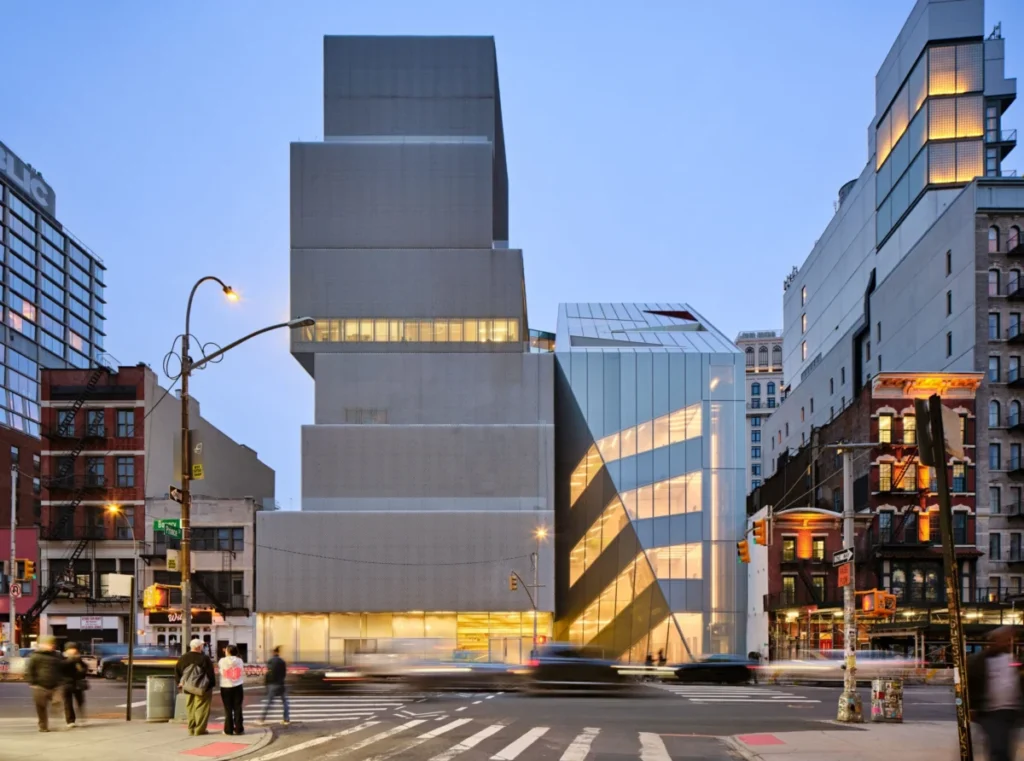

The New Museum of Contemporary Art has long served as a vanguard for the unconventional, a mission that has been physically manifested in its architecture since its move to the Bowery in 2007. Originally founded in 1977 by Marcia Tucker, the institution was established to champion the work of living artists whose contributions fell outside the traditional museum canon. Decades later, that spirit of institutional risk-taking has reached a new architectural zenith with the completion of a major expansion designed by OMA (Office for Metropolitan Architecture). This new addition, a glass-shrouded prism that stands in deliberate contrast to the museum’s original "stacked box" silhouette, marks the final chapter of Director Lisa Phillips’ twenty-five-year tenure and reinforces the museum’s role as a cornerstone of Lower Manhattan’s cultural landscape.
The story of the New Museum’s physical identity is one of calculated evolution. When the museum decided to build its first permanent home on the Bowery in the early 2000s, it chose the Japanese firm SANAA, led by Kazuyo Sejima and Ryue Nishizawa. At the time, SANAA was a relatively obscure choice for a New York City flagship, yet the firm’s design—a series of shifted, windowless boxes clad in industrial aluminum mesh—became an instant icon. It reflected the grit of the then-ungentrified Bowery while providing the neutral, high-ceilinged spaces required for contemporary installations. However, the museum’s success quickly outpaced its footprint. Almost from the moment the SANAA building opened in 2007, the limitations of its 58,000-square-foot capacity became apparent. The verticality of the design, while striking, created bottlenecks for visitors and limited the museum’s ability to host simultaneous large-scale exhibitions, educational programs, and community events.
A Chronology of Expansion
The path to the current expansion began in earnest in 2008, when the museum acquired the adjacent property at 231 Bowery. This 50-foot-wide parcel, formerly a restaurant supply store, provided the necessary "breathing room" for the institution to double its exhibition space. After years of fundraising and strategic planning, the museum announced in 2019 that it had selected OMA to lead the design of the new wing.

The choice of OMA, a firm founded by Pritzker Prize-winner Rem Koolhaas, signaled a shift in strategy. While SANAA’s building was an exercise in minimalist sculpture, the OMA project was tasked with a more complex surgical operation: integrating with an existing landmark while establishing its own modern identity. The project was spearheaded by Shohei Shigematsu, the partner heading OMA’s New York office. Shigematsu, who had previously worked on the expansion of the Musée national des beaux-arts du Québec and the Faena Forum in Miami, brought a research-heavy approach to the Bowery site.
Construction on the $89 million expansion faced the dual challenges of a narrow urban site and the global disruptions of the early 2020s. Despite these hurdles, the project remained focused on its core objective: creating a seamless flow between the old and the new, increasing the museum’s total square footage to approximately 118,000 square feet.
The Architectural Magic Trick: Prism vs. Mesh
The design of the OMA expansion is predicated on a visual and structural dialogue with the SANAA building. Where the original structure is opaque and metallic, the new addition is transparent and luminous. Shigematsu designed a glass-covered tower that angles away from the street, creating a dramatic setback that allows the original SANAA boxes to retain their distinct profile. This "prismatic" geometry is not merely aesthetic; it serves as a functional solution to the museum’s need for light and circulation.
One of the most praised elements of the new design is what Director Lisa Phillips describes as a "magic trick." From the street, the addition appears to be a slender, angled stairway or a light-filled atrium. However, the building extends deep into the lot, hiding massive gallery spaces behind its crystalline facade. Four of the expansion’s floors are dedicated to gallery extensions that connect directly to the SANAA building. By punching through the original cinder-block side walls, OMA has created expansive, continuous floor plates that allow for more ambitious curatorial projects.

Inside, the expansion is anchored by a complex switchback stairway that serves as both a circulation route and a social space. This architectural feature addresses one of the primary criticisms of the 2007 building: the reliance on slow-moving elevators to transport visitors between floors. The new stairway encourages a more organic, "promenade" style of viewing art, where the journey between galleries becomes part of the experience itself.
Supporting Data and Technical Specifications
The expansion brings a significant increase in the museum’s functional capacity:
- Gallery Space: The project adds roughly 10,000 square feet of new gallery space, nearly doubling the previous exhibition areas.
- Educational Facilities: A new permanent home for the museum’s NEW INC incubator—the first museum-led cultural incubator—is integrated into the upper floors.
- Public Space: The ground floor features an expanded lobby and a public plaza, improving the museum’s interface with the Bowery’s heavy foot traffic.
- Materiality: The glass facade utilizes high-performance laminated glass with integrated shading, designed to minimize solar heat gain while maximizing natural light in the non-gallery areas.
A particularly "serendipitous" technical detail, as noted by Phillips, occurs on the fifth floor. Due to the specific angles of the glass and the building’s orientation, the afternoon sun creates a natural refraction effect, casting rainbows across the gallery floors. While some critics have pointed out minor construction defects—inevitable in a project where dozens of reflective and transparent materials meet at acute, non-standard angles—the overall effect is one of "joyful" complexity.
Statements and Reactions
The completion of the building coincides with the retirement of Lisa Phillips, who has led the New Museum through its most transformative era. Reflecting on the project, Phillips stated, "I loved the original building, but it had its limitations. I’m proud that I’m leaving the museum with such a desirable campus. People are experiencing the building joyfully, and that was always the goal."

Shohei Shigematsu emphasized the importance of the building’s transparency in relation to its urban context. "From the street, you think it’s just a kind of staircase, but there are very large gallery spaces in the back," he explained. "We wanted to create a building that feels open and inviting, providing a counterpoint to the solid mass of the original building while still respecting its presence."
The architectural community has largely viewed the expansion as a successful marriage of two disparate styles. Critics have noted that while SANAA’s building was a masterpiece of "object" architecture, OMA’s addition is a masterpiece of "connective" architecture, proving that two world-class firms can coexist on a single 100-foot stretch of New York real estate.
Broader Impact and Implications
The New Museum’s expansion is more than just a local construction project; it is a case study in the evolution of the modern urban museum. In an era where many cultural institutions are criticized for "starchitecture" projects that prioritize form over function, the New Museum has attempted a middle path. The OMA wing is undeniably a bold architectural statement, yet its primary purpose is to fix the operational flaws of its predecessor.
The project also reflects the continued transformation of the Bowery. When the museum first arrived in 2007, the area was still defined by its history as "Skid Row." Today, the Bowery is a hub of luxury boutiques, high-end galleries, and expensive real estate. The New Museum’s expansion solidifies the neighborhood’s status as a premier global art destination, though it also raises questions about the displacement of the very "emerging" and "edgy" culture the museum was founded to celebrate.

As the museum prepares for a change in leadership, the new campus provides a robust infrastructure for the next generation of curators and artists. With doubled gallery space, improved circulation, and a more visible presence on the street, the New Museum is well-positioned to continue its mission of showcasing innovative, early-career artists on a grander scale. The "magic trick" on the Bowery—the hidden volume and the refracting light—serves as a fitting metaphor for an institution that has always sought to make the invisible visible.