
The renovation of a historic 1920s residence in Northern California has recently been completed, marking a significant collaboration between architect Andrew Mann of Andrew Mann Architecture and interior designer Chloe Redmond Warner of Redmond Aldrich Design. Located in the Oakland area, the project was commissioned by a prominent tech founder and a physician, a couple deeply integrated into the region’s philanthropic and social circles. The primary objective of the renovation was to reconcile the home’s original Art Deco elegance with the diverse, often conflicting demands of a modern high-profile family. The clients required a space that could seamlessly transition from hosting elegant political fundraisers and intimate dinner parties to serving as a functional, cozy environment for their three young children.

The project represents a growing trend in high-end residential design where "livability" and "versatility" are prioritized alongside aesthetic preservation. According to Warner, whose upcoming book, This Must Be the Place, is scheduled for publication in May, the mandate was absolute: the house had to be "everything." This meant the design needed to accommodate a rotating cast of company founders, musicians, and local activists while remaining a sanctuary for the family’s daily life.
Architectural Refinement and Circulation Improvements
While the original 1920s structure possessed what designers call "wonderful bones"—including expansive windows and a commanding site—it suffered from significant functional deficiencies common in homes of that era. Before the intervention of Andrew Mann, the house lacked a formal entryway, a deficit that created logistical challenges for a family of five. Furthermore, the internal circulation was restricted, and one of the children’s bedrooms was essentially a modified closet.

Mann’s architectural strategy focused on a surgical addition: a new foyer that mirrored the original home’s materials and geometry. This addition was designed to appear as though it had always been part of the structure, yet it fundamentally altered the home’s daily utility. By providing a dedicated space for mail, backpacks, and sporting equipment, the new entry resolved what the homeowners described as a major source of daily stress. This emphasis on the "landing zone" reflects a broader architectural shift toward acknowledging the messier, practical realities of family life within luxury environments.
At the base of the home’s original Art Deco staircase, Warner established a sophisticated visual anchor. She curated a vignette featuring a bespoke Italian travertine table complemented by two cedar stools designed by Benno Vinatzer. To soften the transition between levels and improve acoustics, a wool herringbone runner was added to the steps, blending the house’s historic grandeur with modern tactile comfort.

The Curation of an "Undateable" Living Environment
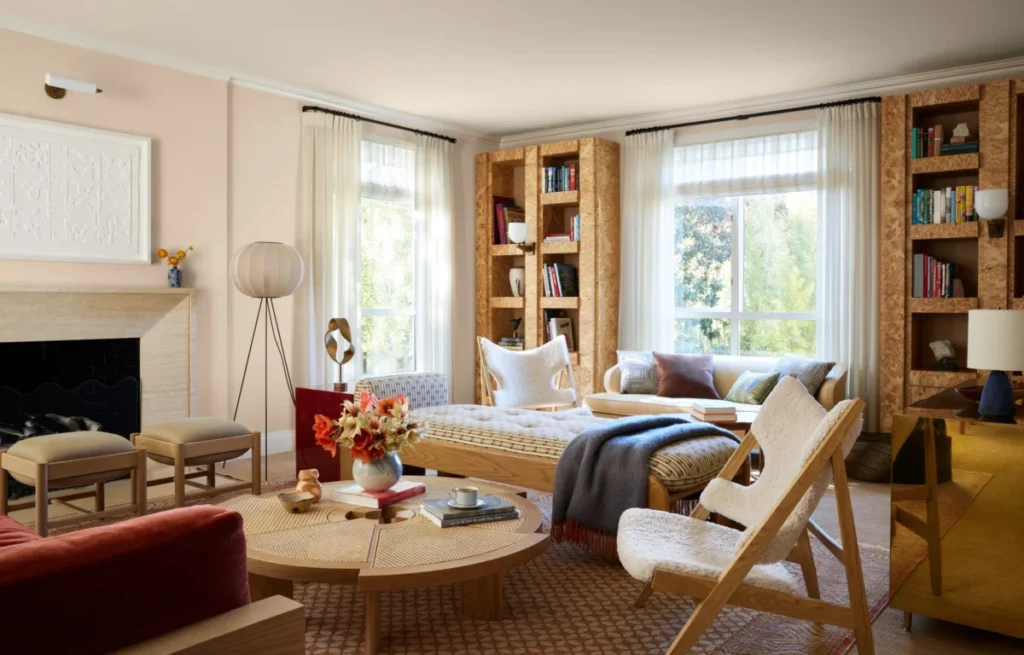
The interior design philosophy applied to the formal living areas was centered on the concept of being "undateable." Rather than adhering to a single period or trend, Warner integrated furnishings and lighting from various decades to create a space that feels evolved rather than decorated.
The living room serves as the centerpiece of this eclectic approach. It features custom burl wood built-ins that provide warmth and architectural depth. These are paired with high-design pieces, including a Rio Low Coffee Table by Charlotte Perriand for Cassina—an oak and cane piece that exemplifies mid-century modernism. The room also includes a striped daybed from Lawson-Fenning and a Knit-Wit Floor Lamp by Iskos-Berlin for Made By Hand.

This layering of items from the 1920s through the 2020s is a hallmark of Warner’s style. By avoiding the homogeneity of a single era, the designers aimed to create a home that reflects the human history of its inhabitants rather than a specific showroom catalog. This approach is increasingly popular among Bay Area professionals who seek to distance themselves from the sterile, minimalist "tech aesthetic" in favor of spaces that feel "warm, creative, and human."
Formal Dining and the Psychology of Bold Design
One of the most challenging aspects of the renovation was the dining room, where the clients initially expressed hesitation regarding bold color and pattern. Given the range of guests they host—from local artists to government officials—the homeowners were concerned that a dark or highly patterned room might feel overwhelming or overly formal.

Warner successfully advocated for a copper-toned Japanese floral wallpaper from Schumacher. To balance the visual intensity of the print, she mixed vintage black leather-and-stained beech chairs by Silvio Coppola for Bernini with two-toned wood Nakashima straight-back chairs. The Nakashima pieces, icons of the American craft movement, help ground the room and reduce the formality of the floral wallpaper.
The result is a space that the clients describe as having "warmth and depth," offering a view over Oakland’s Claremont Canyon. The inclusion of a painting by a local artist further ties the interior to the home’s geographic context, reinforcing the idea that the residence is a product of its specific Northern California environment.

The Kitchen and Family Room: Hubs of Casual Interaction
While the formal areas of the home were designed for entertaining, the kitchen and family room were engineered for maximum durability and casual comfort. The kitchen utilizes a combination of natural wood Shaker-style lower cabinets and deep blue V-groove paneling, painted in Benjamin Moore’s "Evening Sky."
The space was designed to be expansive yet intimate. A burgundy leather banquette wraps around a custom table by Jacob May, creating a "weeknight dinner" hub that can expand to accommodate up to 14 people. According to the homeowners, this area has become the natural gathering point for their children’s friends, fulfilling a primary goal of the renovation: making the house a "neighborhood hub."

In the family room, the husband provided specific direction to ensure the space performed for sports viewing and relaxation. The room is anchored by a deep teal Ligne Roset Togo sectional—a 1970s design classic known for its low profile and extreme comfort. Nesting tables by Gianfranco Frattini for Cassina provide flexible surfaces for game nights.
Private Sanctuaries and Tactile Luxury
The upper floors of the home transition into more tranquil, private spaces. The primary bedroom is defined by an ethereal, hand-painted "inkblot" wallpaper by Porter Teleo in a pale celery hue. This serves as the backdrop for a Mauro Mori poster bed and a rope-wrapped Half Dome Flush Mount by Cuff Studio. The room is finished with a forest-colored silk rug by Erik Lindstrom and Mondrian-inspired curtains by Pat McGann, creating a serene environment that contrasts with the social energy of the ground floor.

The attention to detail extends to the children’s quarters. In one compact room, Warner upholstered the walls in a green-and-blush striped Ceraudo fabric to improve acoustics and add a sense of "cozy" enclosure. A lofted bed with leather-wrapped railings maximizes the vertical space, while a chocolate brown Faye Toogood Roly Poly armchair provides a whimsical seating option.
The primary bathroom reflects a more graphic, Art Deco-inspired aesthetic, featuring Onyx Velluto stone in the shower paired with brass fixtures from the Waterworks Highgate collection. This choice maintains the home’s historic DNA while providing the luxury of a modern spa.

The Role of Sensory Design and Cultural Context
A unique element of this renovation was the use of sound and music as a design tool. Warner curated a specific playlist to set the tone for the project, featuring artists such as Fleetwood Mac, George Harrison, and Khruangbin. This "soundtrack" was intended to evoke the atmosphere of a "dream dinner party" in the spirit of literary icons Joan Didion and John Gregory Dunne.
The family’s lifestyle is further supported by a brass turntable cabinet by Studio Ilse, which houses a record collection. The homeowners noted that the ritual of choosing and playing vinyl has become a communal activity for their children, offering a tactile alternative to digital streaming. This focus on "analog" experiences is a recurring theme in the home, from the upholstered walls to the handmade furniture.

Broader Implications and Design Analysis
The completion of this Oakland residence highlights several key trends in contemporary high-end architecture. First, it demonstrates the enduring value of "slow design"—the careful selection of pieces that represent various historical periods to create a sense of longevity. Second, it underscores the importance of "functional luxury," where architectural interventions (like the new foyer) are valued as much for their impact on daily mental health as for their aesthetic beauty.
For the tech and medical professionals who inhabit such spaces, the home is no longer just a private retreat; it is a multi-functional platform for social influence, philanthropy, and family development. The ability of Andrew Mann and Chloe Redmond Warner to balance these competing needs suggests a sophisticated understanding of the modern American family’s evolving requirements.

As the homeowner reflected, the success of the renovation lies in its emotional resonance: "It’s not a given that a big renovation delivers on its emotional promise, and this one truly has." With the upcoming release of Warner’s book, the design community will likely look to this project as a primary example of how to modernize a historic home without sacrificing its character or its soul. The project stands as a testament to the idea that a house can, indeed, be "everything"—provided it is designed with both human instinct and architectural precision.